
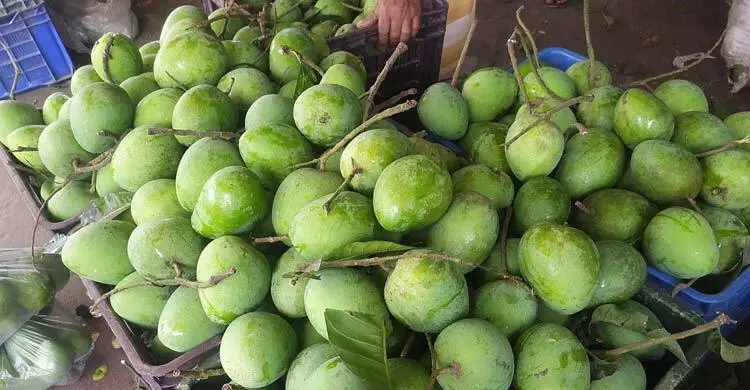
The delicious Haribhanga mango has begun appearing in Rangpur's markets. Ahead of its official marketing launch, the mango, recognised as a geographical indication (GI) product for its unmatched taste and aroma, is already on sale in various markets in Rangpur, though at somewhat high prices.
On Thursday (20 June), traders were seen selling Haribhanga mangoes at the mango market near the city's central bus terminal, Padaganj bazaar, Lalbagh, City Bazar and other areas. Prices are a little higher because demand is strong at the start of the season. Large mangoes are selling wholesale at Tk 2,800 to 3,200 a maund, medium ones at Tk 2,200 to 2,400, and small ones at Tk 2,000 to 2,100 a maund. Retail prices are higher still.
Talking to the agriculture department and growers, it was learned that ripe Haribhanga mangoes will be available from the last week of this month. Any found in the market before that will be unripe. Some dishonest traders are breaking the rules to sell unripe Haribhanga mangoes in the hope of higher prices.
Area, output and the GI tag
According to the Rangpur office of the Department of Agricultural Extension (DAE), mangoes are grown on 3,335 hectares in Rangpur this year, of which Haribhanga accounts for 1,905 hectares. The production target this year is 29,710 tonnes.
The Haribhanga mango is fibreless, sweet and tasty, with a very small stone and thin skin. Each mango weighs 200 to 300 grams. On 12 February this year, the Haribhanga mango was recognised as a geographical indication (GI) product of Rangpur.
The district administration will formally launch Haribhanga mango marketing on 21 June (Friday).
The main market for Rangpur's Haribhanga mangoes is Padaganj haat in Khoragachh union of Mithapukur, a wholesale market. Rezaul Islam, a young entrepreneur and mango grower from Padaganj, has grown mangoes on more than 12 acres.
He told Jago News that he had taken extra care of his trees during the hostile weather and intense heat. But because it did not rain on time, the mangoes are somewhat smaller, and yields are expected to be a little lower.
Buyers, sellers and officials
Rafiqul Islam, who had come to buy mangoes at the central bus terminal market, told Jago News: "I bought five kilograms of ripe mangoes for Tk 250, which works out at Tk 50 a kg. Large mangoes are selling at Tk 2,800 to 3,200 a maund."
Alamgir Hossain, a mango seller at the terminal market, said Haribhanga mangoes had begun to be picked from the trees a few days earlier. He said buying mangoes at Padaganj and bringing them to the city involves various extra costs, which is why prices are a little higher, but they will come down somewhat once picking is in full swing.
Md Riaz Uddin, deputy director of the DAE in Rangpur, said the scorching sun and lack of timely rain meant the Haribhanga yield could be lower this year. But as there were no major storms during flowering, the mangoes did not suffer much damage. Mango prices are good this year, and Rangpur's growers will get good prices too, he said.
Deputy Commissioner Mohammad Mobassher Hasan said the district administration had organised a Haribhanga mango fair and exhibition at the Padaganj School and College ground on the afternoon of 21 June. Regular monitoring through law enforcement agencies has been arranged so that there are no problems in marketing Haribhanga mangoes.
Source: Jagonews24. First published in Bengali on The Agro News.
Comments
(0)