
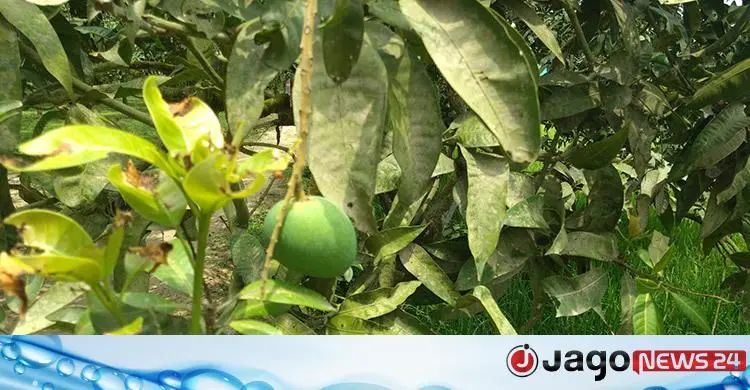
The Haribhanga mango, a symbol of Rangpur's heritage and prestige whose reputation has spread abroad, is only about a month and a half away. People in the trade expect more than Tk 200 crore of business around the mango in the Rangpur region this season if the weather stays favourable.
According to the Department of Agricultural Extension (DAE) in Rangpur, Haribhanga mangoes have been grown on more than 2,000 hectares in the district this year. The rain of the past few weeks has helped the fruit grow larger and juicier. Hailstorms and gusty winds caused slight damage in some areas, but overall the yield is expected to be better than last year.
Mature fruit from mid-June
Agriculture officials and growers say mature Haribhanga mangoes normally reach the market from the middle of June. Haribhanga mangoes found on the market before then are immature: a section of dishonest traders breaks the rules and sells unripe fruit in the hope of a slightly higher price.
Agriculture specialists say the Haribhanga tree gives a low yield one year and a good yield the next. The low year is called the off year and the good year, in agronomists' language, the on year. This is an on year: the trees are carrying plenty of fruit, far more than last year.
According to the agriculture office, blossom began appearing on the trees from early December this year. The mangoes are picked around mid-June, and the agriculture department hopes picking will start on time.
The mango cultivation target for Rangpur district this year is about 3,500 hectares, of which Haribhanga covers more than 2,000 hectares. Haribhanga yields about 10 to 12 tonnes a hectare, worth more than Tk 200 crore.
Growers and traders
Nazmul Islam, a young entrepreneur and mango grower from Padaganj in Mithapukur, told Jago News he has planted mangoes on more than 12 acres. Hail and storms a few days ago caused some damage to the orchard, and further storms would mean losses, he said, but if the weather stays favourable the harvest should be good.
The main market for Rangpur's Haribhanga is the Padaganj hat in Khoragachh union of Mithapukur, a wholesale market. Local wholesaler Abdul Malek said many large buyers from Dhaka, Chattogram, Sylhet and elsewhere in the country have already started getting in touch. "We hope both prices and demand for mangoes will be satisfactory this time," he said.
Principal Fakhrul Anam Benju, president of the Rangpur district unit of Shushashoner Jonno Nagorik (SUJAN), said the Haribhanga is no longer confined within the country: it is exported to Malaysia, Singapore and other countries in South-east Asia. Within Bangladesh, direct supply from orchards through Facebook and e-commerce platforms has multiplied in the past few years. Since it was recognised as a geographical indication (GI) product, the mango's brand value has also grown, which helps secure good prices.
Benju added that despite the huge trade potential, growers are somewhat worried about the lack of cold storage and modern preservation. Because the Haribhanga perishes quickly, special trains or fast vehicles should be arranged to transport it, he said.
Sirajul Islam, additional director of the DAE in Rangpur, said: "This is the mango's on year. There is a lot of fruit. The agriculture department is supporting growers with advice."
The Haribhanga is fibreless, sweet and tasty. Its stone is very small and its skin thin, and each fruit weighs 200 to 300 grams. The Haribhanga mango was recognised as a GI product of Rangpur on 12 February 2024.
Source: Jagonews24. First published in Bengali on The Agro News.


Comments
(0)