
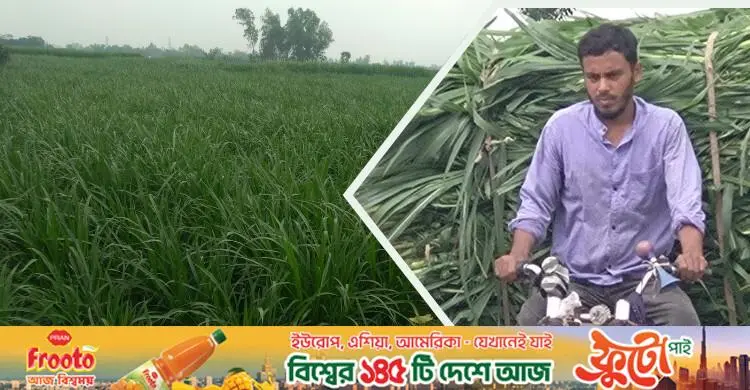
Commercial cultivation of improved Napier grass is growing by the day in Rangpur. As an alternative to straw and manufactured cattle feed, the grass has become livestock farmers' main standby. In many areas it also earns several times more than traditional rice farming, so farmers are giving up paddy and turning field after field over to grass.
In Badarganj, Taraganj, Pirgachha, Mithapukur and Sadar upazilas and elsewhere in the district, former crop land, fallow plots and land around homesteads are now green with Napier grass. From a distance the fields look like paddy, but they are in fact improved fodder grass.
Local farmers say that while it is hard to make a profit of around Tk 40,000 a year after costs from two rice crops on an acre, cutting and selling grass four or five times a year can earn up to Tk 1 lakh after costs.
Farmers' experience
Momdel Hossain, a farmer in Gopalpur union of Badarganj upazila, said: "Straw used to be so expensive that keeping cattle had become hard. Now I grow Napier grass on two bighas of my own land. After meeting my farm's needs I sell the surplus at market and make an extra Tk 30,000 to 35,000 a year per bigha (30 decimals). The money from grass now easily covers my children's education and household costs."
Farmers say the grass needs far less fertiliser, pesticide and labour than rice or other crops, and once planted it yields continuously for four to five years.
Khoybar Ali, a farmer from Nayapara village in Rangpur Sadar upazila, told Jago News: "The grass grows well on high ground. Once you plant the root clumps, you get grass for four to five years. Rows should be three and a half to four feet apart. It can be planted all year, but planting in the monsoon is best. Apply plenty of cow-dung manure at planting. If you add 50 kg of urea and 15 kg of TSP per acre after 20 days, the grass can be cut after 50 days."
Amjad Hossain, a farmer from Bogurapara in Tambulpur union of Pirgachha upazila, said: "Before, feeding bought bran and oilcake ate up all the profit. Last year I started growing Napier grass on one bigha. Now my cattle feed costs have halved, and my cows give more milk than before."
Grass growers say that after harvesting rice the land has to be prepared again, with many jobs that cost money without bringing matching profit. Napier grass, once planted, can be sold for four or five years with only the cost of looking after the land.
A new market
In local markets Napier grass is now bundled and traded commercially, much like paddy. At Khamar Mor in Rangpur city, grass seller Sabur Ali said bundles bought from farmers at Tk 4 each are sold at market for Tk 9 to 10, and demand rises several-fold at the Qurbani Eid compared with the rest of the year.
Agricultural economists say there is no alternative to growing improved green fodder such as Napier grass if the country's dairy revolution is to be sustained. If cuttings were made more readily available through government and private channels, it could bring a huge change to the rural economy.
Amjad Sarkar, a retired teacher at Mithapukur Degree College, said: "Napier grass has some unique advantages. It grows fast, and once planted it can be cut about four to six times a year. It has much more protein and fibre than ordinary grass, which helps increase cows' milk yield and livestock growth. It can be grown on any abandoned land, roadside or yard with a little fertiliser and irrigation, and it suffers far less from pests and disease."
Official figures
According to the Rangpur district livestock office, the numbers of livestock and farms in the district are rising steadily. To ensure a supply of safe and nutritious feed, the government is distributing improved Napier cuttings (stems) free of charge and holding regular training on cultivation.
Napier grass was grown on 107.40 acres in the district in the 2023-24 financial year. The area has grown since, to more than 137.90 acres in the current 2025-26 financial year, with a production target of about 44,000 tonnes.
Rangpur District Livestock Officer Dr Nazmul Huda told Jago News: "High-yielding Napier grass is becoming more popular as livestock feed across the country. Farmers are struggling with the cost of rearing animals because of rising prices of manufactured feed. In this situation, ordinary farmers in remote areas and commercial dairy farm owners alike are turning to Napier grass as a nutritious alternative to straw. It meets animals' nutritional needs while cutting farmers' production costs by about 40 per cent."
He added: "Napier grass is very nutritious for livestock. Feeding it increases milk production and reduces disease. I believe Napier cultivation will play an even bigger role in reviving Rangpur's rural economy and sustaining the dairy revolution."
Source: Jagonews24. First published in Bengali on The Agro News.



Comments
(0)