
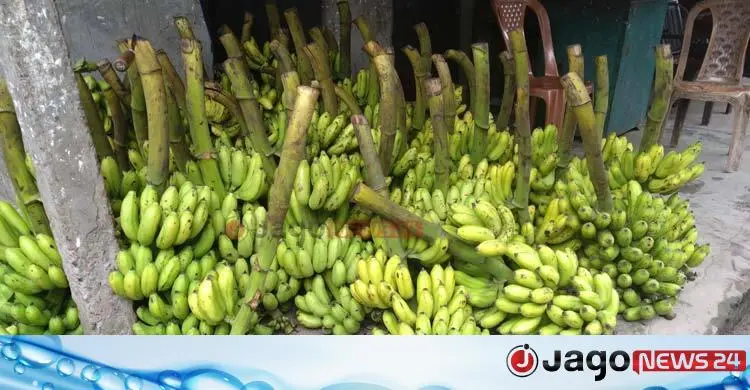
Favourable soil and weather are making commercial banana farming more popular by the day in the Rangpur region. Banana plants are now seen not only on farmland but along roadsides, on pond banks and on empty plots next to homes. Because the crop costs little and earns well, local farmers are growing more interested in it.
But a lack of proper storage and modern processing means large quantities of bananas are lost every year, a major obstacle for this promising sector. Those involved believe that if the necessary steps were taken, the region's bananas could play an important role in the national and local economy.
According to the regional offices of the Department of Agricultural Extension (DAE) in Rangpur and Dinajpur, bananas are grown to a greater or lesser extent in all eight districts of Rangpur division. Varieties including Sagar, Malbhog, Chini Champa and Mehersagar are widely cultivated.
Farmers say a banana planting keeps yielding for a long time, and because it needs little capital and labour and earns well, many young entrepreneurs are turning to it. The trouble comes after harvest: bananas perish quickly, and if they are not sold soon after picking they rot.
Production figures
According to the DAE's Rangpur regional office, in 2022-23 bananas were grown on 4,208 hectares in Rangpur, Gaibandha, Kurigram, Lalmonirhat and Nilphamari districts, producing 112,357 tonnes. Mango was the second-largest fruit that year, at 70,070 tonnes from 5,785 hectares.
In 2023-24 Rangpur district grew bananas on 2,260 hectares and produced 88,140 tonnes; Gaibandha produced 12,870 tonnes from 1,188 hectares; Kurigram 13,860 tonnes from 405 hectares; Lalmonirhat 7,200 tonnes from 180 hectares; and Nilphamari 12,157 tonnes from 323 hectares. In all, the five districts grew bananas on 4,356 hectares and produced 134,227 tonnes. Mango output that year was 69,774 tonnes from 5,748 hectares.
In 2024-25 the five districts grew bananas on 4,077 hectares and produced 134,916 tonnes. Of this, Rangpur produced 88,140 tonnes from 2,260 hectares, Gaibandha 11,093 tonnes from 746 hectares, Kurigram 17,870 tonnes from 496 hectares, Lalmonirhat 7,477 tonnes from 180 hectares and Nilphamari 14,336 tonnes from 395 hectares. Mango, again the second-largest fruit, was grown on 5,808 hectares and produced 75,564 tonnes.
Bananas are also grown every year on 3,000 hectares or more in Dinajpur, Panchagarh and Thakurgaon districts. Bananas worth several crore taka change hands every day at markets such as Dashmail in Dinajpur, Shathibari in Mithapukur upazila on the Rangpur-Dhaka highway, Palashbari in Gaibandha and Fanshitola in Gobindaganj.
Farmers lose out after harvest
Anwar Hossain, a farmer from Tokeya village in Payrabondh union of Mithapukur upazila, Rangpur, told Jagonews24: "Banana farming can change our fortunes, but when we cut a lot of bananas at once, there is no cold store or specialised storage, so we have to sell cheaply to middlemen. With even a little delay the bananas start to spoil, so we don't make the profit we hoped for."
Despite bumper harvests, no government or private banana processing centre has been set up in the Rangpur region, so no commercial ventures making chips, juice or powder from bananas are possible.
Poor transport and packaging also mean a large share of the fruit is damaged on the way to Dhaka and other big markets. Middlemen take advantage, forming syndicates to buy bananas from growers at nominal prices, so farmers are denied the profit their hard work deserves.
Saju Mia, a banana grower from Tushbhandar Paikantari village in Kaliganj upazila, Lalmonirhat, told Jagonews24 that one bigha (27 decimals) costs Tk 40,000 to Tk 50,000 to cultivate and takes 300 plants. If the crop is good, a bunch sells for Tk 400-500, so a bigha can bring in Tk 1.2 lakh to Tk 1.5 lakh. Prices are higher during Ramadan.
"But bananas perish quickly," Saju said. "They cannot be kept long after picking. If there were storage and processing, it would be possible to earn double or more."
Moja Mia, a farmer from the same village, said that to keep commercial cultivation profitable, a plant is harvested at most two or three times, once from the main plant and then once or twice from the ratoon crop. After that the whole plantation is uprooted and replanted, because after three harvests the bananas become smaller and disease increases sharply.
Anisur Rahman, a banana grower in Palashbari upazila, Gaibandha, said: "In this area we usually eat bananas once they ripen after picking, or use green bananas as a vegetable. Beyond that we cannot make use of the banana's many other uses, mainly because there is no long-term storage or processing. So small and medium growers like us cannot gain much financially."
In his view, if cold stores or specialised collection centres were built near every big banana market by the government or private sector, taking account of the fruit's nutritional value and many uses, banana farming would be transformed. Not only would farmers and traders benefit, but consumers would get fresh, chemical-free bananas all year at fair prices.
Calls for policy and investment
Traders and agricultural experts say that ensuring modern storage and processing of bananas in the Rangpur region could bring about a huge change in the national and local economy.
Emdadul Hossain, president of the Rangpur Chamber of Commerce and Industry, told Jagonews24 that there is no arrangement for storing or processing not only bananas but also mangoes, lychees, jackfruit or any other fruit in the region, and a separate industrial policy is needed for the region for the sector to develop sustainably.
He said banana growers need low-interest bank loans, temperature-controlled cold stores suitable for bananas, processing factories to make food products from bananas, direct links between farmers and large chain shops, and training in modern harvesting, packaging and natural ripening. With government and private initiatives, he said, the region's bananas would play an important role in the national economy.
Agriculturist Sirajul Islam, additional director of the DAE's Rangpur regional office, told Jagonews24 that the banana is an excellent fruit that can be used in many tasty dishes both green and ripe. Green bananas make a nutritious vegetable, and ripe bananas can be made into fine desserts and snacks.
He said the banana flower can be cleaned, cut and cooked as a vegetable dish with potatoes and spices or with fish, and is a great source of iron.
With the right coordination of government support and private enterprise, the report concludes, bananas from the Rangpur region could meet domestic demand and be exported as well, raising the country's economy and farmers' incomes many times over.
Source: Jagonews24. First published in Bengali on The Agro News.
Comments
(0)