
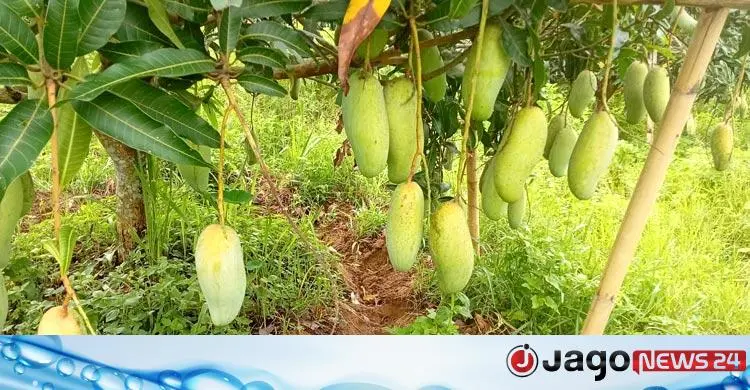
Even at the end of the season, markets in the hill district of Rangamati are full of mangoes. With a good crop this year, buyers are getting them cheaply.
In the district town and the upazilas, hill-grown Amrapali, Rangui, banana mango, BARI-4, Haribhanga and Katimon are on sale, and they are even cheaper in upazila markets than in town.
According to the Department of Agricultural Extension (DAE) in Rangamati, the district produced 38,285 tonnes of mangoes on 3,625 hectares in the 2024-25 season. In 2025-26 the area rose to 3,635 hectares, and thanks to the hill slopes and favourable weather, output is likely to exceed the target.
Alongside local varieties, commercial orchards are growing well-known and expensive foreign varieties such as Rangui (from Myanmar), Amrapali (from India), BARI Aam-4, Miyazaki, banana mango, Brunei King and Katimon. Amrapali, the tastiest, reaches the market late in the season and is in the highest demand.
Sellers cut prices
Kanchan Chakma, a seasonal fruit seller at Banarupa bazar in Rangamati town, said: "The yield is good this year, so I am selling Amrapali and Rangui cheaply. You can get three kilos from me for just Tk 100, and I will give more off to anyone who buys more. I have sold seasonal fruit in different markets for four years, and mangoes have never been this cheap."
Bindu Majumder, a long-standing fruit trader at Banarupa, said his mangoes are dearer because he sells only the best, picked from the market, and customers can return any that are bad. He sells Amrapali, BARI-4 and Haribhanga at Tk 60 a kg and banana mango at Tk 100.
Another retailer, Doyalal Chakma, sat on the pavement selling only banana mango. "This variety is being grown a lot now. Its price has halved from last year and may fall further next year. I am selling it for only Tk 80 a kg."
A seasonal fruit market is held almost every day at Samata Ghat near Banarupa bazar, where local retailers and wholesalers buy fruit to take to wholesale markets in Dhaka, Chattogram, Cumilla and elsewhere. Samata Ghat wholesaler Zia Uddin Bablu said prices are very low this year because of high production in the hills. Haribhanga sells for Tk 1,000 to Tk 1,600 a maund, Amrapali for Tk 1,000 to Tk 1,400, and Rangui for Tk 400.
Growers cannot cover costs
Growers are frustrated. They say setting up orchards and producing fruit is costly, and with transport added they see only losses. Rangui grows well in the hills but now sells for just Tk 10 a kg wholesale, not even covering production costs.
Sadhan Bikash Chakma, a farmer in Longadu upazila, said: "I sold my big two-acre orchard for just Tk 1 lakh. Because there is no price in the market, the trader still has not picked the mangoes. Prices may rise a little at the end of the season, and then they will start. Many more farmers have taken up mangoes, but if they do not get a price, farmers will lose money."
Faruk Hossain, son of Abdur Rahim, a former district council member and owner of the largest mango orchard in Longadu, said: "We grow Amrapali, Mallika, Khirsapat and Rangui on about 50 acres of hill land. This 15-year-old orchard used to earn Tk 10 to 12 lakh a year; this year it has fallen to Tk 7 lakh. Given what we spent on the orchard, we have not made much profit."
Md Moniruzzaman, deputy director of the DAE's Rangamati district office, said transporting mangoes from remote orchards near Kaptai Lake is very costly. Fruit bagging keeps mangoes free of insects and fungus, but at Tk 3 to Tk 3.50 per bag, small growers cannot afford to use it fully. So although production is high, farmers cannot achieve good quality, and prices are comparatively low.
Source: Jagonews24. First published in Bengali on The Agro News.
Comments
(0)