
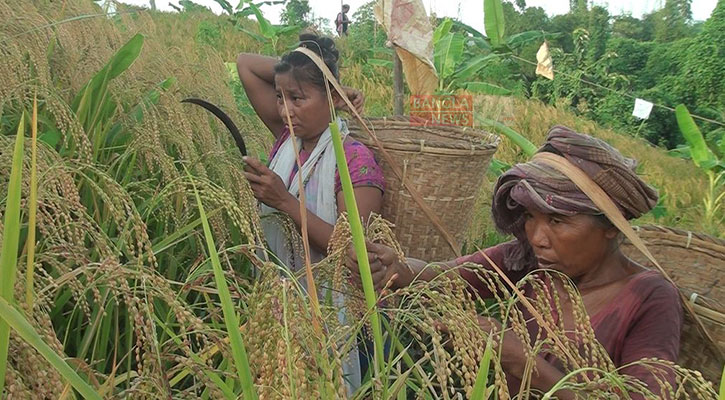
The hills of Rangamati are gleaming with golden jhum paddy, and the harvest festival has begun. Jhum farmers are overjoyed and busy bringing the ripe paddy home. Agriculture is the main occupation of the small ethnic communities of the Chittagong Hill Tracts.
Many began harvesting their jhum crops on Thursday (21 October).
Jhum farmer Sumitra Chakma of Bilaichhari Para in Mogban union, Rangamati Sadar upazila, told Banglanews: "I planted seven kilograms of Turki rice on two acres of land and I am harvesting now. When I went to Barkal upazila, a relative gave me Turki rice seed brought from Mizoram in India as a gift. I brought it back and planted it. I have heard the variety is very good and yields well."
Basu Deb Chakma, a jhum farmer from the same area, said: "Along with other crops, this year I planted Turki rice on three acres. I hope to get a good crop. I have also planted chillies, bitter gourd, yardlong beans, ridge gourd, snake gourd, ash gourd and teasle gourd."
Suresh Debi Chakma said: "Besides planting Chhuri rice, I planted the new Turki variety on two acres. It is a variety brought from India and yields well, so I took seed from people nearby and planted it on my land. I have started cutting the Chhuri rice, and after that I will cut the Turki rice."
How jhum is farmed
According to the Department of Agricultural Extension (DAE) office in Rangamati, many crops are grown in jhum, including local and high-yielding rice varieties, sweet pumpkin, marfa, chinal, beans, cucumber, bitter gourd, okra, sesame, maize, chillies, foxtail millet, bilati dhonia (culantro), yardlong beans, ridge gourd, snake gourd, ash gourd, teasle gourd, Malabar spinach, jhum taro, mukhi kochu, aubergine, bottle gourd, sponge gourd, ginger, turmeric, barley, cotton and hill potato, known as the cold potato.
The office said the jhum method is also different. In the months of Poush and Magh, a hill is chosen for cultivation at a convenient time. All the trees, bamboo and undergrowth are then cut and left to dry in the sun until the month of Chaitra. In Chaitra and early Baishakh the dried vegetation is set on fire and burns to ash, along with the top one or two inches of soil. The ash and burnt soil make the land fertile. After one or two showers soften the soil, sowing begins.
According to the office, jhum rice (high-yielding) has been grown on 5,580 hectares of hill land in Rangamati district this year. Thanks to favourable weather and the right amount of rain, the jhum yield is good. Varieties grown include BRRI dhan24, 26, 27 and 48, along with Kalabini, Sadabini, Gelong, Kobarok, Amei, Badoe and Bini rice.
Krishna Prasad Mallik, deputy director of the DAE's Rangamati region, told Banglanews that the jhum yield this season is better than last year. Along with local seed, jhum farmers have grown the drought-tolerant, high-yielding BRRI dhan24, 26, 27 and 48, he said.
He added that although jhum cultivation harms the environment, the hill people have no alternative to it, and it also carries their heritage. To prevent soil erosion, jhum farmers are being asked to farm across the slope of the hills.
Source: Banglanews24. First published in Bengali on The Agro News.
Comments
(0)