
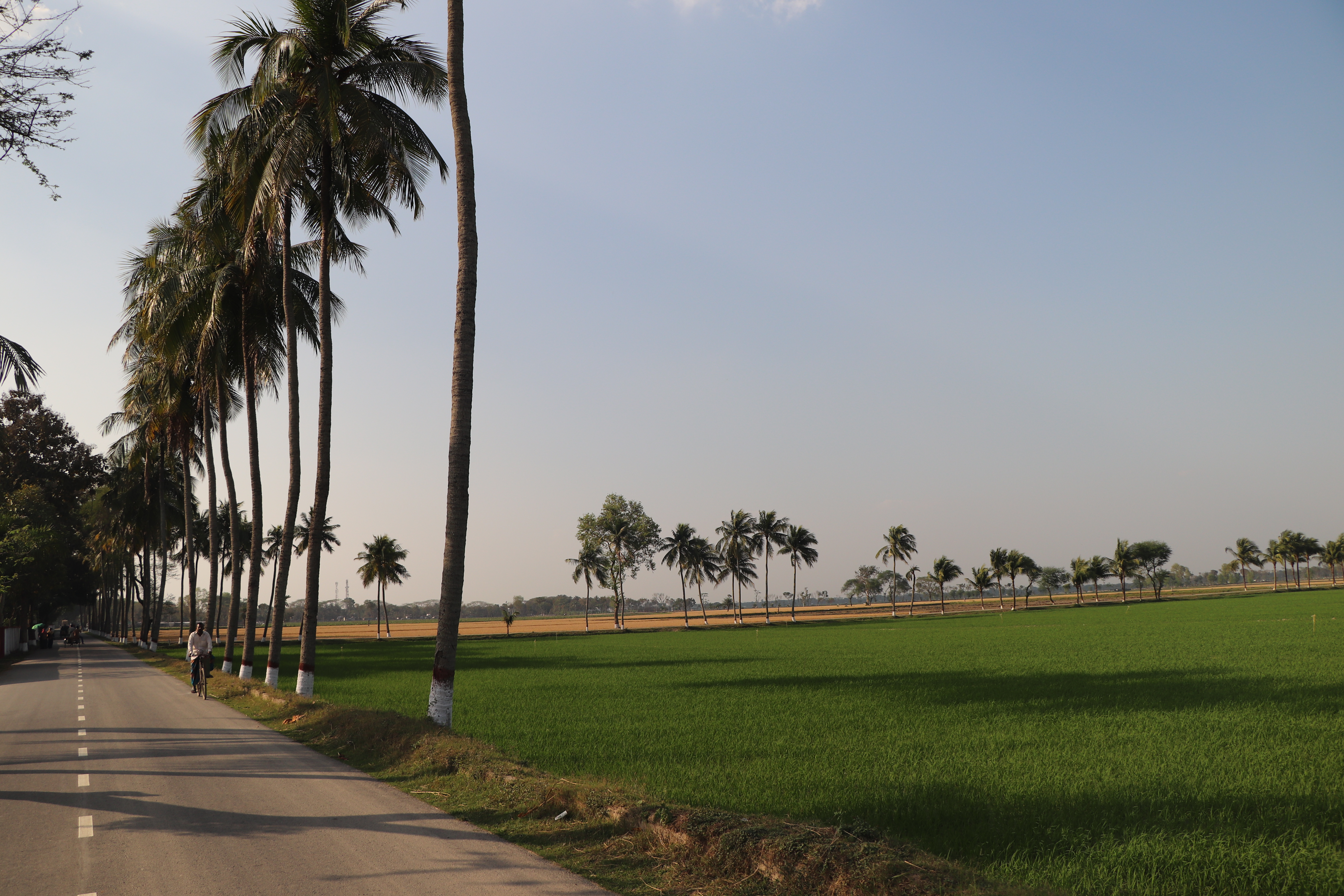
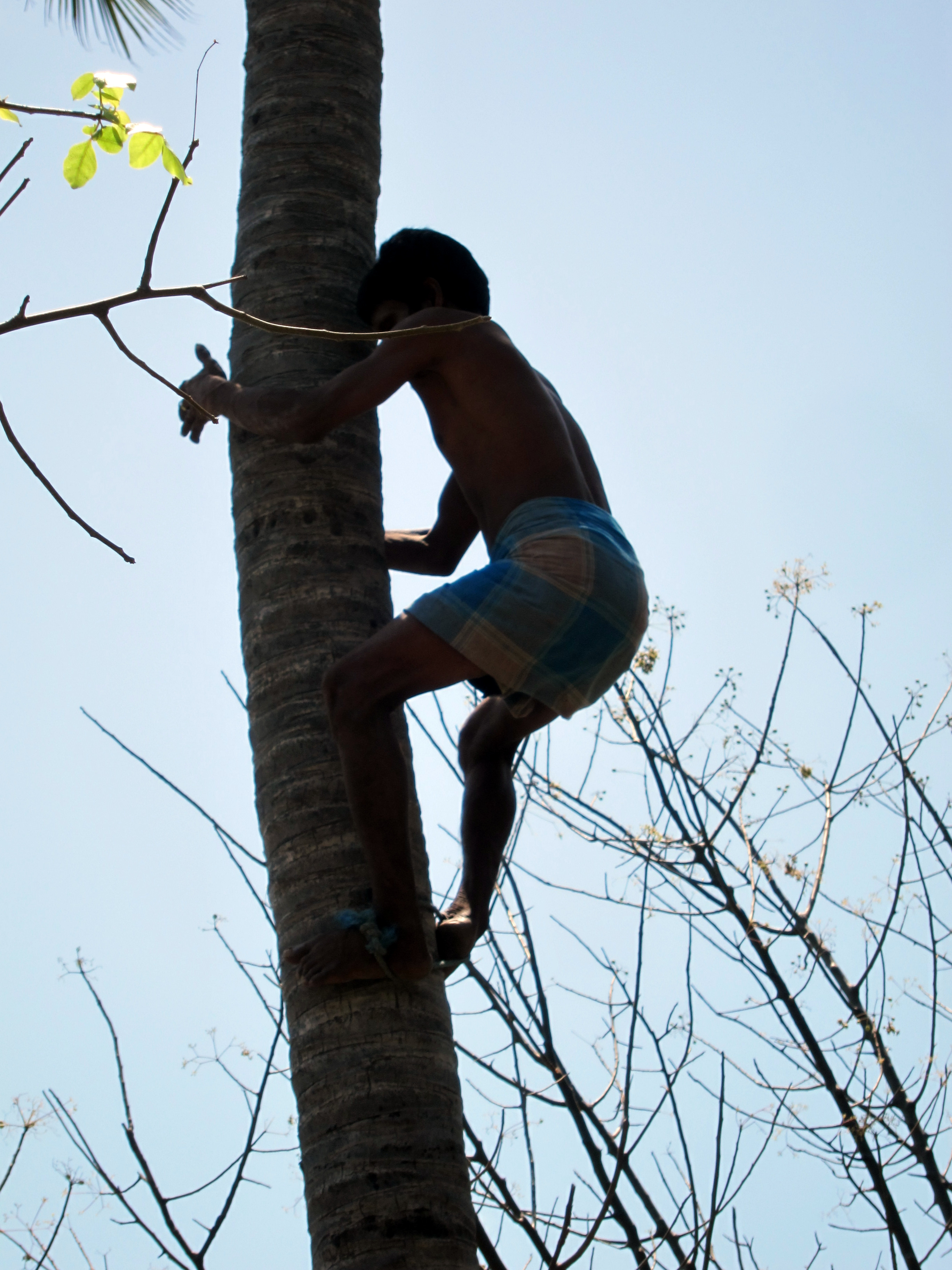
A 35-year-old man named Shahen Shah Ali climbed a tall coconut palm to pick green coconuts on Sunday, 14 December 2025, drank the water of one of them and fell asleep at the top of the tree. He did not answer the people calling up to him from the ground, and a rescue team of the fire service needed about two hours to bring him down. It happened around midday beside the West Kashimnagar Eidgah ground in Ramganj upazila of Lakshmipur district, Jagonews24 reported that day.
Nobody was reported hurt. The fire service brought him down with the help of a ladder and later left him in front of the Ramganj Upazila Health Complex, according to the leader of the Ramganj fire service team.
Two hours at the top of the tree
According to the report, Shahen Shah Ali climbed the palm to pick green coconuts, known in Bangladesh as dab. Once at the crown he drank the water of one nut and fell asleep there, among the fronds. People below called out to him again and again, but he did not respond.
As word spread, a crowd gathered in the area around the Eidgah ground. Local people tried to get him to come down and could not, and at one point they called the fire service. A rescue team from the Ramganj fire service went to the spot and worked for about two hours before he was brought down from the top of the tree.
The team leader described the rescue in stages. The firefighters first asked the man to climb down by himself; he stayed where he was. Much later he was brought down with the help of a ladder. Before coming down, he lowered seven green coconuts on a rope. After the rescue, the team dropped him off in front of the Ramganj Upazila Health Complex, the government hospital of the upazila.
What local people and the fire service said
A local resident, Parvez Hossain, told Jagonews24 that the man who had fallen asleep in the tree was, in his words, somewhat mentally disabled. He said the man had given his home as somewhere in the north of the country but could not give any further details of who he was. "We tried hard, but we could not get him down," Parvez Hossain said.
Rezaul Karim, leader of the Ramganj fire service team, said a man named Shahen Shah Ali had climbed to the top of the coconut tree and drunk green coconut water sitting up there. "On getting the news we went to the spot and first asked him to come down from the tree. He stayed put. Much later he was brought down with the help of a ladder," he said. He added that the man lowered seven green coconuts tied with a rope at that point and was afterwards dropped off in front of the health complex.
The report did not say whether the man needed any treatment, and it gave no further information about his home or family. The account here keeps to what the reporter, the local resident and the fire service team leader said on the day.
Ramganj upazila and Lakshmipur district
Ramganj is the north-eastern upazila of Lakshmipur district. Banglapedia, the national encyclopedia of the Asiatic Society of Bangladesh, gives its area as 169.31 square kilometres. It borders Faridganj, Hajiganj and Shahrasti upazilas to the north, Lakshmipur Sadar and Raipur upazilas to the south and Chatkhil upazila of Noakhali to the east. Ramganj thana was formed in 1891 and became an upazila on 24 March 1983. It has one municipality and ten unions, and the 2001 population census counted 285,686 people there.
The same entry lists mango, jackfruit, orange, coconut, betel nut and banana as the upazila's main fruits, and coconut and betel nut head its list of main exports, followed by orange, shitalpati mats and household goods made of iron. Agriculture was the main source of income for 31.62 per cent of households in the census data Banglapedia cites, with commerce at 19.14 per cent and rent and remittance at 13.25 per cent. Its main crops are paddy, wheat, jute, potato and pulses; shitalpati and nakshi kantha are among its cottage industries; and it has about 50 hats and bazars, among them Sonapur Hat, Paniala Hat and Bhatra Hat.
Lakshmipur district, in Chattogram division, covers 1,440.39 square kilometres. It is bounded by Chandpur to the north, Noakhali to the east, Bhola and Noakhali to the south, and by Barishal, Bhola and the Meghna river to the west; its main rivers are the Meghna, the Dakatia and the Katakhali. Lakshmipur became a subdivision in 1979 and a district in 1984, and it has five upazilas: Lakshmipur Sadar, Raipur, Ramganj, Ramgati and Kamalnagar. Banglapedia, citing the 2011 census, gives its population as 1,729,188 and agriculture as the main source of income for 47.51 per cent of households.
A district of coconut palms
Lakshmipur is one of the country's best-known coconut districts, and a palm like the one in Ramganj is a common sight around its homesteads. In January 2025 the deputy director of the Department of Agricultural Extension (DAE) in Lakshmipur told The Daily Ittefaq that the district had coconut orchards on 2,735 hectares, besides the palms in almost every homestead yard, and that 26,000 tonnes of coconut were produced there in the 2023-24 fiscal year.
The same Ittefaq report described a trade built on what used to be thrown away. Coconut husk, once discarded or burned as fuel, is now turned into fibre and coir dust, and about 30 factories in the district were processing it. The fibre goes into mattresses, cushions, rope, slippers, toys and decorative goods, and the dust is used in farming as a growing medium where soil is scarce. Workers dry the fibre in the sun and press it into bales of 20 kilograms, and the fibre and dust are sent to Khulna, Dhaka, Cox's Bazar, Shariatpur and other places where mattresses, doormats, rope and furniture cushions are made. A factory owner at Dalal Bazar said he bought the husk of one coconut for two to three taka. An official of the district office of the Bangladesh Small and Cottage Industries Corporation (BSCIC) said that no government office kept exact figures on the income from coir.
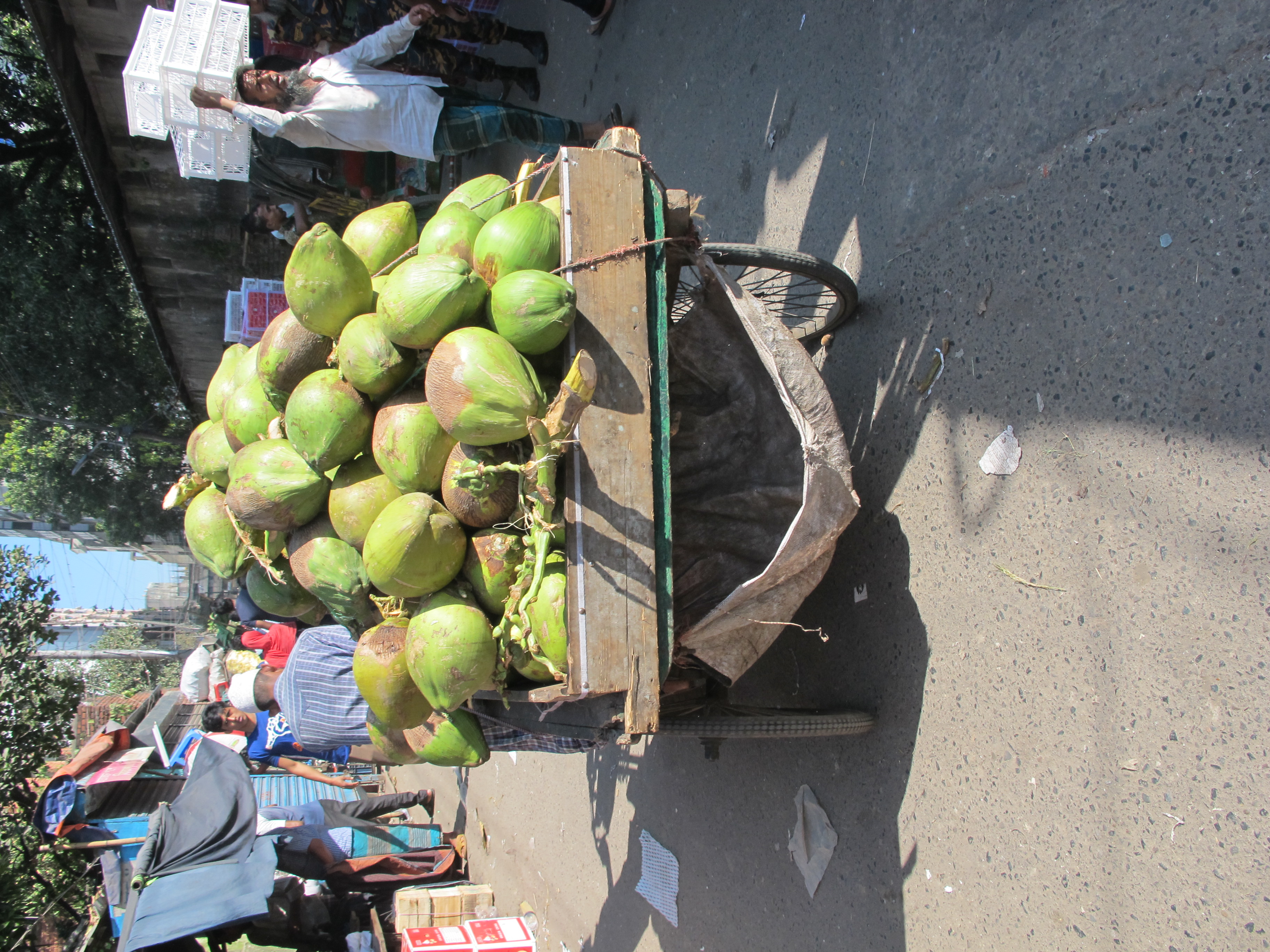
Green coconuts from the district also travel far. When Prothom Alo looked at the dab trade in April 2022, wholesalers said the main supply to Dhaka's wholesale markets came from Lakshmipur, Noakhali, Bhola, Barishal and Pirojpur, where local depots buy nuts at auction and sell them on to traders across the country. Green coconuts were then selling in Dhaka for 60 to 120 taka each depending on size, while a Lakshmipur trader said he had just sent medium-sized nuts to Dhaka at 48 taka each, against under 40 taka two weeks earlier. In Bagerhat, the paper's correspondent found, a green coconut still on the tree was then selling for 30 to 40 taka depending on size, up from 20 to 25 taka a month before, as the heat pushed demand up.
The coconut palm and the green coconut
The coconut palm, Cocos nucifera, belongs to the palm family and grows throughout the tropics. Banglapedia describes it as a tree that reaches 8 to 30 metres, with a smooth cylindrical trunk marked by the ring-like scars of fallen leaves, and notes that a well-cared-for palm may yield 200 or more fruits a year. The nuts grow in bunches at the crown, just below the fronds, which is why picking them means climbing the whole height of the bare trunk.
In Bangladesh the palm is grown mainly as a homestead tree, for its fruit and its many other uses, and also as an avenue tree along roads. The flesh of the mature nut is eaten raw and used in sweets and cooking; dried copra gives oil; the husk gives coir for mats, rope and brushes; the hard shell is burned as fuel and made into charcoal; the leaves are woven into mats and baskets and used for thatching; and the trunks are used for rafters, posts and small bridges. The tender nut, the dab that Shahen Shah Ali drank, is in great demand as a refreshing drink, Banglapedia notes.
Banglapedia puts the national area under coconut at about 31,600 hectares, with a total production of about 96,000 tonnes; the entry does not say which year these figures refer to. The DAE count for Lakshmipur alone, 2,735 hectares of orchards in 2023-24, leaves out the palms that, in the DAE official's words, stand in every homestead yard.
Falls from height: what the figures show
The Ramganj climb ended without injury, but falls are among the most serious injury risks in daily life. The World Health Organization's fact sheet on falls, published in April 2021, says falls are the second leading cause of unintentional injury deaths worldwide after road traffic injuries. It estimates that 684,000 people die from falls each year, that more than 80 per cent of these deaths happen in low- and middle-income countries, and that the Western Pacific and South-East Asia regions account for 60 per cent of them. About 37.3 million falls a year are severe enough to need medical attention, and falls cost more than 38 million disability-adjusted life years each year, causing more years lived with disability than transport injuries, drowning, burns and poisoning combined.
WHO notes that men consistently have higher death rates from falls, which it links partly to risk-taking and to hazards at work, and it lists occupations at elevated heights among the risk factors. Among the measures it recommends are stricter workplace safety rules and programmes in high-risk occupations; harnesses, restraint systems, fall-arrest systems and safe scaffolding for people working at heights; and fencing off or otherwise restricting access to dangerous areas.
In Bangladesh, trees are a common source of such falls. A study published in the Mymensingh Medical Journal in October 2021 looked at the records of 69,740 patients who came to the casualty department of Mymensingh Medical College Hospital between 19 November 2017 and 18 November 2019, an average of 96 a day. Men outnumbered women three to one, and the 11-20 age group was the largest. Injury from a fall from height accounted for 43 per cent of all the patients, ahead of road traffic accidents at 25 per cent and physical assault at 18 per cent. The authors wrote that patients who had fallen from trees were most numerous in April to June each year, at 35 per cent.
Earlier rescues from coconut palms
The Ramganj case was not the first time firefighters were called to bring someone down from a coconut palm. In June 2021 Prothom Alo reported that a 22-year-old woman in Begumpur village of Maheshpur upazila, Jhenaidah, had climbed a coconut palm alone at night and could not come down. The acting station officer of the Maheshpur fire service said his team brought her down from the 60-foot tree with a rope after about 40 minutes; she lost consciousness during the rescue and was sent to hospital, where she was said to be doing well.
In March 2023 Dhaka Tribune Bangla reported a longer operation in Madhukhali, Faridpur. A 15-year-old boy had climbed a coconut palm about 50 feet tall on a school field to pick green coconuts and became stuck at the top. When his younger brother could hear nothing from him, local people called the national emergency number 999. A fire service official in Madhukhali said that because the tree was very tall and the station lacked the equipment for such a rescue, the Faridpur station was called in; the boy was brought down at about 1:30 at night, some five hours after the call, admitted to the Madhukhali Upazila Health Complex, and released the next morning after he recovered.
Rescues at height are part of the same work in other settings. In March 2024, Prothom Alo reported, a caller told 999 that a Ferris wheel at a park near the Rupsha bridge in Khulna had broken down with 15 to 20 people stuck 40 to 50 feet up. The call was passed to the Tutpara fire station in Khulna, and its team brought 15 people, among them 10 children, down unhurt.
The fire service and the 999 line
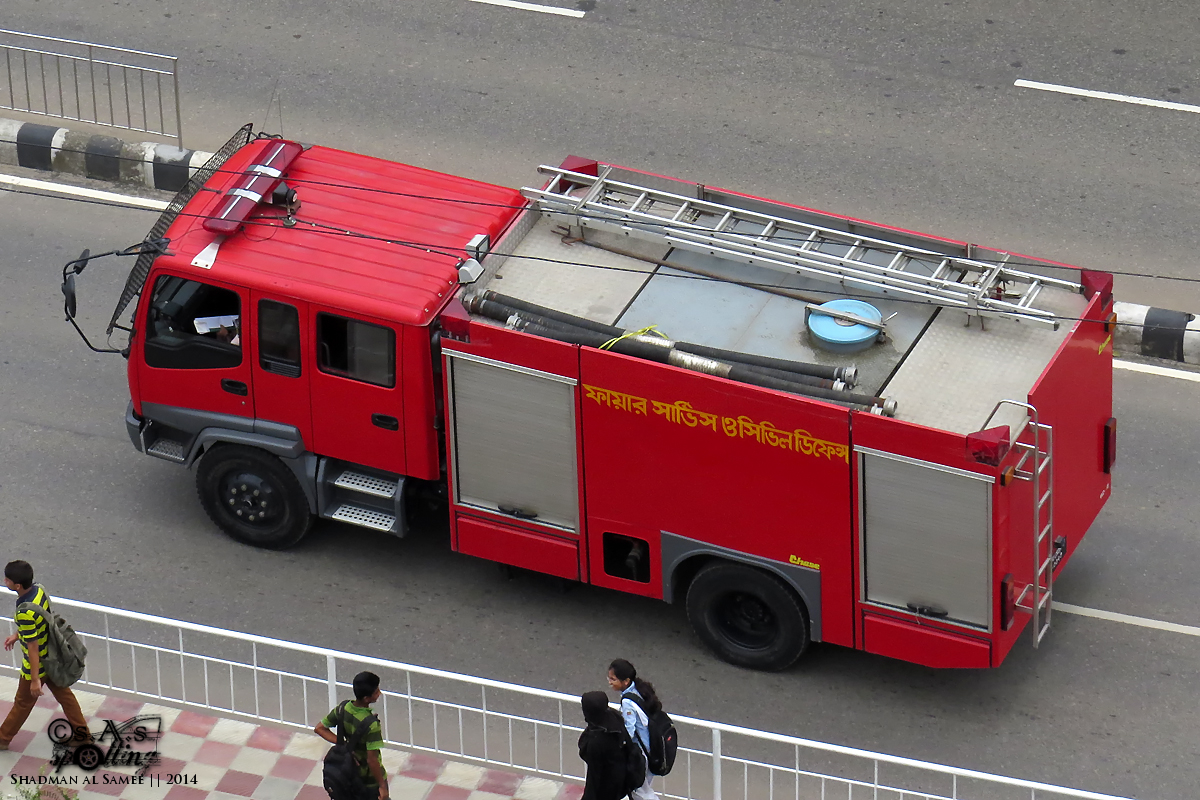
Bangladesh Fire Service and Civil Defence (FSCD), the agency whose Ramganj team carried out the rescue, is the national emergency service responsible for firefighting, rescue operations and civil defence. It works under the Ministry of Home Affairs and, besides fighting fires, carries out technical rescues, inspects buildings for fire safety and trains members of the public in firefighting, first aid and disaster response.
Many of its rescue calls now come through 999, the national emergency service number. According to figures from Police Headquarters reported by Prothom Alo in November 2024, the 999 service was launched on 12 December 2017. It is free from any phone, runs under the Ministry of Home Affairs and connects callers to the police, the fire service and ambulances. In the almost seven years to 31 October 2024 it received 58,488,107 calls; 1,933,294 of them sought emergency help, and the fire service provided 156,129 of the services given. Between 1 January and 31 October 2024 alone the fire service responded to 23,957 emergencies through 999.
Officials of the service told Prothom Alo that accidents, saving the lives of people and animals, wildlife rescues and fires were among the reasons it had become widely used across the country, and that many calls about non-emergency matters still reached the line.
Mental health and getting care
The local resident's description of the man as mentally disabled was his own view, and the report gave no medical information about him. In the 2021 Jhenaidah case, the upazila health officer told Prothom Alo that episodes of that kind are mental illness, and that the village belief that such a person is possessed by jinn has no scientific basis.
Many people in Bangladesh with a mental health condition never reach care. A study in BMC Psychiatry, published in August 2025 and based on the National Mental Health Survey Bangladesh 2019 data from 7,270 households, found that about 90 per cent of people with a mental health disorder did not seek mental health care. The treatment gap was highest for addictive disorders, at 95.24 per cent, and lowest for bipolar disorder, at 65.63 per cent. The authors concluded that mental health service coverage needed to be increased urgently. Anyone worried about a family member's mental health should see a doctor, for example at the upazila health complex.
Photo: Kamaltf / Wikimedia Commons (CC BY-SA 4.0)
Sources: Jagonews24, Banglapedia (Asiatic Society of Bangladesh), The Daily Ittefaq, Prothom Alo, Dhaka Tribune Bangla, World Health Organization, Mymensingh Medical Journal, BMC Psychiatry, Wikipedia

Comments
(0)