
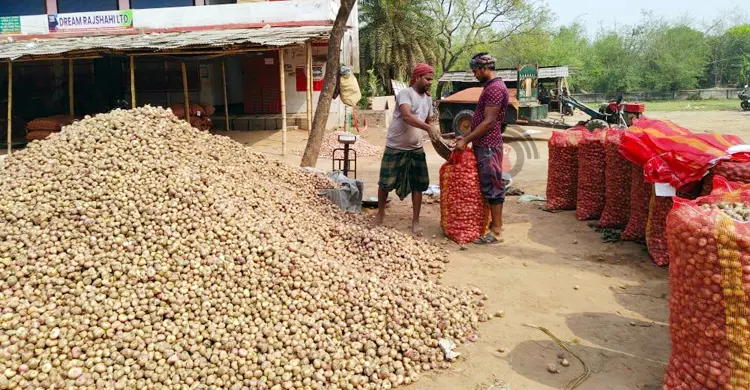
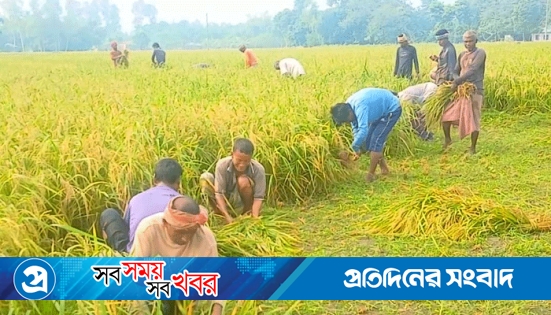
Farmers sow dreams of green in the soil, and with fertiliser, irrigation and care their crops grow. They cut the crop and bring it to market to sell. But far from making a profit, they do not even get a fair price. Middlemen take the lion's share of the profit, and farmers get only a nominal price.
The Khorkhori bypass is known as one of Rajshahi's main wholesale vegetable markets. Work starts there at the crack of dawn, as farmers from Paba, Mohanpur, Tanore, Godagari, Charghat and Bagha in the district bring their produce to sell.
They pick vegetables from the field the day before and set off overnight with trucks or trolleys full of produce for the Rajshahi market. From there, truckloads of vegetables are sent in the early morning to the capital and other cities.
Mainly, big traders from market associations in Dhaka buy vegetables from farmers here and send them to Dhaka. Fresh vegetables also go from this market to the city's small and large markets. Once they move from Khorkhori to the city markets, vegetable prices rise by Tk 5 to Tk 15, which is almost double. Overall, farmers are deprived of a fair price.
Wholesale and retail prices
A visit to the market found:
- Potatoes selling wholesale at Tk 13-14 a kg, but at Tk 20-25 in local markets.
- Aubergines at Tk 5-10 wholesale, but Tk 25-35 in local markets.
- Onions at Tk 18-20 wholesale and Tk 25-30 retail.
- Green chillies at Tk 30-40 wholesale, but Tk 80-100 a kg in retail markets.
- Cucumbers at Tk 20 wholesale and Tk 35-45 a kg retail.
- Pointed gourd at Tk 50-52 wholesale and Tk 60-80 retail.
- Bitter gourd at Tk 35-40 wholesale and Tk 60-80 retail.
- Bottle gourd at Tk 20-25 a piece wholesale and Tk 30-40 retail.
Among new vegetables, drumsticks are selling wholesale at Tk 100-120, but the same product sells for Tk 150-160 a kg in local markets. Cauliflower is plentiful but sells wholesale at Tk 25-30 and retail at Tk 40-50.
Okra, another new vegetable, is Tk 40-50 a kg wholesale but Tk 100 a kg retail. Cheap radishes are Tk 4-5 a kg wholesale but Tk 10-15 retail. Ginger is Tk 40-45 wholesale and Tk 55-60 a kg in local markets, and garlic Tk 28-30 wholesale and Tk 40-50 a kg in local markets.
In other words, almost every vegetable sells for Tk 15 to Tk 20 more in local retail markets.
Traders' view
Md Shariful Islam, a vegetable seller at the Khorkhori market, said supply had been low for the past two or three weeks because winter was over and winter vegetables were no longer widely available, so fewer vegetables were coming to market. Vegetables will become even scarcer through March, April and May, and prices will rise a lot then, he said.
He said some vegetables had come to market ahead of summer, but very few. Some winter vegetables are also still on the market. Winter vegetables are comparatively cheap, but early summer vegetables are expensive. The market will stay like this for about three months.
Another wholesale vegetable seller, Tarikul Islam, said the vegetable market was poor. A lot of sweet pumpkin is coming from Joypurhat, which they buy wholesale at Tk 16-17 a kg, with transport and labour costs on top. But sweet pumpkin is currently selling at Tk 16-17 a kg in the market. Only a week ago they made a profit of Tk 2-3 a kg.
Trader Mohammad Tuhin bought 150 maunds of onions at the Khorkhori market. He said householders from the villages come to sell onions there. He bought them at Tk 20-22 a kg and will sell them at the Master Para market in the city at a profit of 50 paisa to Tk 1 a kg. Those buyers will in turn sell the onions at a profit of Tk 5-10 a kg.
Rafiz Uddin, a wholesale onion trader at Khorkhori, buys onions and sends them to Dhaka. He told Jagonews he had bought onions from Paba and Godagari in Rajshahi and from Natore at Tk 20 a kg, and will sell them in Dhaka at Tk 25. That leaves some profit after transport costs, he said.
An official's solution
Md Abdullah Hil Kafi, scientific officer and additional agriculture extension officer at the Rajshahi agricultural extension office, said that although the amount of cultivated land in Rajshahi has shrunk, vegetable farming has gone well. In the 2020-21 rabi season, vegetable production totalled 18,114 tonnes, and output this time is about the same. On that basis there should be no shortage of vegetables in the market. Rather, some middlemen traders take advantage even when there is enough produce in the market, and farmers are left out in the middle.
As a solution, he said the crisis could be overcome by setting up open agricultural hubs in Rajshahi city and at different places in the upazilas. There, farmers would have space to keep their produce and trade directly with wholesalers from Dhaka and elsewhere in Rajshahi. Only this can change farmers' fortunes, he said, and nothing else.
Source: Jagonews24. First published in Bengali on The Agro News.
Comments
(0)