
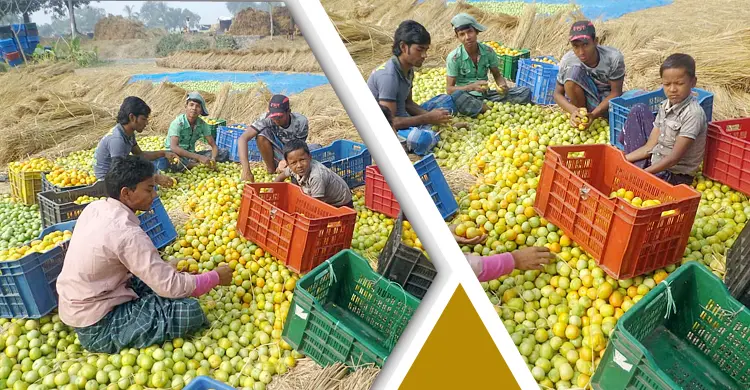
Tomato cultivation in Rajshahi has almost doubled compared with before, bringing a bumper crop at the very start of the season, and farmers are profiting from the large early output.
The Rajshahi agricultural extension office says the tomato season usually runs from November to February. Early tomatoes are grown on the chars of Godagari, Paba, Charghat and Bagha upazilas.
Many also grow tomatoes as a companion crop in the early stages of lemon, malta, guava and jujube orchards, which raises output. Tomato planting begins after the post-monsoon Aus rice harvest.
Hybrid varieties dominate
Hoping for higher yields, farmers grow high-yielding hybrid varieties such as Bipul Plus, VL-642, Saosan-8323, UL-742, Maharaj and Salamat, which is why yields have multiplied this season.
About 36 varieties of tomato are grown in the Rajshahi region, but five or six hybrids are grown the most. There are five local varieties, but they are hardly grown.
According to sources, tomatoes were grown on 3,660 hectares in Rajshahi in the Rabi season of 2020-21. The average yield was 22.6 metric tonnes; the target was 36 metric tonnes and roughly the same was achieved. Total output was 82,621 metric tonnes.
This financial year the target was set at 36 hectares, but at the very start of the season it was exceeded, reaching 37.23 hectares. The extension authorities expect tomatoes to be grown on about 4,500 hectares.
That is because tomato growing on chars, in homesteads and as a companion crop has increased greatly this year. So far this season about 77,500 metric tonnes have been produced, against a total of 86,500 metric tonnes last year.
Big money in the trade
Of Rajshahi's nine upazilas, tomatoes are grown most in Godagari, Paba and Bagmara, which produce more than two-thirds of the crop. After meeting local demand, it is sold across the country.
Traders from Dhaka and elsewhere come and buy whole tomato fields, then take the crop by truck to sell around the country. Farmers in the Rajshahi region are profiting and being encouraged to grow more.
Local agriculture office sources say the tomato trade in the Rajshahi region exceeds Tk 400 to 500 crore a year. A bigha produces 60 to 70 maunds of tomatoes.
At a minimum price of Tk 1,000 a maund, that sells for Tk 60,000 or 70,000, which is not possible with rice or other crops. Godagari upazila produces the most tomatoes in Rajshahi, with trade of about Tk 200 crore a year.
Tipu Sultan, a tomato farmer from Matikata village in Godagari, said he has grown tomatoes on 10 bighas. About 15 maunds came first, selling at Tk 1,800 to 2,200 a maund (green). As the days go on, more tomatoes will come and prices will fall. Prices are good early and drop later, but they are good now.
Shafiqul Islam, another Godagari tomato farmer, said both the crop and prices are better than last year. The tomato season comes before winter, so wholesale buyers from Dhaka come to the area, look around and buy whole tomato fields at once, then leave with truckloads. That is why tomato farming is more profitable and more convenient.
Officials on prices
Godagari upazila agriculture officer Sharmin Sultana said the tomato season usually runs for four months from November to February. Tomatoes are grown twice in the area, and some are harvested early in the season, when demand is high and farmers get better prices.
KJM Abdul Awal, deputy director of the Department of Agricultural Extension (DAE) in Rajshahi district, said the tomato is, in a word, a cash crop. It is grown most in Godagari, Paba and Bagmara, and the area is growing every year as market demand rises. Farmers are adopting modern methods to raise yields, and yields are rising.
He said that although 36 varieties are grown in Rajshahi, four or five high-yielding types dominate. Early on, from August to October, tomatoes sold in the market at about Tk 150 to 170.
From November to now they are selling at Tk 100 to 120. But at the end of the Rabi season, around March, the same tomatoes will sell at Tk 50 down to as little as Tk 10 to 15, the usual end-of-season price.
Source: Jagonews24. First published in Bengali on The Agro News.
Comments
(0)