
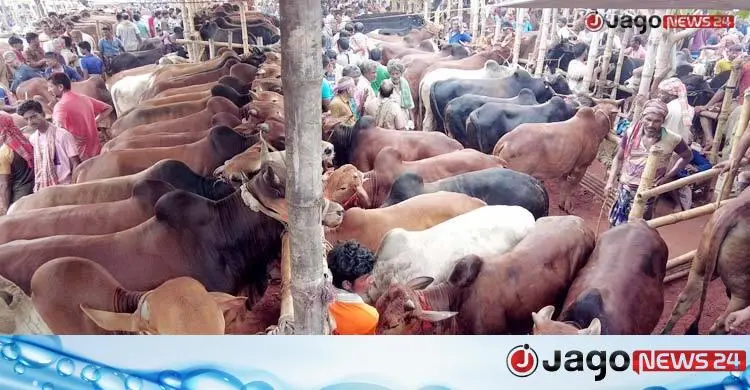
Eid-ul-Azha is only three weeks away, and sacrificial animals have already started arriving at the markets. Farmers say production costs have risen somewhat this year, but Indian cattle no longer dominate, so demand in the market will be for local cattle. Farmers are therefore hopeful of getting good prices.
According to the district livestock office, 463,011 animals are ready for sacrifice in Rajshahi this year: 104,841 cattle, 3,425 buffaloes, 311,339 goats and 43,406 sheep. The likely demand for sacrificial animals in the district is put at 371,058, leaving 91,953 more animals than needed.
Those involved say the surplus will help meet demand in the capital and other parts of the country. Not only Rajshahi district but the whole division has an encouraging supply of animals.
According to the divisional livestock office, about 43 lakh animals are ready in Rajshahi division against a likely demand of about 24 lakh, so officials say there is no fear of a shortage of sacrificial animals.
Border watch boosts local farming
Indian cattle once dominated the markets in this border region, but strict border surveillance has ended that trend over the past few years. This has increased people's interest in raising livestock locally, and commercial farms have now sprung up in almost every upazila, boosting self-reliance and creating jobs.
Preparations to hold more than 300 sacrificial animal markets across Rajshahi division are almost complete, and trading has begun in some areas. Those involved expect busy trade, with crowds of buyers and traders, a few days before Eid.
Higher costs, hopes of good prices
Abdul Malek, a farmer in Godagari upazila, said he started raising animals early using traditional methods. Although production costs have risen, he hopes to get good prices.
Sujan Ali of Tanore upazila said: "I planned and started raising cattle six months ago. At first I was a little worried about feed prices. Now the animals are well prepared, and I hope to get good prices in the market."
Rafiqul Islam, a farmer in Paba upazila, has been raising cattle and goats to a plan for about a year, using traditional methods on his own farm. Because feed and medicine prices have risen somewhat this year, his costs are higher. Even so, he expects good demand for animals in the Eid market and good prices as a result.
Aklima Akter, a farmer in Bagmara upazila, said that because demand is higher for smaller animals, she has raised goats and sheep alongside cattle, which she will take to market for Eid.
Rubel Hossain, a cattle farmer from the Mohanpur area of the city, believes Indian dominance will decline considerably as local cattle production grows. He told Jago News: "If cattle are raised within the country, the country will become self-sufficient and Indian dominance will fall a great deal, because every year when Eid-ul-Azha comes we look towards India. If the government pays a little special attention to cattle farmers, large-scale cattle production is possible at home."
Officials: local animals will meet demand
Dr Ananda Kumar Adhikari, divisional livestock director in Rajshahi, said demand for sacrificial animals can be met with locally produced animals. "Veterinary services, health checks and awareness activities will be stepped up at the markets. Farmers are being advised to supply surplus animals to other parts of the country," he said.
District livestock officer Dr Md Atoar Rahman said: "As in previous years, demand for sacrifice will be met with local animals this year too. If the surplus animals can be supplied to different parts of the country, farmers will benefit financially. And if farmers profit, they will be even more keen to raise cattle."
Source: Jagonews24. First published in Bengali on The Agro News.

Comments
(0)