
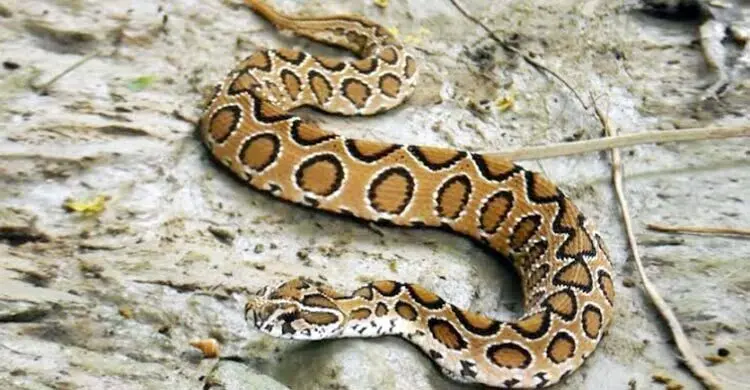
Venomous Russell's vipers are being seen everywhere from Rajshahi's Barind region and the Padma chars to people's homes. Farmers are too afraid to go into their fields, and snakebite cases are rising day by day. Rajshahi has no separate antivenom for this snake's bite; bites from all snakes are treated with the same antivenom.
Snake researchers and experts say there is treatment for this species' bite, and the risk of death falls if treatment is taken in time. The Russell's viper is not at all the most venomous snake in the country, and more people recover from its bite than die.
Hospital figures
According to Rajshahi Medical College Hospital (RMCH), 213 snakebite patients were admitted to the hospital in 2023. Of them, 164 recovered and went home and 49 died, a recovery rate of 77 per cent.
Up to 12 June 2024, 59 snakebite patients were admitted to RMCH. Of them, 50 recovered and went home and nine died, a recovery rate of 84 per cent.
In 2023, Russell's vipers bit 50 people in Rajshahi. Of them, 13 died and 37 recovered, a recovery rate of 74 per cent.
Abu Shahin, associate professor in the medicine department at RMCH, has researched Russell's vipers. He said the snake was common in the Barind region, including Tanore and Godagari, in the 1960s and 70s, but from the 1980s until 2010 it disappeared. Then, in 2013, a patient bitten by this snake was first seen at RMCH.
Abu Shahin said Russell's viper venom is haemotoxic. As soon as it bites, human tissue is quickly destroyed, kidney function declines and the wound rots. About 60 per cent of patients die because of kidney problems. Antivenom must be taken as quickly as possible after the bite.
"In our country, one vaccine is used for three snakes. It is mainly an Indian vaccine and works 70 per cent. If a vaccine for snakes of our own region were made, it would work 100 per cent and the death rate would also fall," Abu Shahin believes.
Snake and reptile expert Borhan Biswas Roman said Russell's vipers give birth between May and July, producing 6 to 90 young at a time. Their behaviour is somewhat different from the cobra and other venomous snakes. Russell's vipers have come with floodwater and are living in Rajshahi's rivers and char areas, and Rajshahi has now become a refuge for the snake.
Antivenom missing in six upazilas
Although the number of Russell's viper bite patients is rising day by day, six upazila health complexes in Rajshahi have no antivenom; only Tanore and Charghat upazilas have it. So whenever this snake bites, people have to rush to RMCH.
Habibur Rahman of Godagari, who was treated at RMCH, said: "A snake bit me while I was working in the field, and I had to be treated at Rajshahi Medical. I am well now. There is no medicine for this snake in Godagari, so I had no choice but to rush to Rajshahi."
Dr Shankar Kumar Biswas, officer in charge of the RMCH emergency department, said: "The antivenom we have here is polyvenom, and it is available throughout the country. It is not just for Russell's vipers; it is used for venomous snakes in general. The hospital currently has more than 2,000 doses of antivenom, and more will arrive within a day or two."
Rajshahi Civil Surgeon Dr Abu Sayeed Md Faruk said: "Two of our upazilas have antivenom. The rest will get it within a day or two. Rajshahi Medical College also has enough antivenom. Antivenom is now being kept at the upazilas so that snakebite patients can be treated easily."
Health Minister Dr Samanta Lal Sen recently told the media that the country has enough antivenom and that he has instructed hospitals everywhere to keep it. Antivenom is a substance that is effective against venom or can neutralise it.
According to the Directorate General of Health Services, four lakh people in the country were bitten by snakes in 2023. Of them, seven and a half thousand died, most of them bitten by cobras and kraits. No exact figure is available for how many died from Russell's viper bites.
Source: Jagonews24. First published in Bengali on The Agro News.
Comments
(0)