
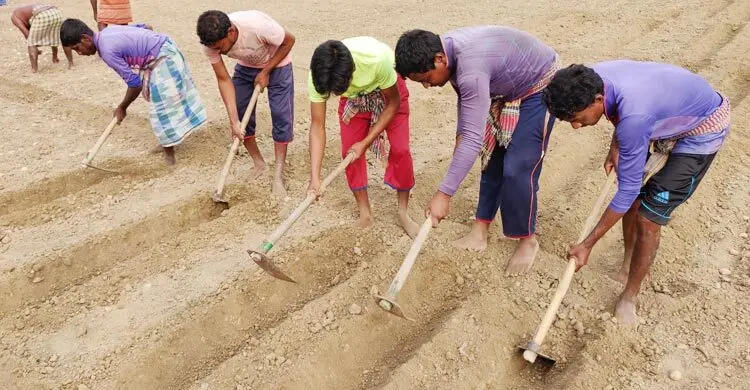
Potato farmers in Rajshahi and across the northern region are deeply worried about fertiliser and seed. At the height of the potato season, a sudden rise in fertiliser prices and a shortage of good seed have left them in serious difficulty. Farmers blame the artificial shortage on a syndicate of dishonest traders and some agriculture officials and staff. Unable to get the fertiliser they need, many are paying Tk 400-500 more per sack in some cases.
Agriculture officials say they are holding group meetings and yard meetings with farmers to raise awareness, and a campaign to stop the use of more fertiliser than the approved dose is continuing. Farmers, however, say government efforts to teach them the proper use of fertiliser and pesticide are very inadequate, as most of them have not been told about it.
Allocations not raised despite record target
According to annual reports of the Department of Agricultural Extension (DAE) and the Bangladesh Bureau of Statistics, of the 106 lakh tonnes of potatoes produced in the country in 2023-24, 79 lakh tonnes were produced in Rajshahi alone. Yet despite a record production target, the Bangladesh Agricultural Development Corporation (BADC) and the Bangladesh Chemical Industries Corporation (BCIC) did not increase seed and fertiliser allocations this season. The result is a shortage of potato seed and fertiliser that has ultimately pushed up their prices.
According to the Rajshahi DAE, the district's potato target this season was 35,800 hectares, but with a rush to grow potatoes this year an extra 3,500 hectares are being planted. If conditions are favourable, the target is to produce about 11.5 lakh tonnes from 39,300 hectares, the highest in several years. Farmers allege that BADC and BCIC dealers, citing low allocations, are charging them up to Tk 450 extra per sack.
Farmers apply what their forefathers did
Habibur Rahman, a farmer in Tanore upazila, said: "We don't really know when and how much fertiliser to apply to our land. We follow the practice of our forefathers. Before planting potato seed we use two sacks (100 kg) of MOP (muriate of potash), one sack (50 kg) of DAP (diammonium phosphate) and one sack of TSP (triple superphosphate) per bigha. When the leaves come up we apply a little more."
"To grow potatoes on my 15 bighas I need 30 sacks of MOP, 15 of DAP and 15 of TSP," he said. "After standing in a long queue for hours at the BCIC dealer's shop, I got just one sack of MOP at the government price."
Mostakin Islam, another farmer in the same upazila, said: "Before planting I am applying two sacks of MOP, one and a half sacks of DAP and half a sack of TSP per bigha. The more fertiliser we use, the more we will harvest at the end of the season." Asked whether anyone from the agriculture department had contacted or advised them on how much fertiliser to apply, he said no.
Khorshed Alam, a farmer in Bagmara upazila, said they too were applying two sacks of MOP and one sack each of TSP and DAP per bigha. Farmers there are competing to apply fertiliser in their potato fields in the hope of higher yields.
At a BCIC dealer's shop at Baya Bazar in Paba upazila, MOP with a government price of Tk 1,000 was being sold for Tk 1,180, DAP priced at Tk 1,050 for Tk 1,300, and TSP priced at Tk 1,050 for Tk 1,700.
An employee at the shop said: "Because the BCIC allocation is very small compared with farmers' demand, we have collected fertiliser from elsewhere. When a single farmer needs 200 sacks, each dealer was allocated a total of 120 sacks of TSP."
Experts: far more than needed
But Kawsar Ali, a professor in the Department of Crop Science and Technology at Rajshahi University, said: "Twenty to 25 kg of MOP and TSP or DAP is enough to prepare a bigha for potatoes. For lack of awareness, farmers are using excess fertiliser, which is nothing but waste. Overuse not only causes farmers financial losses, it also damages the topsoil, which reduces production."
Umme Salma, deputy director of the Rajshahi DAE, said: "We are doing our best to make farmers aware so that they apply the approved dose of fertiliser. We regularly hold group and yard meetings with farmers, and a campaign is under way to make sure no more than the approved dose is applied. We are doing our best to monitor the situation."
She said no dealer should be able to charge farmers extra, and promised immediate action on any complaint.
Source: Jagonews24. First published in Bengali on The Agro News.

Comments
(0)