
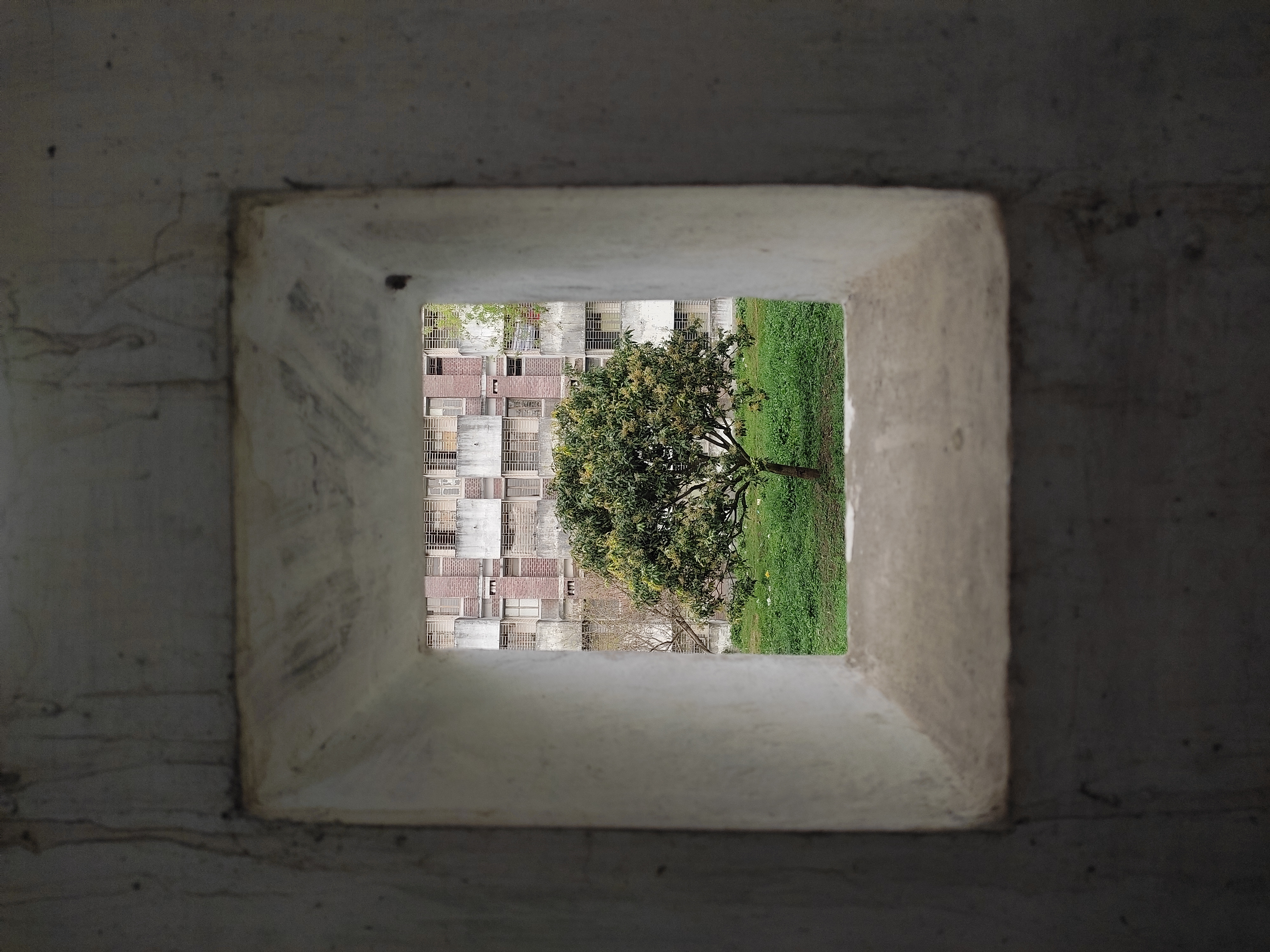
Unknown people cut down 117 young mango trees in a farmer's orchard in the Kazipara area of Nowhata municipality, in Rajshahi's Paba upazila, during the night before Wednesday, 17 December 2025. The orchard stands beside Sindur Kusumbi Kazipara Non-Government Primary School and belongs to farmer Saidur Rahman, who had planted it two years earlier. The damage was found at dawn on Wednesday, and Jagonews24's district correspondent reported it that afternoon.
According to the report, the farmer lost two years of labour, hope and investment in a single night. At the site, rows of mango trees lay cut through at the base, and heaps of branches and leaves were scattered across the ground. Many of the felled trees were still carrying the buds of new blossom.
133 trees on fifteen and a half decimals
Saidur Rahman told the reporter that two years earlier he had planted 133 improved-variety mango trees on 15.5 decimals of land in Sindur Kusumbi mouza. The orchard held trees of the Baromashi, Katimon, Amrapali, Haribhanga, Gourmati and BARI-4 varieties. From the start, he said, he had done his utmost with regular irrigation, fertiliser and disease control. Many of the trees had already come into blossom, and he had been hoping that selling their fruit this year would improve his family's finances.
"Just yesterday I planted about 60 kg of garlic seed as a companion crop among the mango trees. Altogether we had big plans. But when I came at dawn, everything was finished. Of the 133 trees, 117 had been cut down. It feels as if someone has driven a knife into my chest," he said.
By his own estimate, the loss came to about Tk 3 lakh, counting the trees, the cost of tending them and other expenses. The report added that the damage was not only financial: two years of work, the prospect of future income and the security of the family's livelihood had collapsed together.
Neighbours call for an inquiry
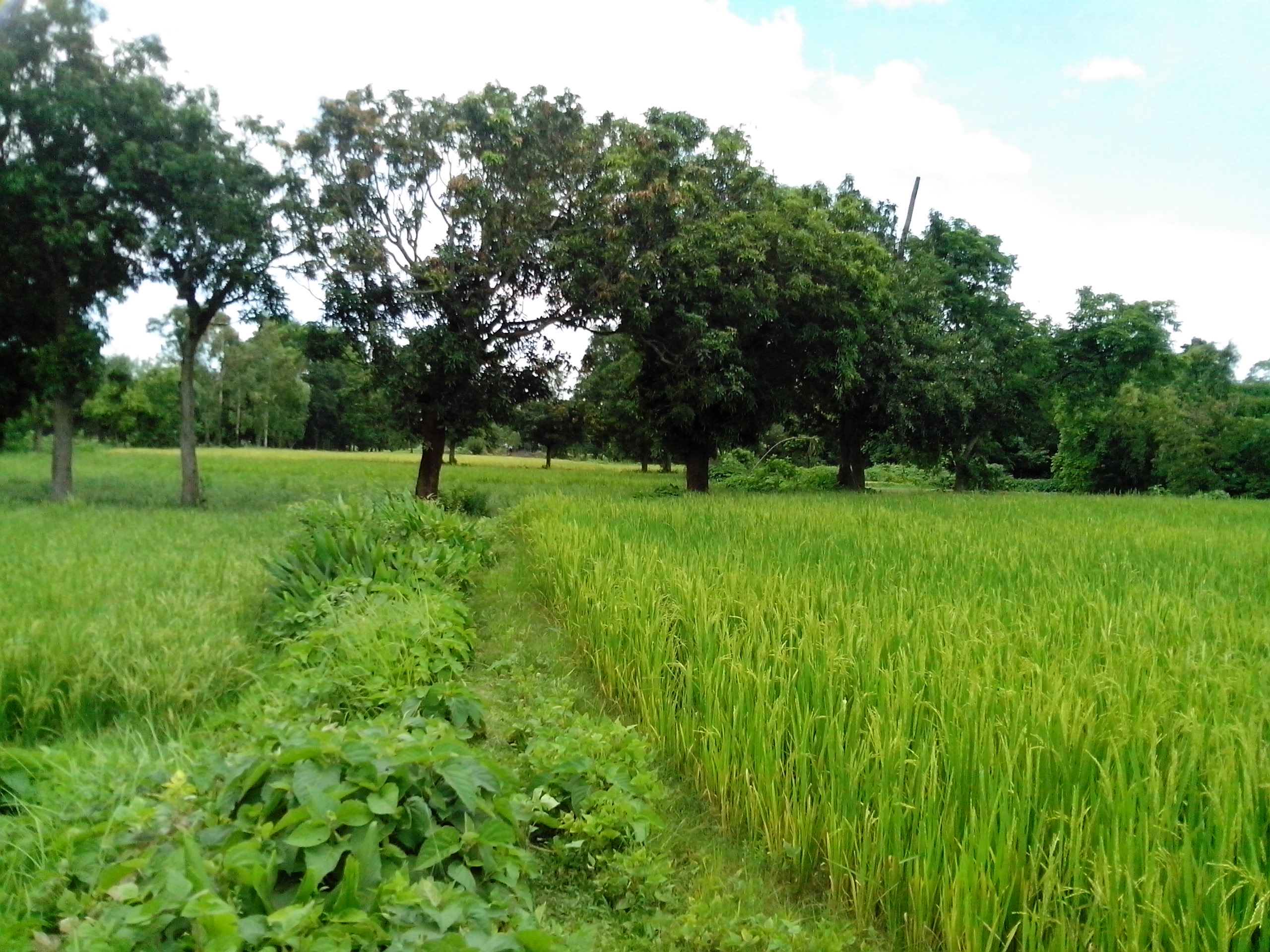
Local residents told Jagonews24 that the area is relatively quiet, which, in their view, made it easy for the culprits to carry out such sabotage late at night. When the news spread, farmers and residents from the surrounding area hurried to the orchard.
Local resident Monowara Begum said there should be no enmity towards trees. She called for a quick investigation, the arrest of those responsible and exemplary punishment, and said such incidents are not just one farmer's loss but also harm the area's farm production and its environment.
Isha Khan, a farmer from Kazipara, said: "This is not mere mischief; it was done deliberately. Such treatment of a farmer's life cannot be accepted. Today it is Saidur Rahman, tomorrow someone else. If this goes on, people will lose interest in farming."
Locals suspected that an old enmity, a land dispute or some other motive might lie behind the felling. That was their speculation: the reports of 17 December named no suspect and did not say who had cut the trees.
A written complaint and a police inquiry
After the incident, Saidur Rahman filed a written complaint with Paba police station. Sub-Inspector Protap Kumar, the investigating officer at the station, told Jagonews24 that after receiving the complaint the police had visited the orchard and carried out a preliminary investigation. All angles, including previous enmity and land disputes, were being examined, he said, and those responsible would be identified and brought to justice.
Two other outlets carried the same account later that day. Desh Rupantor reported the felling of the 117 trees in the Nowhata Kazipara area with the same details of the orchard, the varieties and the complaint, and bdnews24 quoted the same sub-inspector on the place and time of the incident and on the inquiry. None of the reports of 17 December named any suspect or mentioned an arrest, and none said whether the written complaint had yet been recorded as a formal case.
What the Penal Code says about destroying property
Deliberate damage to another person's property is dealt with in Bangladesh under the chapter on "mischief" in the Penal Code, 1860, the text of which is published by the Legislative and Parliamentary Affairs Division on bdlaws.minlaw.gov.bd. Which provisions apply in any particular case is a matter for the police investigation and, if it comes to that, the courts; the sections below describe the law, not a finding about this incident.
Section 425 defines the offence. A person commits mischief when, intending to cause wrongful loss or damage to the public or to any person, or knowing that he is likely to cause it, he causes the destruction of any property, or any change in it or in its situation that destroys or diminishes its value or utility or affects it injuriously. The section's explanations add that the offender need not intend loss to the owner in particular, and that mischief can be committed even on property the offender owns jointly with others. One of its illustrations is drawn from farming: a person who drives cattle into another's field, intending or knowing that it is likely to damage the crop, commits mischief.
- Section 426 sets the general punishment for mischief: imprisonment of either description for up to three months, or a fine, or both.
- Section 427 covers mischief that causes loss or damage of fifty taka or more: imprisonment of either description for up to two years, or a fine, or both.
The chapter goes on to deal with more particular forms of mischief, such as killing or maiming animals and damaging works of irrigation, roads, bridges and channels.
Paba upazila and Nowhata
Paba is one of the nine upazilas of Rajshahi district. Banglapedia, the national encyclopaedia published by the Asiatic Society of Bangladesh, gives its area as 340.03 square kilometres. It is bounded by Mohanpur and Tanore upazilas to the north, the Indian state of West Bengal and Charghat upazila to the south, Puthia and Durgapur upazilas to the east and Godagari upazila to the west; its main rivers are the Padma and the Shiba. Paba thana was formed in 1949 and became an upazila on 11 November 1983.
The upazila contains two municipalities, Katakhali and Noahata (Nowhata), and eight unions. Banglapedia, drawing on the 2011 census of the Bangladesh Bureau of Statistics, records Paba's population as 314,196 and that of Nowhata municipality, with its nine wards and 40 mahallas, as 57,119. Banglapedia lists the upazila's airport at Noahata, and the upazila's best-known markets and fairs include Noahata Hat and the Noahata Krishi Mela, an agricultural fair.
Farming is the backbone of the area. According to Banglapedia, agriculture was the main source of income for 54.68 per cent of households; 49.46 per cent of households owned farmland and 50.54 per cent were landless. The main crops are paddy, wheat, jute, potato, onion, vegetables and betel leaf; the main fruits are mango, jackfruit, banana, papaya, guava and litchi, and mango is among the upazila's main exports to other areas.
Rajshahi district as a whole covers 2,425.37 square kilometres. Banglapedia describes it as a region of Barind tract, diara and char lands, crossed by the Padma, the Mahananda and the Shiba rivers.
Rajshahi's mango economy in 2025
The orchard was cut down in the heartland of Bangladesh's mango trade. In May 2025, at the start of that year's harvest, the Department of Agricultural Extension (DAE) told the state news agency BSS that nearly 3,363,986 mango trees were spread across 19,578 hectares in Rajshahi district, and that it expected a yield of 13.20 tonnes per hectare. The president of the Rajshahi Chamber of Commerce and Industry told BSS that the season's mango production in the region was expected to be worth around Tk 10,000 crore, that Bagha upazila was the district's leading producer with a third of its yield, and that 36 tonnes of mangoes had been exported to ten countries from Bagha the previous year.
The same BSS report described Baneswar as the largest mango market in Rajshahi, known as the "mango capital" of Bangladesh, and listed Shaheb Bazar, Haragram, Upashahar, Shalbagan, Rajabari, Godagari, Kansat and Rohanpur among the region's other mango markets. A scientist at the Regional Fruit Research Station said Naogaon had 12,671 hectares under mango that year with a production target of 161,242 tonnes, and Natore 4,823 hectares expected to yield 56,021 tonnes.
Harvesting in Rajshahi follows a "mango calendar" set by the district administration so that fruit is picked only when mature. For the 2025 season, BSS reported, Gopalbhog could be harvested from 22 May, Ranipachhand and Lakhna from 25 May, Himsagar or Khirshapat from 30 May, Langra from 10 June, Amrapali and Fazli from 15 June, BARI-4 from 5 July, Ashwina from 10 July, Gourmati from 15 July and Ilamati from 20 August.
In July 2025 an additional director of the DAE told BSS that mangoes had been grown on 87,307 hectares across Rajshahi, Naogaon and Chapainawabganj districts that year, with expected production of around 10 lakh tonnes worth about Tk 10,000 crore. Growers in the region were adopting ultra-high-density planting, in which trees are set closer together than in traditional orchards, and fruit bagging, in which each fruit is covered with a bag to protect it from pests such as fruit flies and to reduce the need for pesticides.
At national level, DAE figures cited by The Daily Star in July 2023 put Bangladesh's mango production in the 2021-22 fiscal year at 2.35 million tonnes, of which about 600,000 tonnes were Amrapali, grown in all 64 districts. The paper reported that Bangladesh ranked seventh among the world's mango-producing countries. In February 2024 the Fazli mango of Rajshahi and Chapainawabganj was already on the list of Bangladesh's registered geographical indication (GI) products.
The six varieties in the orchard
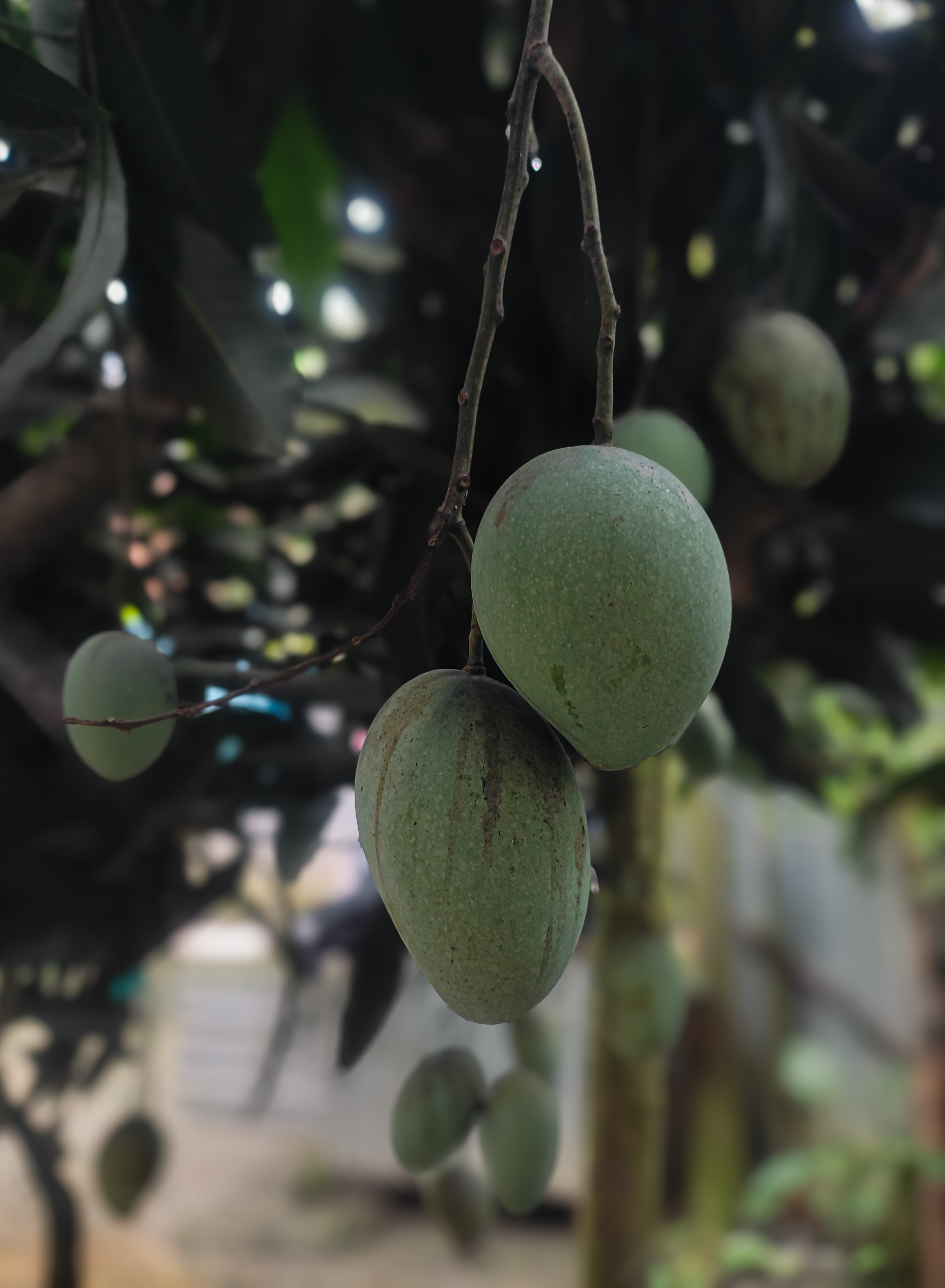
Bangladesh has around 800 mango varieties, most of them local, Prothom Alo reported in June 2025. The Bangladesh Agricultural Research Institute (BARI), whose work on new mango varieties began in 1993, had by then released 18 varieties under the name BARI Aam, three of them hybrids; 14 came from its mango research station in Chapainawabganj. Saidur Rahman's orchard mixed several of these newer varieties with well-known regional ones.
- Amrapali: released in Bangladesh as BARI Aam-3 after being introduced from India, according to Prothom Alo. The Daily Star described it as a popular hybrid developed from the Dashehari and Neelam varieties and, in 2023, as the country's most produced mango. A Chapainawabganj grower told the paper that it fruits from the second year after planting and takes up less space than other varieties, so more trees fit on less land.
- BARI-4 (BARI Aam-4): a hybrid bred by crossing an Ashwina mother flower with the pollen of a coloured mango variety from Florida in the United States; the result was better than Ashwina in weight, sweetness, yield and appearance, Prothom Alo reported. It is a late variety; the 2025 Rajshahi calendar allowed its harvest from 5 July.
- Gourmati: officials of the DAE told The Daily Star in September 2023 that it is a new variety that arose naturally and was first found in Chapainawabganj in 2012, and that it is usually on the market for about a month from mid-August to mid-September, when other mangoes are scarce. Growers said it fetched high prices but needs bagging, which raises costs.
- Haribhanga: the celebrated mango of Rangpur. In February 2024 the Department of Patents, Designs and Trademarks published the journal approving Rangpur's Haribhanga mango as a geographical indication product, bringing the number of Bangladesh's approved GI products to 28, The Daily Star reported.
- Katimon: a Thai variety that local entrepreneurs brought to Bangladesh about six years before 2023, according to The Business Standard. It carries flowers and fruit at the same time and can give three to four crops a year, against the single season of conventional varieties, BSS reported in July and September 2025. A DAE training officer said in 2023 that it was grown on around 15 hectares in Rajshahi, and the Regional Fruit Research Station said it was studying the variety's susceptibility to disease.
- Baromashi: the name means "twelve-monthly" and is used for mangoes that fruit outside the usual season; the reports did not say which variety Saidur Rahman's Baromashi trees were.
Young trees, December buds and a garlic intercrop
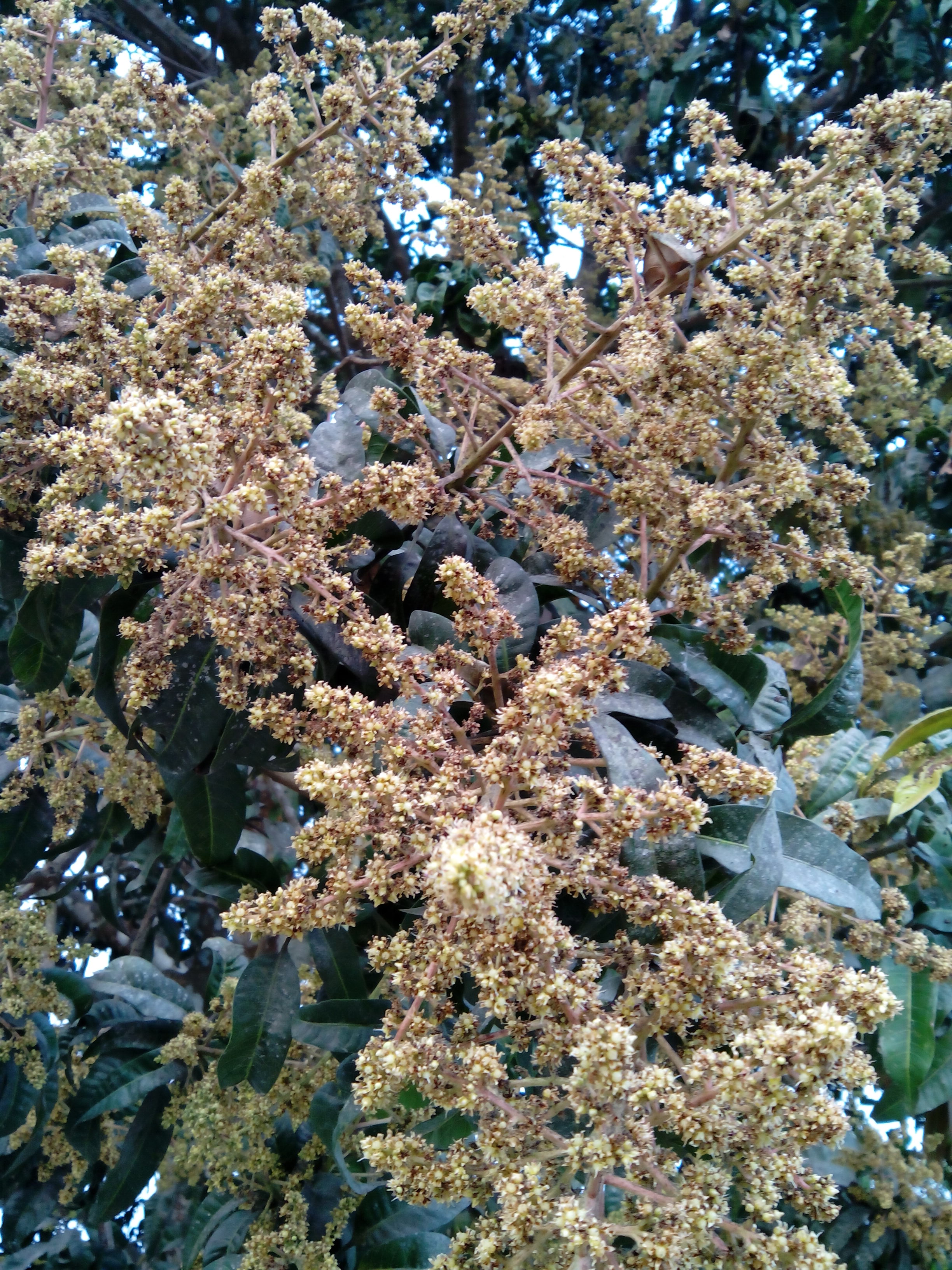
Banglapedia notes that mango trees in Bangladesh normally flower from January to March, and that fog, rain or cloudy weather at that time reduces fruit set. A single inflorescence may hold 100 to 250 flower buds, but only one or two out of about a thousand flowers become mature fruit, and two or three fruits on a panicle are often enough for a satisfactory crop. Trees propagated by grafting usually begin to bear in the fourth year after planting and stay productive until about their 45th year. The buds seen on Saidur Rahman's two-year-old trees in mid-December were therefore ahead of the usual flowering season. Off-season types behave differently: a Durgapur farmer who planted Katimon saplings told BSS that flowers began to appear in the year after planting.
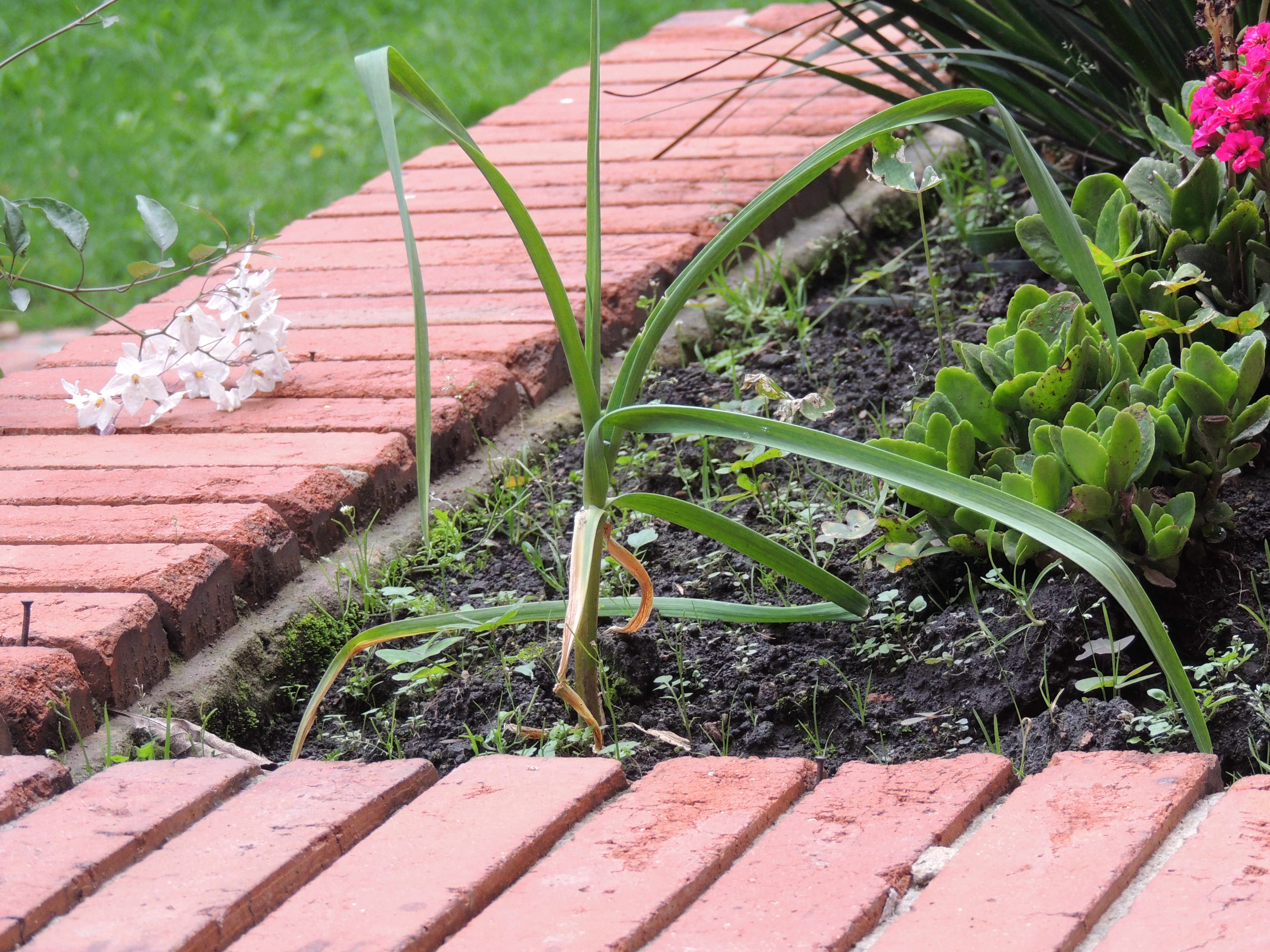
Saidur Rahman had used the space between his young trees for garlic, sowing about 60 kg of seed the day before the trees were cut. Banglapedia describes garlic (Allium sativum) as a hardy plant whose pungent bulb is used in cooking and medicine. It thrives on fertile, well-drained loam, needs a cool, moist period during growth and a relatively dry period while the cloves mature, and is planted in November and December. Rajshahi is one of the areas where its cultivation is concentrated, along with Faridpur, Jessore, Rangpur, Dinajpur, Pabna, Dhaka and Comilla; Banglapedia puts national output at about 90,170 tonnes from 25,593 hectares.
Earlier orchard destruction in the region
The Paba felling was not the first such case in the mango belt of northern Bangladesh. On 14 November 2019 Jugantor reported that about 10,000 young mango trees on some 60 bighas of land belonging to 11 growers had been cut through overnight in fields of Jamalpur and Gondoil villages on the border of Sapahar and Porsha in Naogaon. The growers, most of whom had leased the land and planted mainly Amrapali, put their loss at about Tk 50 lakh. The officer in charge of Sapahar police station said then that the site had been visited but that no complaint had yet been filed. The paper noted that in that Barind area, where water shortages had long left farmers with a single rain-fed aman crop, about 2,000 hectares of new mango orchards were being planted each year.
In September 2024 a businessman alleged at a press conference in Naogaon town that more than 800 BARI-4 mango trees in his orchard in Patnitala upazila had been cut down on 15 September amid a dispute over the land, bdnews24 and other outlets reported. One of the people he accused told reporters that the land belonged to his family. The officer in charge of Patnitala police station said police had been sent to stop the felling and that the businessman had gone to court.
Photo: Tanvir Rahat / Wikimedia Commons (CC BY-SA 4.0)
Sources: Jagonews24, Desh Rupantor, bdnews24, BSS (Bangladesh Sangbad Sangstha), Banglapedia (Asiatic Society of Bangladesh), The Penal Code, 1860 (bdlaws, Legislative and Parliamentary Affairs Division), The Daily Star, Prothom Alo, The Business Standard, Jugantor
Comments
(0)