
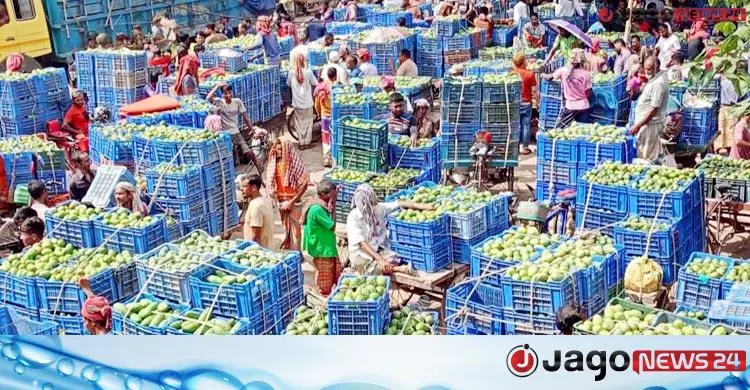
Only a few weeks ago, Rajshahi's farmers were full of hope at the sight of trees laden with mangoes. After Eid-ul-Azha that hope has turned to disappointment. Mangoes are piled up at the markets but there are not enough buyers, and expected prices are not being paid. In a season of record yield, thousands of farmers fear losses.
According to the Department of Agricultural Extension (DAE), mangoes have been grown on 19,062 hectares in Rajshahi this season. The production target is about 2 lakh 44 thousand tonnes, with a market value of about Tk 800 crore. But the abundant yield has become a source of worry rather than a blessing for many farmers.
Scenes at Baneshwar
Baneshwar in Puthia is Rajshahi's largest mango market. At the start of the season it is crowded with wholesale buyers, aratdars and retailers, but after Eid a different picture has emerged.
From dawn, vans, auto-rickshaws, pickups and trucks loaded with mangoes arrive from across the district. Farmers bring mangoes from their orchards full of hope, but disappointment shows on many faces when they hear the aratdars' prices.
Rahman Ali, a mango grower in Puthia upazila, said he had cared for his orchard all year, applying fertiliser and pesticide on time and irrigating. Thanks to good weather the trees bore plenty of fruit, and seeing them laden with mangoes filled his heart. "Looking at the mangoes on the trees, I thought I would make a good profit this time. But at the market that hope is gone. At the prices mangoes are selling for, it is hard even to recover production costs," he said.
Aminul Islam, a mango farmer in Bhubannagar village of Puthia, has about 20 bighas of orchards and has grown mangoes commercially for a long time. He too was hopeful at the start this year. He said an orchard needs care all year, not just spending in the season: fertiliser, pesticide, irrigation, labour, pruning and disease control all add up to large costs. A labourer who once cost Tk 500-600 a day now costs Tk 800 to Tk 1,000, "but at market I find mangoes have no price", he said.
Abdul Hannan, a farmer in Charghat upazila, said that if the market is not good, the yield itself becomes a burden. Many farmers took loans from banks or NGOs to look after their orchards and are now worried, he said.
Raju Mia, a farmer from Pali village in Durgapur upazila, told Jagonews: "Before Eid we thought the market would be good. But at the market I find prices have collapsed. I have to sell Gopalbhog for much less than I should get. Selling mangoes now does not mean profit, it means cutting losses."
Farmers say that if government storage, processing and export opportunities were expanded, the market would not crash like this even with higher production. In their view, long-term market management is urgent to stop the same crisis repeating every year.
Prices by variety
At the start of the season Gopalbhog fetched more than about Tk 2,000 a maund; it is now selling for Tk 1,400 to Tk 1,600. Guti mangoes have fallen from Tk 1,000-1,400 a maund to Tk 700-1,000. Lakshmanbhog is selling for Tk 600-900 a maund, and Ranipasand is also not getting the expected price.
Khirsapat, or Himsagar, is comparatively better placed, selling for Tk 1,200 to Tk 1,900 a maund. Even so, traders say prices are lower than last year.
According to people in the market, Rajshahi's mango market was much livelier at the same time last year. Gopalbhog fetched more than Tk 2,000 to Tk 2,200 a maund, and traders say Lakshmanbhog did not fall below Tk 1,500. This season, many varieties are selling for Tk 700 to Tk 1,000 a maund less than last year.
Market analysts say the fall is due to higher production, reduced demand around Eid and a temporary standstill in supply chains.
Iman Ali, a mango trader at Baneshwar, said that last year at this time wholesale buyers competed for Gopalbhog, but this time there is no such pressure. There are plenty of mangoes but few buyers, so prices cannot be held.
Eid, transport and couriers
Farmers and traders blame Eid-ul-Azha for the situation. Before Eid people are mainly busy buying animals, collecting food and other preparations, and for a few days after Eid, storing meat and feasting naturally reduce demand for fruit.
Trader Md Rajibur told Jagonews: "During Eid people are busier with meat than with fruit, so the mango market naturally slows down."
During the Eid holiday transport ran on a limited scale in many parts of the country, and courier services were not fully operating. This disrupted mango shipments from Rajshahi to Dhaka and other big markets, increasing the pile-up at the markets without increasing sales.
Online mango sellers said that although there were many orders before Eid, many buyers waited because of uncertain delivery during the holiday.
Miraj Afridi, a finance student at Rajshahi University who sells mangoes online alongside his studies, told Jagonews: "For the past few years I have been supplying Rajshahi mangoes to different districts online. Buyers are usually very keen at the start of the season, but this time there has been some stagnation because of Eid. Many regular customers are also late in ordering." He said limits on transport and courier services created uncertainty over delivery during Eid, so sales did not reach the expected level.
Storage and processing
Agriculture officials say almost every orchard has yielded well this year, significantly increasing supply. By the ordinary rule of economics, when supply rises and demand does not rise at the same time, prices come under pressure, and that is what is happening in the mango market.
Farm economists say that although mango is one of Bangladesh's most promising fruit sectors, market management still has several limitations. In their view, the lack of adequate storage means huge quantities of fruit reach the market at once in the season, pushing prices down. Expanding the processing industry and export markets could greatly ease the pressure. If industries for juice, pulp, dried mango, pickles and other processed products develop, farmers could get better prices, they say.
Prof Dr Md Farid Uddin Khan of the Department of Economics at Rajshahi University told Jagonews: "To keep the mango market stable, increasing production alone will not do; opportunities for storage, processing and export must also be expanded. Otherwise, every mango season farmers will face price instability and uncertainty in the market, which in the long run will discourage growers."
Under the district administration's schedule, Langra and Banana Mango can be harvested from 10 June, Amrapali and Fazli from 15 June, BARI Aam-4 from 5 July, Ashwina from 10 July and Gourmoti from 15 July.
Traders say that when Langra, Amrapali and Fazli reach the market, fresh demand may be created, as consumers are comparatively more interested in these varieties.
Aratdars at Baneshwar say the current situation is temporary. People have started returning to work after the Eid holiday, transport is returning to normal and courier services will soon be fully running, which will raise demand for mangoes in Dhaka and other big cities. "We hope the market will pick up in a few days, and prices may rise somewhat then," trader Iman Ali said.
Mohammad Nasir Uddin, deputy director of the district DAE office, said mango production has been good this year and supply is high, so some pressure on prices is natural. "But this is not a long-term crisis. As the season progresses and supply to different parts of the country returns to normal, I hope the market will stabilise," he said.
Source: Jagonews24. First published in Bengali on The Agro News.
Comments
(0)