
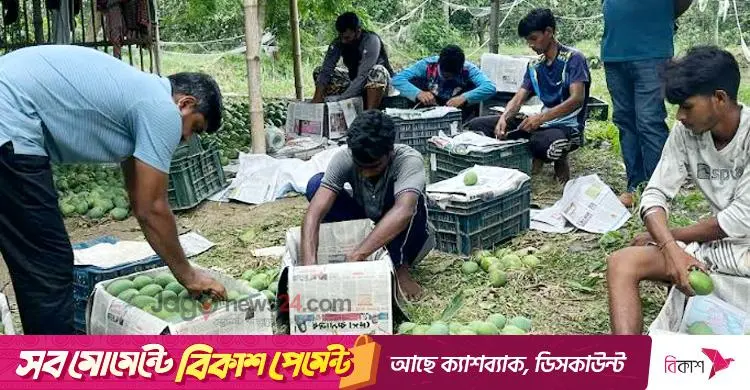
- Rajshahi supplies 70 per cent of export-grade mangoes
- Exports have fallen because of various obstacles
- Transport costs are higher than in neighbouring countries
- Complications with phytosanitary certificates
Mangoes from the Rajshahi region are in high demand at home and abroad, and 70 per cent of the mangoes Bangladesh exports come from Rajshahi. But amid various problems, the region cannot reach its export targets. Over the past three years only 22.11 per cent of the export-grade mangoes produced in the region were exported. Unable to send large quantities of mangoes prepared for export, growers have been left with the country's supershops as their last hope.
Three years of shortfalls
According to the Rajshahi regional office of the Department of Agricultural Extension (DAE), the region produced 4,648 tonnes of export-grade mangoes over the past three years. Of these, 1,027.88 tonnes were exported, just 22.11 per cent of production. In 2021-22 the region produced 550 tonnes of export-grade mangoes and exported 222.88 tonnes, or 40.52 per cent. In 2022-23 production rose to 2,528 tonnes, of which 606 tonnes, just 23.97 per cent, were exported. In 2023-24 export-grade production fell to 1,570 tonnes, and 199 tonnes, just 12.68 per cent, were exported.
This year the region has produced 6,720 tonnes of export-grade mangoes: 200 tonnes in Rajshahi, 6,000 in Chapainawabganj, 505 in Naogaon and 15 in Natore. Although the export season has begun, little has been exported from the region. Chapainawabganj has exported only 17 tonnes and Naogaon only 4.8 tonnes, a total of just 21.8 tonnes this year. A huge amount of mangoes will again be left out of exports.
Related sources said a government project has been taken up for mango exports, aimed at producing quality mangoes for sale abroad. Under it, farmers are trained in improved farming methods, disease and pest management and growing good varieties, and help is given with raising yields, processing and marketing. Its cost has been set at Tk 62 crore, yet despite this spending, success has not come.
Exporters' complaints
Hafizur Rahman Khan, owner of Bipon Agro Products Limited in Rajshahi, told Jago News: "There are several stages to reaching export level. But because of problems with safe premises, packing, grading, cargo planes and so on, we are falling behind. Earlier, demand for our mangoes was high, but there were no farmers. Now there are farmers, but there are few skilled people and little government support. That is why our mango exports have fallen."
He said: "We have told the government about the problems in exporting mangoes again and again, in writing and verbally. They only give assurances but do not solve them. Every year mangoes are left over, and the burden falls on farmers. When contracts are made for mango exports, no one says that these mangoes will be exported, and there is no guarantee clause that all of them will go abroad."
Describing the problems, exporter Hafizur Rahman said: "Mango exports lack intermediaries and contacts with foreign markets. Farmers are also dropping out because they do not get the profit they hoped for. There is no port management as weak as ours anywhere else. Cargo costs are also high. That is why people are losing interest."
Anwarul Haque, president of Raj Chapai Agro Food Producer, said: "Mangoes cannot be exported for various reasons. Mango exports have collapsed. Earlier we sent 3,000-4,000 tonnes of mangoes; this time only 500 tonnes will go abroad. Exports have not yet started this year."
He added: "We are not doing well. We are suffering endless losses. We have repeatedly asked the government to set up a packaging house in Rajshahi. We have been demanding it for 10 years. Every year we are told it will be built in Rajshahi, but it stays at that. However many mangoes are produced, it will not be possible to send so many abroad with a packaging house at Shyampur in Dhaka. Only a handful will go."
"We produce good mangoes. Exporters take them from us. But the number of our growers is falling day by day. There are now about 100 in our organisation; there used to be many more. But many are pulling out because they cannot export mangoes," Anwarul Haque added.
The problems with exporting mangoes
Talking to the agriculture department and growers, it emerged that the main problem for Rajshahi's mangoes is complications with phytosanitary certificates. A plant health certificate is needed to export mangoes, and the process is often complicated and delayed. A lack of enough hot-water treatment plants is another major problem: Europe and many other countries require hot-water treatment before import, and in Bangladesh this is available only in Dhaka.
Beyond that, there is no proper system for storing mangoes and a lack of cooling facilities. Packaging and grading are inadequate, and prices fall because packing and grading do not meet international market standards. Transport and export costs are high, and high air fares and other costs make it hard to export mangoes profitably. Market linkages are also weak: although there are good markets abroad, no government or private initiative builds connections with them.
What officials say
Dr Md Yasin Ali, deputy director of the DAE in Chapainawabganj, said the district produces the most export-grade mangoes in the Rajshahi region, about 6,000 tonnes. Exports have already started and 17 tonnes have been exported, he said, but none went during the Eid holidays and they will now resume. "Given how much has been produced, I don't think we will be able to export it all. Last year we exported 330 tonnes. This time we will try for 500-700 tonnes. The rest will be sent to various supershops," he said.
Umme Salma, deputy director of the DAE in Rajshahi, said mango exports from Rajshahi have not yet begun, delayed by Eid and irregular rain, but this time mangoes will be exported to China.
She said exports from Rajshahi are very small because there is no dedicated cargo plane. It costs Tk 500 in transport to send one kg of mangoes, while the cost is lower from the neighbouring country, which is why they send more.
Arifur Rahman, director of the export-grade mango production project, told Jago News that 70 per cent of Bangladesh's mango exports go from the Rajshahi region, and the export target this year has been set at 5,000 tonnes. He said it does not follow that everything will be exported if production is high. There are several stages to exporting mangoes, and 10 per cent of mangoes spoil just on the way from Rajshahi to Dhaka. Cargo fares are also high, and there are several other problems, including not getting space on cargo flights, but the government is trying to solve them.
"People in the country will also eat good-quality mangoes. Not everything produced will go abroad. We are trying to export as much as possible, and the rest will be eaten by people at home as good-quality mangoes," project director Arifur Rahman added.
Source: Jagonews24. First published in Bengali on The Agro News.

Comments
(0)