
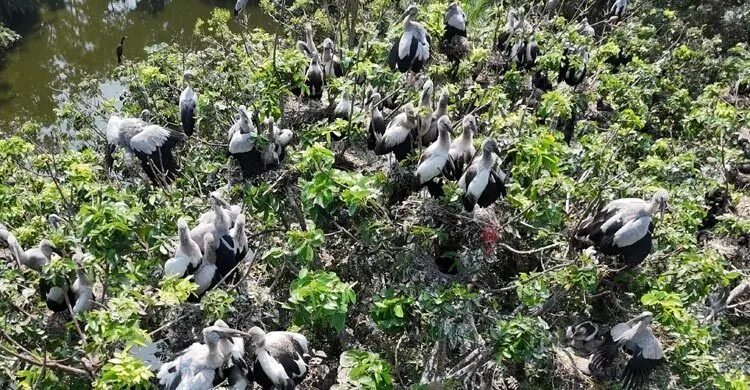
With winter setting in, Shibrampur village in Rajbari Sadar upazila is ringing with the calls of migratory birds. The birds are light grey, with long legs and bills, and their wingbeats and chatter have brought the whole area to life.
Thousands of large, grey-feathered open-billed storks (openbills) have built nests high in the trees of the Kar family's garden and started breeding.
The birds' arrival has excited the garden owners and nature lovers. Every day many people come from far away to see the birds and their home, and many photograph them. There are complaints, however, that some unscrupulous people are trying to hunt or disturb the birds.
The garden owners and local people say the safety of these guest birds is now urgent for the balance of the environment, and want the Kar family garden to become a safe refuge, a sanctuary, with the help of the administration and everyone else.
Nests full of eggs and chicks
As in other years, thousands of migratory birds have flown to the Kar garden in search of warmth and food. The birds first came here about seven to eight months ago, and their numbers are still growing. Almost every nest holds eggs or chicks. Their main food is snails. Each morning the birds go to nearby wetlands, beels and ponds to feed and return to the nests with food in the afternoon or evening. Meanwhile other birds guard the eggs and chicks.
Rather than being annoyed by the noise, the Kar household is working to keep the birds safe, with the help of local people. Visitors of all ages, children included, crowd into the garden every day to see the birds and capture the moment on camera.
Local resident Akash Kar said many more guest birds had come this year than last, "about 10,000 to 15,000". "We love seeing them. Many people come from outside to see them and take photos. We are always on watch so no one can hunt them. But the government and administration must take steps. Birds have nested in every tree in the garden, and every nest has eggs and chicks."
Mojibar Sheikh said: "Many more birds have come than last year. Many people come to kill them but we don't let them. We guard the birds day and night. They go looking for food in the morning and come back before evening with food and twigs for their nests. I want the birds to stay here."
Visitor Hamidul Farabi said he had come from Pangsha after hearing about the birds. "I hear many people come here wanting to hunt them. I want the government to take proper steps to protect them, because these birds keep our environment in balance."
Owners ask for government protection
Garden owners Mukul Kar and Rupa Kar said thousands of birds had been nesting around their pond for about eight to nine months, and many more had come this year than last. "We love their chatter, and many people come with cameras and drones to see them. Others come to kill them, and when we stop them there are quarrels. Still, we are trying to protect the birds."
They said almost every nest has eggs and chicks. "Mischievous youngsters come with air guns and try to kill the birds and chicks and take them away. We have been stopping them for several months and have told the forest department. My demand is that the government protects these birds."
Liton Chakraborty, a journalist and bird lover, said he works on biodiversity through his "Aram Ghar". "I have heard that birds are falling from the tall trees there and getting hurt, and some people take them away or eat them. If anyone finds a sick bird and gives it to us, we can nurse it back to health through Aram Ghar and release it into nature through the administration."
Mir Sayedur Rahman, officer in charge of the Rajbari Social Forestry and Training Centre, said the birds are under regular watch and patrols are being run so that no wrongdoer can harm them. A staff member from his office is on duty there every day from the afternoon until 9pm. The district administration and divisional forest officials have been informed, and loudspeaker announcements and signboards are planned in the area to raise awareness.
Source: Jagonews24. First published in Bengali on The Agro News.


Comments
(0)