
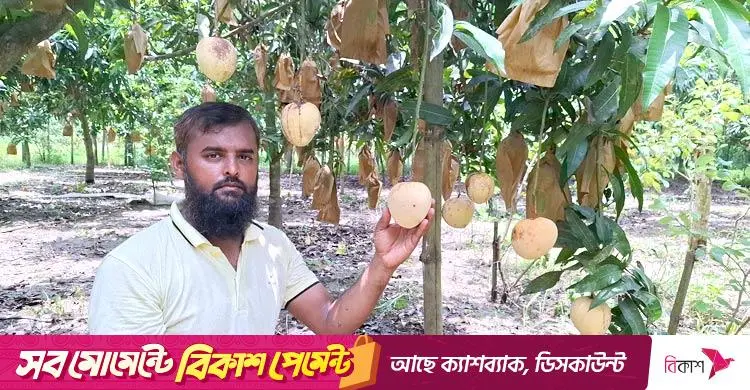
Like many other graduates, Enamul Haque Sajib, a young man from Bhimnagar village in Baliakandi, Rajbari, began looking for a job after finishing his honours and master's degrees. After trying for a long time without success, he decided to grow completely poison-free mangoes using the fruit bagging method. With his mother's advice and help from the upazila agriculture extension office, he is now a successful entrepreneur delivering poison-free mangoes to consumers.
His orchard now has several mango varieties, including BARI 4, Banana, Haribhanga, Kathimon, Nawab Pochondo and Mallika. Because the fruit is completely poison-free and safe, Sajib sells all his mangoes from the orchard at prices above the market.
From losses to profit
About five years ago he planted an orchard of about 350 trees on four bighas of land not far from his house. The trees fruited after a year, but fruit fly attacks and the heavy cost of pesticides left him facing losses. Later, with advice and training from the upazila agriculture extension office, he began growing mangoes by fruit bagging, and this time the young entrepreneur made a profit.
Using fruit bags increases the weight of the fruit, and the mangoes look good and taste sweet. Being poison-free, they are in strong demand locally. As a result, mangoes from Sajib's orchard are selling at the orchard for Tk 10 to 20 a kg more than the market rate.
On another four bighas next to it, he grows mixed oranges, maltas and jujubes, all by modern methods. Seeing his success, many others are becoming interested in growing fruit by bagging.
Baliakandi in Rajbari is known for fruit as well as onions, jute and other crops. Entrepreneurs are now planting orchards to produce poison-free fruit. Among them is young entrepreneur Enamul Haque Sajib, who was the first in Baliakandi, Rajbari district, to start growing mangoes commercially by fruit bagging.
The bags protect the fruit from fruit flies and other pests and diseases and improve the yield. If more fruit is grown this way, safe, good fruit could be available all year round. If used and stored properly, the bags can be reused for two to three years.
What buyers and the grower say
A local buyer said the mangoes and other fruit on the market are often there several months before or after the season, which is very harmful to everyone's health because they contain chemicals. "It is good to see Enamul Haque Sajib growing mangoes by the fruit bagging method. These mangoes show no sign or mark of fruit fly attack and they are very large," he said.
"The mangoes look very good, and we have tasted them; they are very sweet. Because they are poison-free and good, we buy them from the orchard even at a slightly higher price. If all farmers in the country grew fruit this way, we would get poison-free fruit all year. So in future we will also try to plant this kind of orchard," he said.
Orchard owner Enamul Haque Sajib said: "After finishing my studies and failing to find a job, I planted a mixed fruit orchard on eight bighas on my mother's advice. Mango is the main crop. My orchard has several varieties, including BARI 4, Himsagar, Katimon, Haribhanga and Mallika. At first, because I did not use fruit bags, I was suffering losses from fruit flies and other causes. Later, through the agriculture office's training programmes and officers, I learned about fruit bagging, and with their encouragement I started using the method four years ago."
He added: "Now there is no fruit fly attack on the mangoes. The bags are put on once a mango weighs 100 grams, and after that no pesticide is needed. That is why the mangoes look good and grow large, with no marks on the skin. Because they are poison-free, good-looking and tasty, there is great demand for my mangoes, and buyers pay more than the market price to take them from the orchard. I have succeeded with this orchard."
Agriculture office backing
Baliakandi Upazila Agriculture Officer Md Rafiqul Islam said this is the first time fruit is being grown commercially by fruit bagging in Baliakandi. Bagging protects the fruit from fruit flies and is very important for producing safe, environment-friendly fruit, he said, and fruit grown this way can also be exported. The colour of the fruit improves, its size and shape increase, and farmers profit. "So we are encouraging farmers to plant such orchards to produce safe, poison-free fruit, and the upazila agriculture office will help such growers with all kinds of advice," he said.
Source: Jagonews24. First published in Bengali on The Agro News.
Comments
(0)