
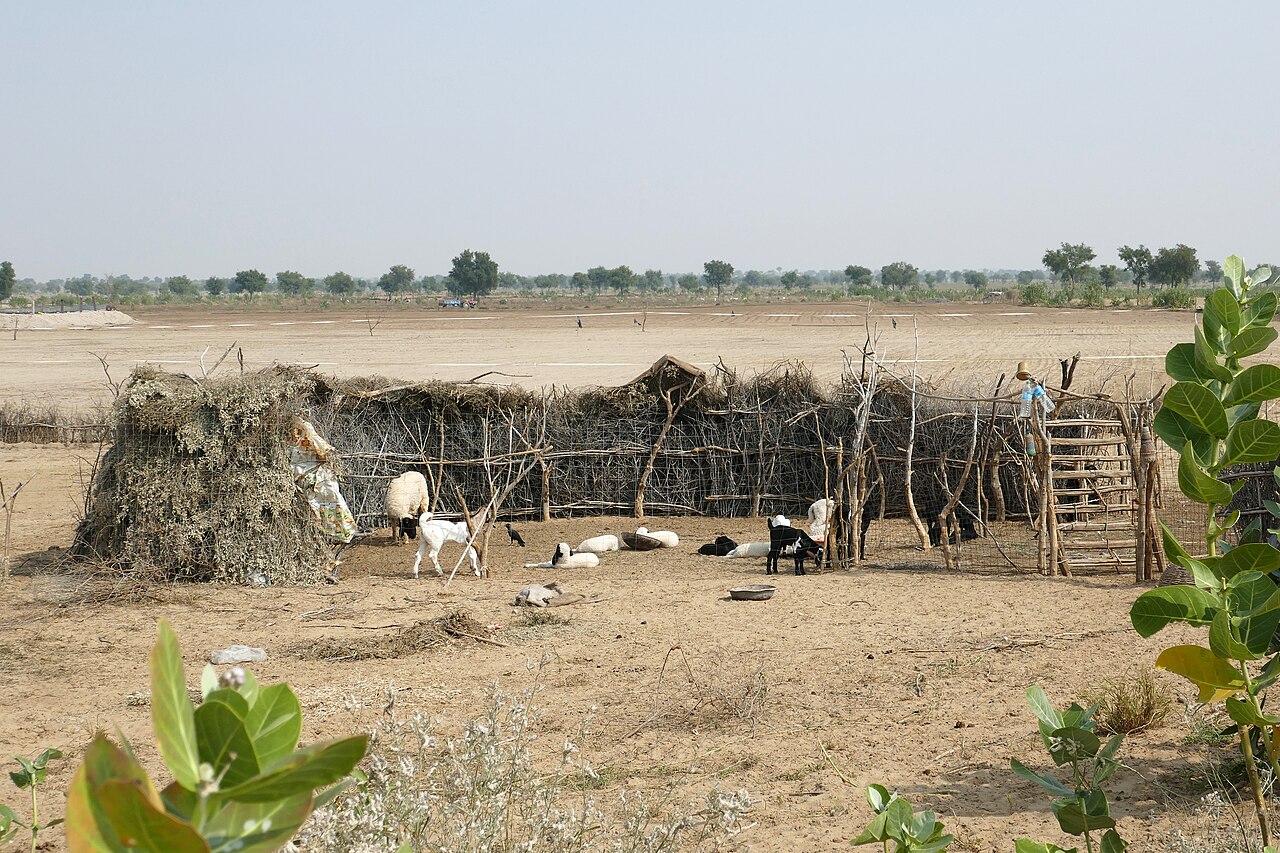
Chatar Singh Jam farms about 100 bighas in Jaisalmer, western Rajasthan, and every kharif season grows cluster beans, moth beans, millet and kacharia, which feed his family and his animals. This year he could sow nothing. "All the fields are empty," he told Down To Earth's Raju Sajwan. Even the khadin, the traditional system that holds rainwater in fields for the rabi crop, has failed because there is not enough moisture.
The India Meteorological Department's figures show Rajasthan received 340.2 mm of monsoon rain from 1 June to 30 September against a normal 435.6 mm, a 22 percent deficit. Western Rajasthan got 198.8 mm against 283.6 mm, 30 percent short. Jaisalmer received 89.1 mm against 176.9 mm, half its normal; Jalore was 59 percent short and Pali 54 percent. October has brought almost nothing: Barmer, Jalore, Nagaur and Pali had no rain from 1 to 23 October, and Jaisalmer and Jodhpur just 0.3 mm each.
Crops and livestock are tied together in the region, because millet and moth bean fields also provide fodder. Jam says fodder has risen from Rs 6-7 a kilo to Rs 15-16. He estimates herders have sold about 20 percent of their sheep and goats so far, at Rs 4,000-5,000 for animals that used to fetch Rs 8,000-10,000, and fears that by the next monsoon in July 2027 the figure could reach 60 percent; this is his local estimate, not an official one. The 2019 livestock census counted 56.8 million animals in the state, with Barmer alone holding about 5.09 million.
Water storage is falling. Of Rajasthan's 693 dams, 216 are completely empty, 378 partly filled and 99 full, the state Water Resources Department says. On 8 October the dams held 61.80 percent of capacity, against 90.38 percent a year earlier, and the 117 dams of the Jodhpur zone held just 15.72 percent, against 80.25 percent last year.
The state government has not declared a drought, which requires an assessment of sowing, soil moisture and water availability as well as rainfall. Opposition parties are demanding a declaration, as Maharashtra and Andhra Pradesh have made.
Photo: Ji-Elle (a goat pen in the Thar desert, Rajasthan) / Wikimedia Commons (CC BY-SA 4.0)
Source: Down To Earth

Comments
(0)