
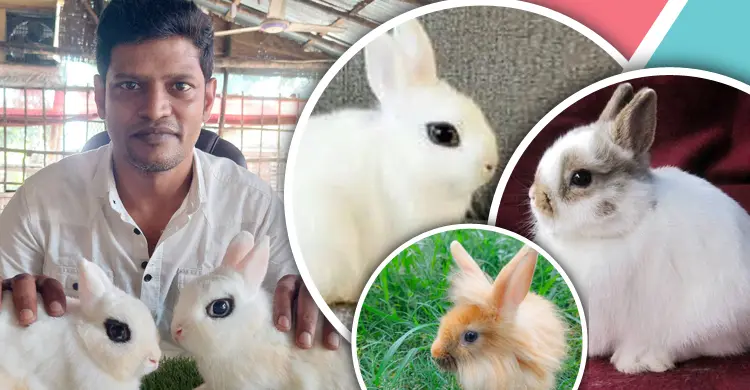
Rabbits are gentle, plant-eating animals that like many kinds of grass. They produce more young than many other animals and can be kept in cages. They suffer few diseases and there is demand for them in the market, so interest in rabbit rearing is growing. Many people are earning money from it as well as enjoying it as a hobby.
Breeds and prices
Fancy breeds are the most popular. In Bangladesh, the Lionhead, Holland Lop, Mini Lop, Lion Lop and Hotot Dwarf are in greatest demand. Giant Angora sells for Tk 6,000-10,000 a pair, Satin Angora Tk 6,000-10,000 a pair, Netherland Dwarf Tk 12,000-14,000 a pair, and Lionhead, Mini Lop, Holland Lop and Lion Lop Tk 24,000-30,000 a pair each.
Feed and space
Grass is the rabbit's main food, given in the morning, at noon, in the afternoon and at night. Rabbits like Napier and Pakchong grass. For every kilogram of body weight, a rabbit should get 50-60 grams of feed, and that feed is cattle feed.
Vegetables are given two days a week and fruit two days a week. Vegetables can include carrot, cucumber, yardlong bean, turnip, cabbage, water spinach and sweet pumpkin; rabbits also eat apple, watermelon and banana. Each rabbit needs at least five square feet of space. On average a rabbit costs Tk 500-700 a month to keep.
Breeding
Rabbits can usually breed at five to six months of age; males need at least seven months. Five to seven months is the best time to start breeding. Kits are born 28-35 days after mating. They usually suckle for 45-55 days, but start learning to eat other food alongside their mother from 18-20 days old. Kits should not be separated from the mother before they are two months old.
Each breeding produces 10 kits on average. Kindling more than three times a year can cause problems: the kits are weak, milk production falls and the mother's health deteriorates.
Health and licensing
Rabbits need a clean place. Kept in damp or dirty conditions, they get a disease called mites, which can eventually kill them. Other common problems include colds, which damp conditions can cause and which can be cured with medicine, and diarrhoea, which is likely when they are given too much grain feed or vegetables.
Treatment for rabbits is easily available in Bangladesh. Anyone who wishes can rear rabbits commercially, but needs a trade licence. There are no restrictions on rabbit rearing in Bangladesh, and it comes under Bangladesh livestock.
Toha Ahmed has been rearing fancy rabbits for a long time and has more than a hundred on his farm. His advice to new keepers is to have a clean place, a supply of grass and clean drinking water, and to give each rabbit at least five square feet of space.
Where to buy
In Dhaka, rabbits are sold at Kataban, Mirpur, Kaptan Bazar and various pet bird and aquarium shops. Outside Dhaka they are available at Tongi market in Gazipur and at Muktagachha in Mymensingh, as well as in Chattogram, Sylhet, Savar, Narayanganj, Bogura, Pabna, Netrokona and other divisional and district towns.
Some interesting facts
Rabbits can be very good companions. Given freedom and the chance, they readily show their personality. Now and then they leap and shake their heads and feet; this is how they show joy, and it is known among rabbit keepers as a "binky". A female rabbit is called a "doe" and a male a "buck".
A rabbit's large ears are not only for hearing; they also help control body temperature. When it is hot, the blood vessels in the ears swell; when it is cold, they contract. Though they seem quiet, rabbits can make sounds. They are also excellent jumpers, able to leap 3 feet high and 10 feet long. Their eyes are on the sides of the head, so they can see an almost perfect 360 degrees, which helps them spot predators.
Most rabbits have a "sweet tooth" and like fruit. A rabbit named Ralph, weighing 55 pounds, eats $90 worth of food a week and has made it into the Guinness book. The average lifespan of a rabbit is 7 to 10 years, but the oldest rabbit lived to 17.
When a rabbit crouches low and makes itself small and stiff, it is showing submission. Rabbits are very calm, but there is nothing to fear from a bite or a scratch; an antiseptic cream, Dettol or Savlon is enough.
The writer, Muhammad Shafiqur Rahman, is an assistant manager, sales operations, at Fair Distribution Limited.
Source: Jagonews24. First published in Bengali on The Agro News.

Comments
(0)