
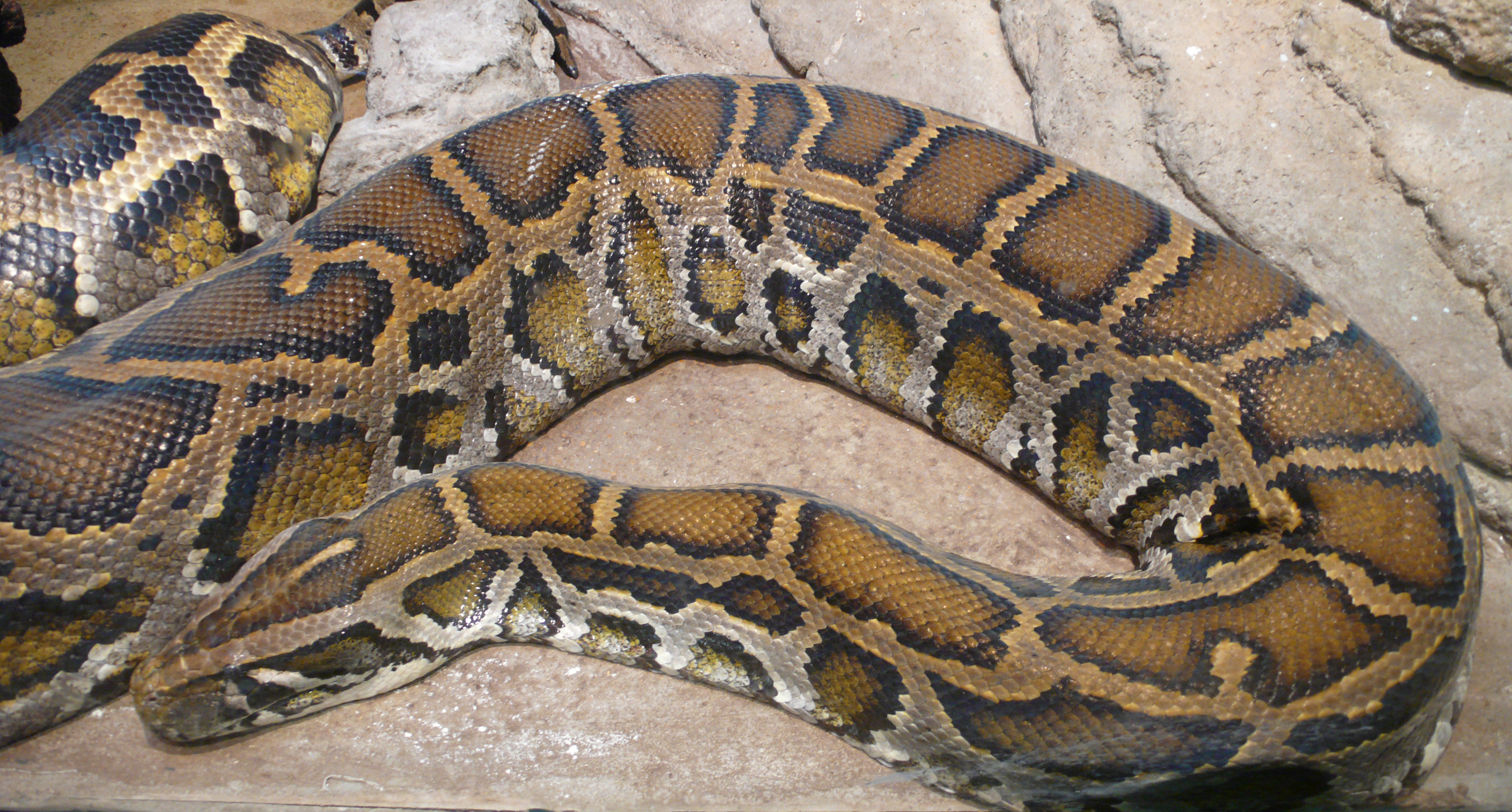
A python that local people estimated at about 10 feet long was found coiled around a rack in the kitchen of a house in Sitakunda upazila of Chattogram on Friday, 15 November 2024. Members of the household cried out when they saw it and neighbours gathered. Volunteers from a local organisation called Jubo Samaj then pulled the snake down, put it in a sack and released it deep in the hills near the house, Jagonews24 reported on 16 November 2024.
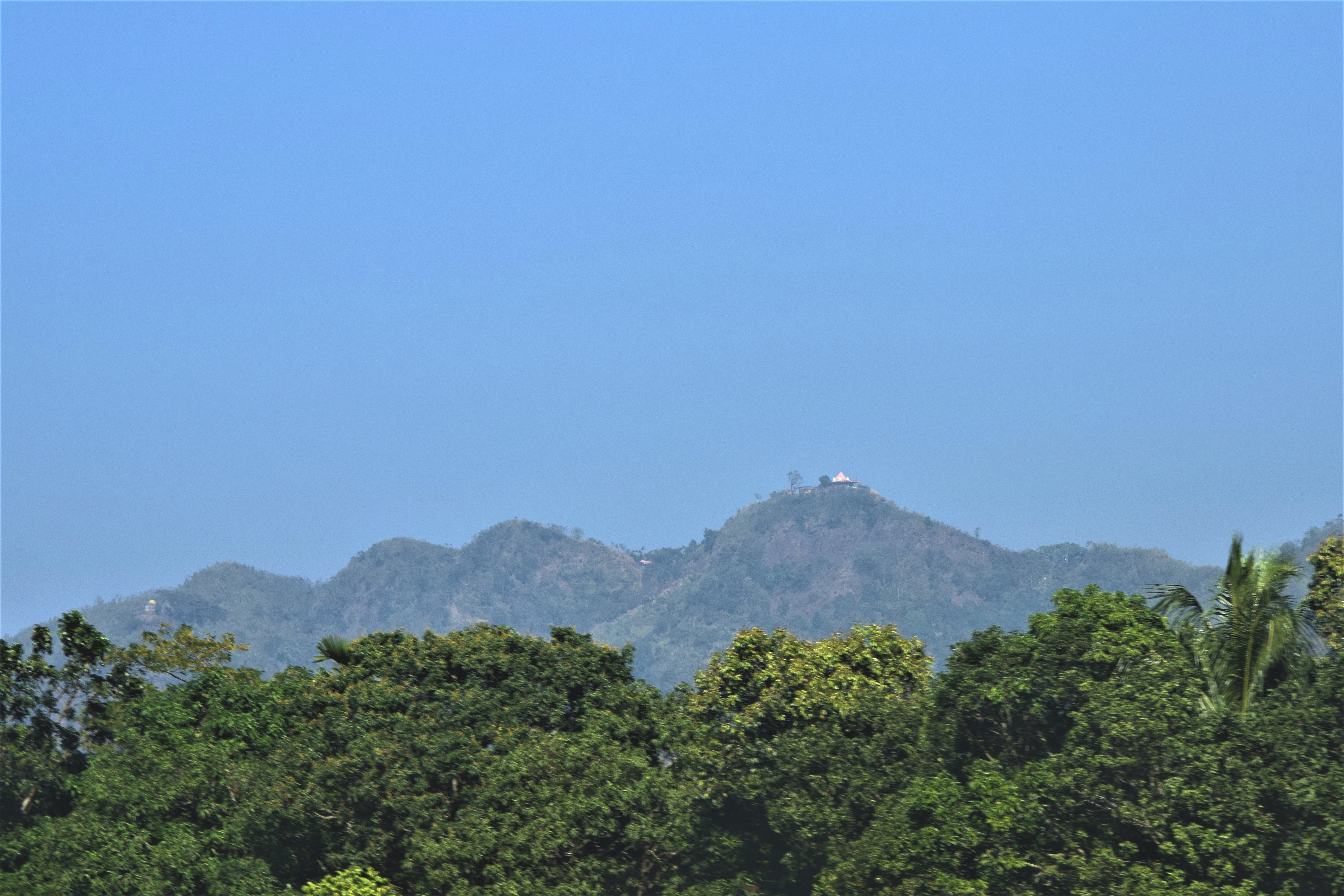
The house is in the East Sonar Para area of Kumira union, and a hillock lies about half a kilometre from it. Local people believed the snake had come down from that hillock into the village in search of food, probably at some time on Thursday night, and had stayed coiled around the kitchen rack until it was seen.
How the snake was found and moved
According to the Jagonews24 report, the python was discovered in the kitchen of a resident named Khalilur Rahman. It had wrapped itself around the kitchen's rack, the wooden or bamboo frame on which household goods are kept in many village kitchens. When family members noticed it and shouted, people from the neighbourhood came to look.
Local resident Ilias Hossain told the paper that a crowd gathered on Friday morning to see the snake, but nobody dared to try to catch it. Residents then called members of Jubo Samaj, a voluntary organisation in the area. A 10-member team led by the organisation's president, Md Saiful Islam, went to the house and pulled the python down from the rack. The team put it in a sack and took it to the depths of the hills close to the house, where it was set free.
The report gave the length only as an estimate by local people, about 10 feet, which is roughly three metres. It did not say which species of python it was, whether the snake was examined for injury, or whether the Forest Department was informed. It reported no injury to any person or to the snake.
Sitakunda, Kumira and the hills above the villages
Sitakunda is an upazila of Chattogram district with an area of 483.96 square kilometres, according to Banglapedia, the national encyclopedia published by the Asiatic Society of Bangladesh. It lies between Mirsharai and Fatikchhari upazilas to the north and Pahartali thana to the south, with Hathazari and Fatikchhari to the east and Sandwip upazila and the Sandwip Channel to the west. Sitakunda thana was formed in 1979 and became an upazila in 1983.
The 2011 population census of the Bangladesh Bureau of Statistics, as quoted by Banglapedia, counted 387,832 people in the upazila. Kumira, the union where the python was found, covers 8,534 acres; the same census counted 20,724 men and 18,172 women there, with a literacy rate of 57.7 percent. Banglapedia lists Kumira Bazar among the upazila's noted markets and the Harmadia Jami Mosque at Kumira among its heritage sites.
The upazila is a narrow strip between the sea and a range of hills. Banglapedia lists its tourist attractions as a long sea beach, a coastal forestry area, the Chandranath temple and hill, and the eco-park and botanical garden. Its main crops are paddy, betel leaf, ginger, turmeric, onion, rubber and vegetables, and its main fruits include mango, jackfruit, papaya, guava, coconut, betel nut, watermelon and pineapple. Banglapedia gives agriculture as the main source of income for 24.12 percent of people, behind services at 28.76 percent.
The hills above the villages carry forest. Banglapedia describes the Sitakunda Botanical Garden and Eco-park as lying in the evergreen Chandranath reserve forest range, and gives the height of Chandranath Hill as 410 metres. This mix of forested hill and settled lowland, with houses built up to the foot of the hills, is the setting in which pythons and people meet in Sitakunda.
Which pythons live in Bangladesh
Pythons are large non-venomous snakes. Banglapedia's entry on the python, written by SM Humayun Kabir, says that two species occur in Bangladesh: the rock python, which it names Python molurus, and the reticulated python. The rock python is the larger and may reach about 5.7 metres. Both live in the mixed evergreen forests of the north-east and south-east of the country, and the rock python is also found in the Sundarbans. The encyclopedia says both have become rare and records the rock python as critically endangered and the reticulated python as endangered in Bangladesh.
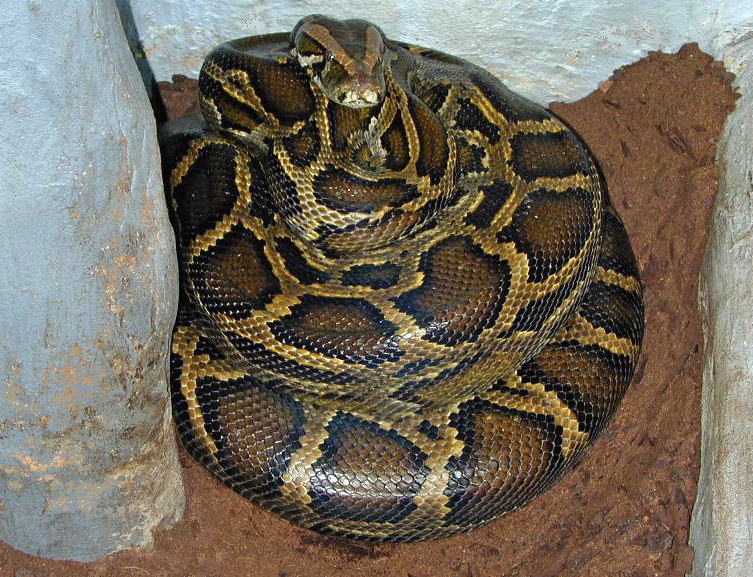
The python of Bangladesh's south-eastern hills is now usually called the Burmese python, Python bivittatus. Smithsonian's National Zoo and Conservation Biology Institute explains that the Burmese python was once treated as a subspecies of the Indian python, Python molurus, and is now recognised by most authorities as a separate species. Reference works list its native range as including southeastern Bangladesh, eastern India, southeastern Nepal, Myanmar, Thailand and other parts of South-East Asia and southern China.
The Burmese python has been listed as Vulnerable on the IUCN Red List since 2012, because its wild population was estimated to have fallen by at least 30 percent in the first decade of this century through habitat loss and over-harvesting. International trade in the species is controlled under Appendix II of CITES, the Convention on International Trade in Endangered Species of Wild Fauna and Flora. The Smithsonian notes that hundreds of thousands of pythons are killed for their skins, which are made into shoes, belts and other goods, and that snakes encountered in the wild are often killed simply because they are snakes.
The Jagonews24 report did not identify the snake in the Sitakunda kitchen. A python about three metres long, found next to the forested hills of south-eastern Bangladesh, fits the size and habitat that these sources describe, but the species was not confirmed in the report.
How pythons live and why they enter homes
According to the Smithsonian, the Burmese python is one of the six largest snakes in the world. Lengths of more than 15 feet (4.6 metres) are common, and the average is between 10 and 16 feet (3 to 4.9 metres); females tend to be larger than males. A snake of about 10 feet, like the one in the Kumira kitchen, is therefore within the normal adult range. The python's body is pale tan, yellowish brown or grey with large dark brown or olive blotches edged in cream or gold.
Pythons are constrictors. They have no fangs and no venom, but many backward-curving teeth that hold prey. Banglapedia says pythons in Bangladesh eat mammals, birds and reptiles, seem to prefer mammals, and take rats, hares, goats, sheep, jackals and deer; the local name ajagar comes from the habit of preying on goats. The snake kills by coiling around its prey until it suffocates, and swallows it whole. The Smithsonian adds that a python does not eat every day: after a successful hunt it may spend days or weeks keeping warm while it digests the meal.
Pythons are also drawn to farms. The Smithsonian notes that domestic fowl and pigs attract Burmese pythons to agricultural settlements, and that pythons spend their mornings soaking up the sun's warmth before they move about to hunt. The World Health Organization's South-East Asia regional guidelines on snakebite, published in 2016, say that snakes may enter houses in search of food or to find hiding places, that livestock kept indoors, especially chickens, are potential prey for larger snakes, and that stored food attracts rodents on which many snakes feed. In the Kumira case, local people believed the python had come down from the hillock looking for food.
Breeding also shapes when pythons are seen. Banglapedia says breeding in Bangladesh starts between December and February and eggs are laid three to four months later, after which the female broods them by coiling around them; she does not look after the young once they hatch. The Smithsonian gives an average clutch of 30 to 60 eggs, sometimes up to 100, and explains that the brooding female warms the eggs by twitching her muscles, raising the temperature inside her coils several degrees above the air. Hatchlings are 31 to 46 centimetres long and must fend for themselves. Burmese pythons become sexually mature at four to five years and live about 20 to 25 years in human care; their lifespan in the wild is not known.
Earlier python rescues in Sitakunda and the zoo's hatchlings
The Kumira kitchen was not the first place in Sitakunda where a python turned up among people. On 12 February 2022, The Daily Star's Bengali edition reported that a python 15 feet long and weighing 22 kilograms had been rescued the previous day, a Friday, from the Madambibirhat area of Bhatiari union in Sitakunda. Quoting a forest officer at Faujdarhat, the report said local people saw the snake and informed the Forest Department, forest officials went to the spot and rescued it, and the snake was released into the forest of the Bhatiari garden. The officer said it might have come into the settlement in search of food.
Sitakunda's forest has also received pythons hatched in captivity. The Daily Star reported on 24 June 2022 that 11 python hatchlings had emerged at Chattogram Zoo from eggs kept for about 65 days in an incubator. The zoo's deputy curator and veterinarian, Shahadat Hossain Shuvo, told the paper that the hatchlings would stay in the incubator for a month and shed their skin after about 15 days before being released into nature. The same report said that on 23 June 2021, 28 hatchlings had emerged from 31 incubated eggs, and that in June 2019 the zoo's incubator had produced 25 python hatchlings, the first time pythons were hatched in an incubator in Bangladesh.
On 20 July 2023, bdnews24.com reported that the zoo had released 16 incubator-born pythons, along with 10 larger snakes rescued from various places, into the Chunati Wildlife Sanctuary in Lohagara upazila. The deputy curator told the news site that 80 pythons had been hatched by artificial means over four years since 2019, and that the 64 hatched in the first three years had been released in the Sitakunda eco-park. The larger snakes were three to 15 years old and had been brought to the zoo injured or seized from traffickers, some of them by members of the public.
In April 2024, bdnews24.com reported that Chattogram Zoo had opened a glass-walled snake corner 60 feet long and 22 feet wide, with room for 14 species. The deputy curator told the site that many people beat non-venomous snakes to death because of misconceptions, while others bring snakes they find, injured or alive, to the zoo, where they are treated and kept.
The Sitakunda Botanical Garden and Eco-park
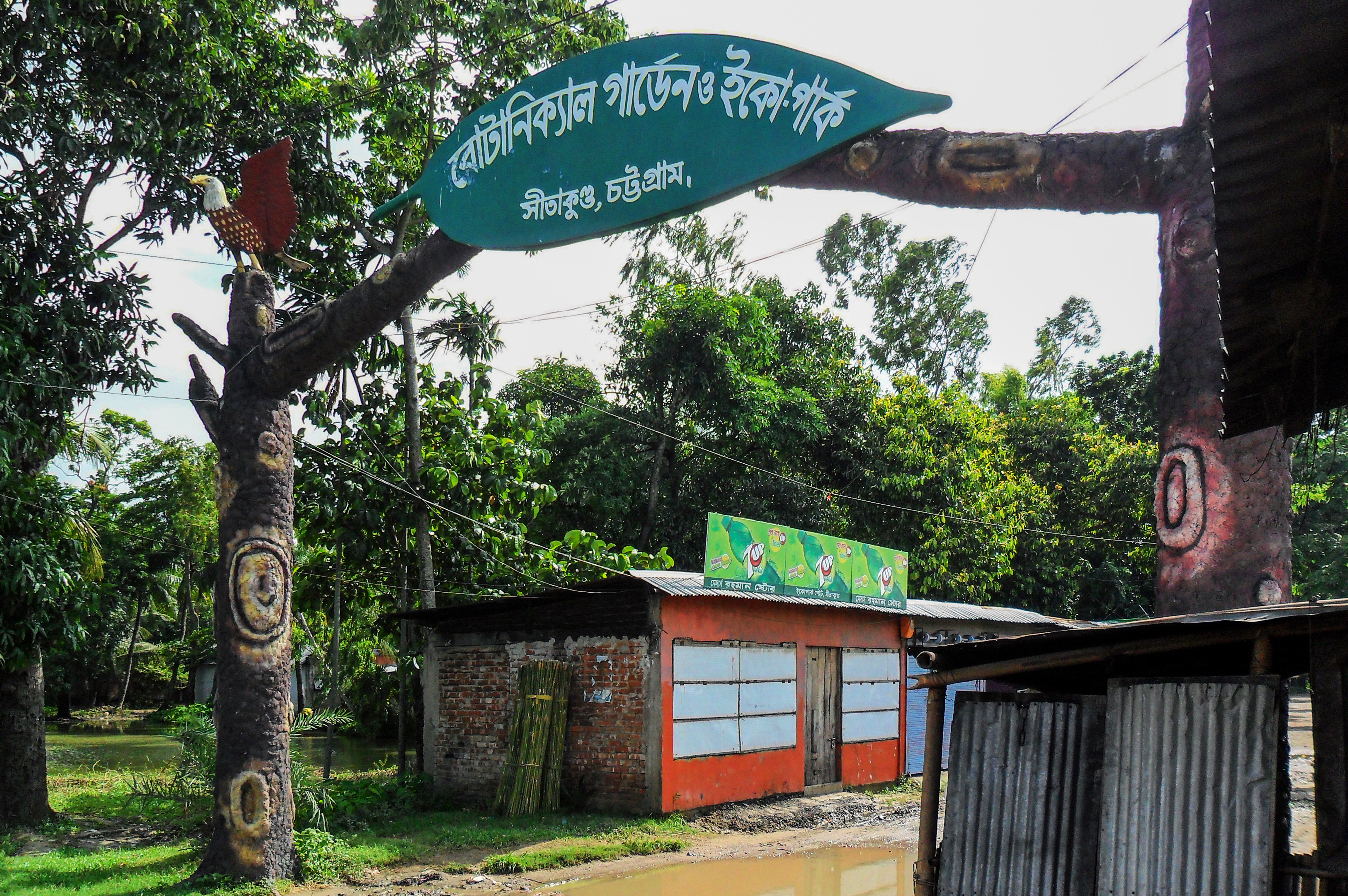
Banglapedia describes an eco-park as a part of a forest brought under intensive management so that visitors can enjoy it without harming its biodiversity. The Forest Department set up nine eco-parks across Bangladesh, and the one at Sitakunda is the oldest. It was set up on 808 hectares in 1999 in the evergreen Chandranath reserve forest range. The Chandranath temple stands on top of Chandranath Hill, about five kilometres from the park's main gate, and pilgrims climb some 1,600 steps to reach it.
The encyclopedia says the park holds 154 species of plants, including fruit trees, timber trees and medicinal plants, and is significant for a rare cycad. It has an observation tower, a picnic spot, an orchid house, a cactus house, a rose garden, an orchard of seasonal fruits and a large pond of water lilies, and is home to various wild animals and birds. The stated purposes of the eco-parks include protecting rare plants and animals, conserving the existing flora and fauna, protecting the environment, supporting the local economy and creating opportunities for study and research.
Banglapedia puts the country's forest land at 2.52 million hectares, 17.08 percent of its area, of which the Forest Department administers 1.52 million hectares, or 10.6 percent of the country. The Sitakunda park lies in the same upazila as Kumira and Bhatiari, where the pythons described in this report were found.
What the wildlife law says
In November 2024 wild animals in Bangladesh were protected by the Wildlife (Conservation and Security) Act 2012, Act No. 30 of 2012, dated 10 July 2012. The Act defines hunting broadly: it includes killing, catching or poisoning a wild animal, or any attempt to do so; chasing a wild animal for any of these purposes; and injuring or harming a wild animal, taking any part of it, or collecting or destroying the nests or eggs of wild birds or reptiles.
Section 6(1) of the Act says that no person may hunt any wild animal without a licence or, as the case may be, a permit issued under the Act. Under section 39, a person who breaks section 6 commits an offence punishable with imprisonment of up to one year, a fine of up to 50,000 taka, or both; for a repeat offence the maximum rises to two years in prison, a fine of up to one lakh taka, or both.
Officials have also described the law's approach to rescued animals. In the July 2023 bdnews24.com report on the Chunati release, Chattogram's wildlife and biodiversity conservation officer said the Act has a provision for releasing rescued wildlife into a safe habitat, and that the Chunati sanctuary, with 7,764 hectares and five types of forest, had been chosen for that reason. In the February 2022 Bhatiari case, the Daily Star report said local people called the Forest Department, whose officials rescued and released the python.
Snakes in the house: what the World Health Organization advises
Pythons are not venomous, and Banglapedia says more than three-quarters of Bangladesh's roughly 90 snake species are non-venomous, while fewer than half a dozen land snakes are highly venomous. The WHO guidelines nevertheless warn that large pythons occasionally attack people, and that bites by non-venomous snakes may be mistaken for venomous ones, leading to unnecessary treatment. Their advice for households is general and applies to any snake found in or near a home:
- Never handle, threaten or attack a snake, and never intentionally trap or corner a snake in an enclosed space; snakes prefer to avoid large animals such as humans, so give them every opportunity to escape.
- In many parts of the region dedicated snake catchers remove snakes found in houses and gardens; keep young children away from areas where snakes are known to be.
- Do not keep livestock, especially chickens, inside the house, and store food in rodent-proof containers, because both draw snakes in search of prey.
- Check houses regularly for snakes and, where possible, avoid building features that give them hiding places, such as open eaves, cracked mud walls and unsealed spaces under floors.
- Clear termite mounds, rubbish and building materials from near the house, keep grass short, and do not let tree branches touch the house.
- Use a light when walking outside at night, and sleep under a well-tucked-in mosquito net, ideally on a raised bed.
The guidelines add that no chemical has been found that repels snakes without being toxic enough to threaten children and domestic animals. If someone is bitten, WHO advises against trying to kill the snake, because this can be dangerous, and says that traditional first aid such as cutting the wound, sucking out venom, tying tight bands, snake stones, herbs or ice does more harm than good. The victim should be reassured and taken to a hospital or health centre without delay.
Snakebite in Bangladesh in figures
Snakes are a public health matter in rural Bangladesh even though the python itself is not venomous. On 18 June 2023, The Daily Star reported findings of a study by the Non-Communicable Disease Control unit of the Directorate General of Health Services: about 403,000 people are bitten by snakes in Bangladesh each year and 7,511 of them die. About a quarter of all bites were by venomous snakes, 95 percent of victims lived in rural areas, and men were at higher risk than women. The report noted that no antivenom was produced in the country.
Earlier surveys, summarised in the 2016 WHO South-East Asia guidelines, gave different numbers. A government and World Bank funded survey in 2009 estimated that 589,919 people were bitten and 6,041 died of snakebite every year in rural Bangladesh. A postal survey published in 1995 suggested 4.3 bites per 100,000 people a year nationally, rising to 7 per 100,000 in areas such as Chittagong Division. The guidelines also recorded that most victims were treated first by traditional healers.
Worldwide, the WHO fact sheet of 12 September 2023 estimated 5.4 million snakebites a year, 1.8 to 2.7 million of them causing envenoming, and 81,410 to 137,880 deaths, with about three times as many amputations and other permanent disabilities. Up to 2 million people in Asia are envenomed each year, and agricultural workers and children are the most affected. WHO listed snakebite envenoming as a highest-priority neglected tropical disease in June 2017 and set a goal of halving deaths and disability from snakebite by 2030.
Snakes also do farmers a service. Banglapedia notes that several non-venomous species that live near homes help control rats and mice, and the Smithsonian describes snakes as essential rodent controllers without which many crops are destroyed by mice. A python that strays into a kitchen from the hills, like the one in Kumira, is part of that wild fauna, protected by law and listed as threatened.
Photo: TimVickers / Wikimedia Commons (Public domain)
Sources: Jagonews24, Banglapedia (Asiatic Society of Bangladesh), Bangladesh Bureau of Statistics (Population Census 2011), Smithsonian's National Zoo and Conservation Biology Institute, IUCN Red List, CITES, Wildlife (Conservation and Security) Act 2012 (Laws of Bangladesh), The Daily Star, bdnews24.com, World Health Organization (Guidelines for the management of snakebites, 2016; snakebite envenoming fact sheet, 2023), Directorate General of Health Services

Comments
(0)