
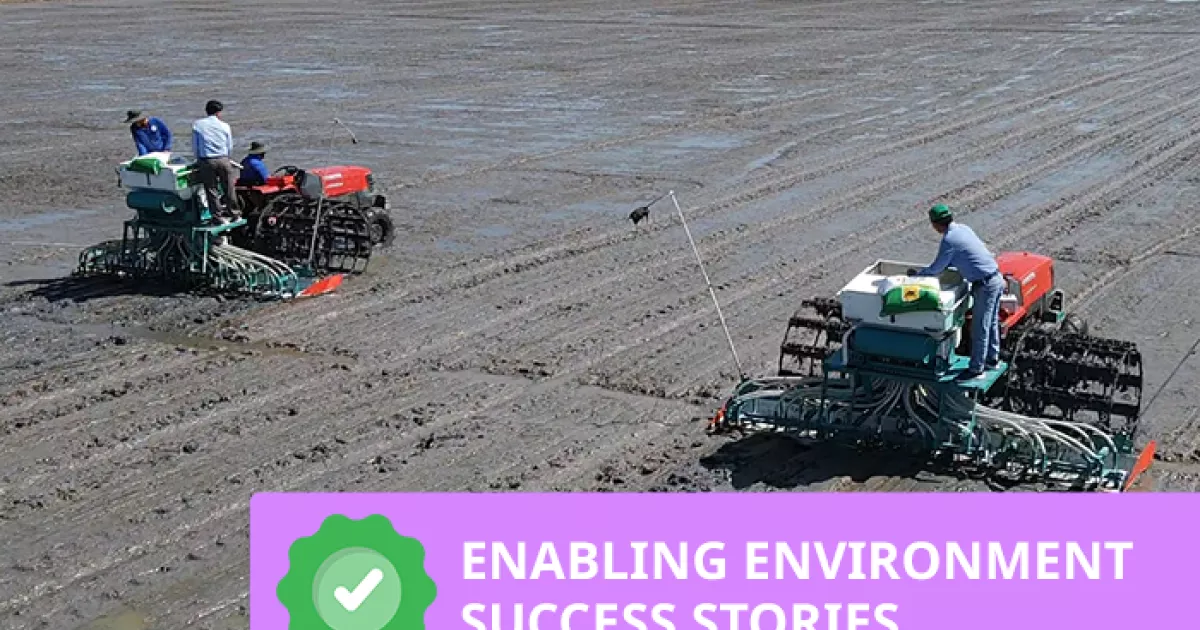
Vietnam has given national technical certification to a rice establishment method that places the seed and the fertiliser at different depths in a single pass, after pilots across eight provinces of the Mekong River Delta cut seeding rates by as much as 65 per cent.
The package, developed by the International Rice Research Institute (IRRI), combines mechanised direct seeded rice with fertiliser deep placement. A dynamic air-assisted seeder drops each seed 1 to 2 millimetres below the soil surface while depositing fertiliser 3 to 4 centimetres down. Putting the nutrient below the seed rather than on the surface improves uptake, encourages root growth and leaves the crop less prone to lodging.
The Mekong Delta has farmed rice for generations on broadcast seeding, heavy chemical use and hand labour. Rising input costs and a changing climate have made that harder to sustain, and the government's flagship programme for One Million Hectares of High-Quality, Low-Emission Rice by 2030 gave IRRI a policy frame to scale into.
The obstacles were cost and knowledge. Specialised seeders are beyond an individual smallholder, so IRRI worked through agricultural cooperatives, which share the capital and running costs, and with machinery manufacturers and local government. Field demonstrations, baseline surveys and training programmes were used to show the economics rather than assert them, and IRRI helped the Ministry of Agriculture and Environment draft the technical guidelines that led to certification.
The pilot results are substantial. Alongside the two-thirds cut in seed, nitrogen fertiliser use fell by up to 43 per cent and pesticide applications dropped. Yields rose by up to 15 per cent, and participating cooperatives saw net profits rise by between 26 and 79 per cent.
The work has since moved north to the Red River Delta, where pilot sites in Hai Phong, Ninh Binh and Hung Yen recorded sharp profit gains against conventional practice. Through June 2026 hundreds of farmers had completed the technical training.
Bangladesh's own rice fields face the same three pressures — expensive labour, expensive urea and pressure to cut emissions from flooded paddy. Deep placement of urea is already promoted here in guti form; the Vietnamese case shows what happens when the placement is mechanised and the state certifies it.
Source: CGIAR
Comments
(0)