
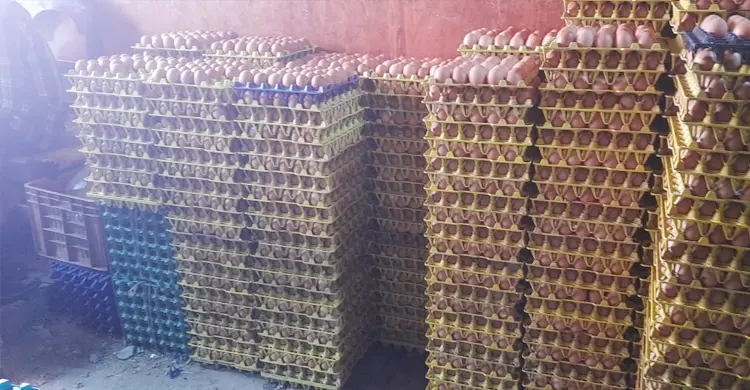
Bangladesh's demand for eggs is now four and a half crore a year and production is nearly 5 crore, yet a syndicate wants to import eggs by showing a shortage. The push to import eggs is aimed at laundering money.
Sumon Howlader, president of the Bangladesh Poultry Association (BPA), said this at a press conference at the Dhaka Reporters Unity (DRU) on Tuesday.
The farmers' organisation put a seven-point list of demands to the government to keep the country's marginal farmers in business, including not giving this group permission to import eggs.
The demands
The demands listed were:
- protect the poultry sector from dishonest syndicates;
- do not allow egg imports;
- cut prices by raising government subsidies on feed and other facilities;
- set fair prices in line with production costs by drawing up a poultry policy and forming a poultry board;
- bring all farmers under registration;
- provide bank loans on easy terms and incentives for farmers who have suffered losses.
Sumon Howlader said the poultry industry was under serious threat, yet some anti-national importers had applied to import eggs and would do so as soon as the government gave permission. "We consider it another conspiracy to destroy the poultry industry," he said.
"Save the marginal farmers"
"The demand for eggs in Bangladesh is four and a half crore, and we are producing nearly 5 crore," he said. "Those who still talk of an egg shortage are out to swindle. Because demand in the market is low, farmers in our country cannot sell their eggs and chickens. Those who still talk of an egg and chicken shortage want to destroy the country's marginal farmers and pocket crores of taka through a syndicate. Our appeal to the Prime Minister is: stop egg imports and save the marginal farmers."
The association also alleged that a handful of corporate companies, luring marginal farmers in the name of contract farming and cheating them by taking stamped papers and cheques from them, had siphoned off thousands of crores of taka a year.
Source: Jagonews24. First published in Bengali on The Agro News.

Comments
(0)