
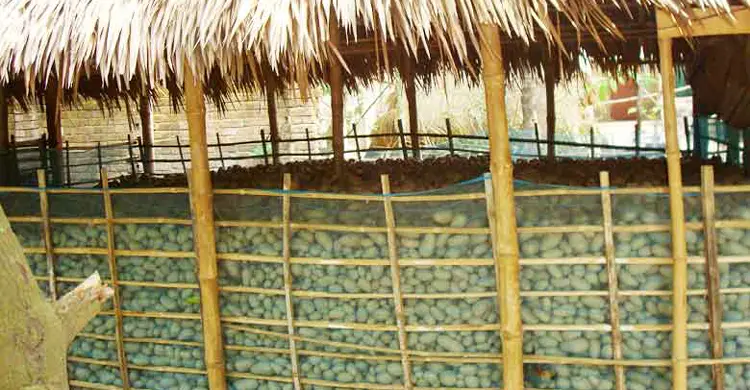
The Department of Agricultural Marketing (DAM) is considering building model houses of bamboo, wood, tin, brick masonry and RCC pillars on high, open and partly shaded spots of farmers' homesteads to store potatoes. It has proposed a project titled 'Diversified Use, Storage and Marketing Development of Potato' for this. A pilot programme on the subject was carried out a few years ago, and the department now wants to build such model houses on a wider scale.
But the proposal contains no research on how much farmers would benefit from the storage houses, how they would affect local markets, or whether they would affect potato prices. No study has been done on how long a bamboo house would last or what its economic return would be. Nothing is said about the fear that potatoes stored in tin houses may rot in excess heat. Above all, there is nothing to dispel doubts about whether building storage houses on individual farmers' land would cause disputes among growers.
Planning Commission's objections
Because the project was proposed without research or a study, the Planning Commission has questioned whether it can be implemented. These questions were raised at a recent meeting of the Project Evaluation Committee (PEC) at the Ministry of Planning, chaired by Ramendra Nath Biswas, member (secretary) of the Agriculture, Water Resources and Rural Institutions Division.
At the meeting the Planning Commission said the project states that model potato storage houses will be built on high, open and partly shaded spots of farmers' homesteads. It is proven that these proposed storage houses are not scientific, because houses built of tin heat up, so potatoes risk rotting.
The commission's meeting said the overall matters were poorly presented in the project document, proposed for implementation by June 2025 at a cost of Tk 42.76 crore, and that the project had not been properly prepared.
DAM did, however, build potato storage houses in 40 upazilas of 11 districts in 2015-18 through a programme on homestead potato storage, processing and marketing. The ministry monitored it after it ended, and the monitoring report recommended that such houses could be built in Rangpur and other potato-growing regions of the country. The houses built in 2018 are still usable.
Under the new project, 450 model houses are proposed in 76 upazilas of 17 districts in seven regions of the country. The Planning Commission believes it is essential to consider whether building a house on one person's land would cause disputes with other farmers storing potatoes. It said DAM could carry out research or a study on whether storing potatoes on racks at household level is profitable, whether the nutritional value of potatoes stored this way is kept intact, and what effect it would have on market prices.
What the department says
At the meeting DAM told the Planning Commission that the farmers on whose land the model houses will be built have already identified high, shaded spots in their yards and given written consent. Research on the durability of the houses has been done through the Bangladesh Agricultural Research Institute (BARI), and the houses built through the programme in Rangpur division are still usable.
Planning Commission member (secretary) Ramendra Nath Biswas said the proposal did not properly reflect how the project activities would be carried out, as there was no study or survey behind it. Nor does the proposal contain any research on how much potato farmers benefited from the 40 storage houses built under the earlier programme, what effect they had on local markets, or whether they affected potato prices.
The Implementation Monitoring and Evaluation Division (IMED) of the Ministry of Planning, the government's only project monitoring body, has also questioned the proposed project. IMED said the project states the model houses would be built on private land, but it is not clear whether the landowner will donate the land. If not, building a house with government money on one person's land could cause conflict among local people.
When the project is fully implemented, the landowner may end up using the house alone and give others no chance, it said. There is no research data on whether land will be found for the 450 proposed model houses or on how durable they will be. The project's activities and implementation process are not realistic, IMED said.
However, Md Anwarul Haque, deputy director (Rangpur division) of DAM, told Jagonews that the project was taken up to spread the technology. "We will build some potato stores. We will build special bamboo walls, and put cork sheets under the tin so the stores do not heat up."
On the risk of disputes among farmers, Anwarul Haque said the person at whose home a house is built will have to be given some facilities. A house will last 15 to 20 years and can store only 30 tonnes of potatoes. "It is only a model. Other farmers will be encouraged by seeing them. Farmers will benefit once the houses are built," he said.
Surplus potatoes rotting
People involved with the project's objectives said there is demand for potatoes in the country and potatoes are being produced, but for lack of proper storage, potatoes of the desired quality cannot be supplied to the market. That is why the project was proposed. In the last fiscal year (2019-20) the country produced 10.917 million tonnes of potatoes. By the department's estimate, annual demand is only 7.7 million tonnes. Cold stores can hold 2.8 to 3 million tonnes, and the rest rots.
The project's stated aim is therefore to help potato farmers get fair prices by improving household-level storage and to raise domestic demand by increasing diversified use of potatoes, strengthening the government's poverty reduction efforts through sustainable marketing.
Its specific objectives are to improve the socio-economic condition of potato farmers by forming 450 farmer marketing groups of 30 people each, one around each model house, and building their marketing capacity; to train 18,900 farmers, agribusiness people, agri-entrepreneurs and processors to increase diversified use of potatoes; and to link the 450 farmer marketing groups with exporters and processors to help them get fair prices.
The main activities in the proposal are forming farmer marketing groups in 450 batches, and training a total of 18,900 people in 120 batches of entrepreneurship development training and 80 batches of export-support training for farmers, agribusiness people and agri-entrepreneurs, plus 16 batches of training of trainers (TOT). There will also be 8 batches of motivational tours, 450 model storage houses, and 22,950 cubic metres of earth filling for land development for the model houses.
Building extension questioned
The project also includes a 3,500 sq ft vertical extension adding a fifth floor to the Rangpur agricultural marketing building, 1,400 sq ft of repair and renovation of the building (up to the fourth floor), and 11 regional seminars and workshops.
A representative of the Planning Commission's Programming Division told the meeting that space had been kept under the construction head for the fifth-floor extension (3,500 sq ft) of the Rangpur building. It needs to be known how necessary extending the building from four to five floors is, and whether DAM has the capacity to run such a project must also be considered.
A DAM representative said machinery is installed on the first floor of the existing four-storey building, the second and third floors are used for office work and the fourth floor as dormitory rooms. The main purpose of extending it to a fifth floor is to create training facilities in the building.
Source: Jagonews24. First published in Bengali on The Agro News.


Comments
(0)