
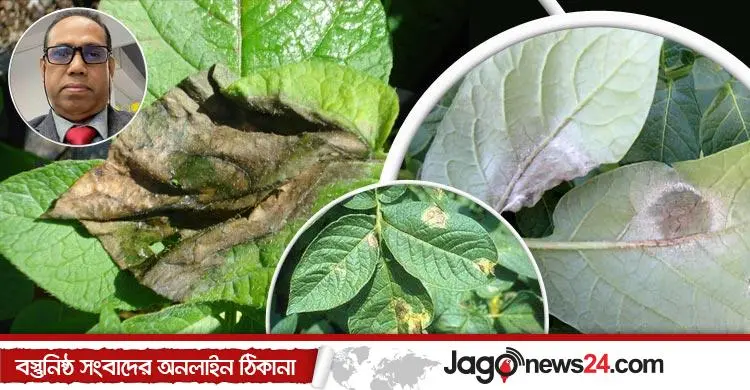
Potato late blight (known in Bengali as morok or nabi dhosa) is caused by a fungal attack. It first surrounds parts of the leaves, shoot tips and stems. When relative humidity is high, most of the crop in a field can be infected within 2-3 days. In the early morning, a white powder-like fungus can be seen on the underside of infected leaves. An infected field gives off a burnt smell and looks as if the crop has been scorched.
Weather favourable to the disease usually comes at any time between November and February (mid-Kartik to mid-Falgun): low temperatures (10-16 degrees Celsius at night and 16-23 degrees in the day) and foggy, humid conditions (humidity above 90%). If drizzle falls in foggy weather, the disease can reach epidemic level within 2-3 days. Wind, rain and irrigation water spread the pathogen quickly from infected plants to healthy ones.
Symptoms of late blight
- The disease first shows as wet, light-green, round or irregular patches on leaves near the base of the plant, which quickly turn black, and the leaves rot.
- In the morning, a white powder-like growth of the pathogen can be seen under infected leaves.
- In cold and foggy weather, infected plants rot quickly, and all the plants in a field can die within 2 to 3 days.
- Infected tubers develop brown to blackish spots and become unfit to eat.
Preventive measures
- Use disease-free seed.
- Stop irrigation in an infected field as far as possible.
- Apply balanced fertiliser.
- Plant resistant varieties.
- Collect seed for the next season from healthy plants.
- Raise seedlings from virus-resistant, healthy seed.
- Collect seed only from healthy plants.
- Inspect the field regularly.
- Keep the plot clean.
- Early planting, that is planting potatoes by 15 November, or growing early varieties can greatly reduce the disease.
- Keep 60 centimetres between rows, and within a row 25 centimetres between whole seed potatoes and 15 centimetres between cut seed pieces.
- As soon as low temperatures, fog or rain are forecast, spray an approved fungicide mixture of the mancozeb group every 7-10 days to prevent the disease.
What to do once the disease appears
- Stop irrigating the infected field until the disease is under control.
- As soon as the disease is seen in your own or a neighbouring field, spray every 7 days with an approved fungicide from any one of the following groups, in rotation, mixed per litre of water at the rate given, soaking the plants well: (mancozeb 60% + dimethomorph 9%) 2 grams, or (mancozeb 50% + fenamidone 10%) 2 grams, or (propineb 70% + iprovalicarb) 2 grams, or (ametoctradin 30% + dimethomorph 22.5%) 2 ml, or (mancozeb 64% + cymoxanil 8%) 2 grams, or (flumorph 10% + mancozeb 50%) 2 grams.
- If foggy weather persists for a long time and the disease is severe, spray any one of the following fungicide mixtures in rotation every 5 days at the rate given per litre of water, soaking the plants well: (carbendazim 50%) 1 gram.
- If the outbreak is very severe, spray the fungicide mixture every 3-4 days.
- Spray the fungicide well on both the upper and lower surfaces of the leaves.
- Using a power sprayer instead of an ordinary sprayer gives better results.
Precautions
It is best not to spray fungicide while the plants are wet. If you must spray, mix in soap powder at 2 grams per litre of water. Wear gloves, sunglasses, a mask and an apron while spraying fungicide, and always spray with the wind.
The writer is head of the agriculture division at Madina Tech Limited.
Source: Jagonews24. First published in Bengali on The Agro News.
Comments
(0)