
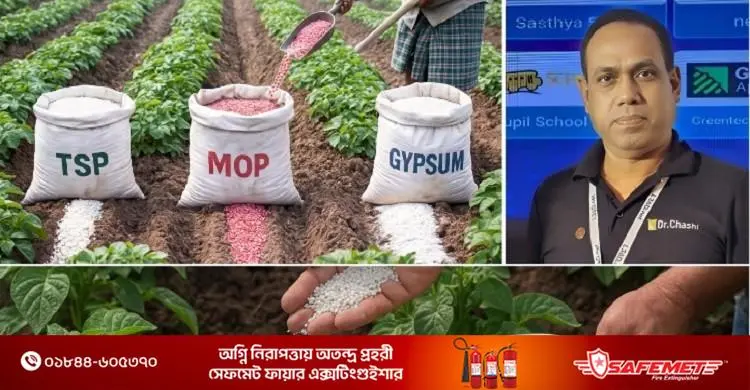
Potato is one of Bangladesh's main winter crops, and balanced fertilisers such as urea, TSP, MOP and gypsum are vital to producing it. Recently, reduced fertiliser supply in various regions, higher transport costs, stock shortages at dealer level and sales at uncontrolled high prices have left potato farmers facing a severe fertiliser crisis. Unable to apply fertiliser on time, farmers are seeing soil fertility fall, problems in tuber formation and yields at risk.
Volatile fertiliser prices are also pushing up farmers' production costs. The situation calls for balanced fertiliser management, quick supply at fair prices, closer monitoring by agriculture offices and fertiliser use based on soil tests. Greater use of organic fertiliser and alternative nutrient systems would also reduce dependence on fertiliser and make potato production more sustainable.
The main causes of the shortage
- Supply chain problems: delays in fertiliser reaching distributors and retail markets from government warehouses, and distributors not keeping to delivery schedules.
- Mismatch of demand and supply: demand for urea, TSP and MOP rises sharply in the potato season, and low or late imports often create shortages in the market.
- Hoarding and overpricing: some traders create an artificial crisis to raise prices, so farmers do not get fertiliser at the set price.
- Transport problems: shortages arise when fertiliser transport is disrupted by higher fuel prices or transport strikes.
- Farmers' lack of knowledge or poor planning: many farmers do not buy the fertiliser they need at the start of the season, and without a clear idea of how much they need, pressure builds at the last minute.
Recommended solutions
- Government: strengthen the supply chain from warehouse to distributor to retail shop; stop hoarding and overpricing through mobile teams; ensure enough fertiliser is imported and stored before the potato season.
- Farmers: buy the fertiliser they need before the season starts, and use fertiliser according to soil tests on the advice of the local agriculture office or sub-assistant agriculture officer.
- Alternative fertiliser: organic fertiliser (cow dung, compost).
- Biofertiliser: this reduces the need for chemical fertiliser.
- Co-operative action: when local farmers buy fertiliser together through co-operative farming or as a group, prices stay stable and stocking and storage become easier.
- Digital monitoring: publishing each area's fertiliser supply, stock and prices digitally reduces crises and rumours.
Shortage of fertilisers other than urea
Potato is one of the main crops of the rabi season in Bangladesh, and balanced fertiliser use is crucial to it. Although potatoes rely on urea (nitrogen), agricultural science holds that phosphorus, potash, sulphur (gypsum) and micronutrients are essential as well, not nitrogen alone. A recent severe shortage of fertilisers other than urea has unsettled the market. Fertiliser is being sold above the government-set price, raising farmers' production costs considerably.
Scientifically, potato root growth, tuber formation, disease resistance and photosynthesis depend on the right combination of TSP, MOP and gypsum. Phosphorus deficiency weakens roots, so plants cannot take up food properly. Potash deficiency shrinks tubers and lowers disease resistance, raising the risk of viral and fungal disease. Sulphur deficiency reduces chlorophyll in the leaves, weakening the plants, and output can fall by 20 to 30 per cent. Having urea alone therefore does not secure production; balanced nutrient management is essential.
Both scientific and economic factors lie behind the current crisis. Higher international prices of imported TSP, MOP and DAP, pressure on foreign exchange, logistics problems and a weak distribution system have cut supply. Hoarding and an opaque trading network in the retail market are pushing prices up. When supply falls, farmers cannot apply fertiliser on time, which harms tuber formation and size, key stages in the potato's life cycle.
In the long run the crisis reduces farmers' profitability and harms national food security. When potato supply falls, market prices become unstable, the processing industry suffers and consumers face higher prices. From the viewpoint of agricultural science, tackling the problem requires transparent management of the fertiliser supply chain, more local fertiliser production capacity as an alternative to imports, balanced fertiliser management based on soil tests, and promotion of modern nutrient technology such as water-soluble fertilisers and micronutrient mixes. The shortage of non-urea fertilisers is not just a temporary market problem but a combined scientific, economic and policy challenge; if it is not solved, potato farming, farmers' incomes and food security will all be at risk.
Steps and solutions
- Strict monitoring to prevent an artificial crisis: surveillance must be stepped up at dealer, distributor and warehouse level.
- Ensuring sales at the set price: fertiliser distribution to farmers through digital cards or registration could be introduced.
- Larger government stocks: early imports or more local production are needed for the rabi season.
- Alternative fertilisers: farmers should be trained in using organic fertiliser and NPK-based alternatives.
- Quick supply in the field: this should be ensured through joint action by the agriculture department, UNOs and local administration.
Farmers need to take planned, science-based steps to cope with the fertiliser shortage in potato farming. Planning stocks in advance according to need, using alternatives such as organic fertiliser, compost and vermicompost, and applying fertiliser in balance will help maintain soil fertility. Setting the right doses on the advice of the local agriculture office, buying fertiliser in clusters or groups and raising awareness against overpricing can all be effective. With science-based management, the impact of the shortage can be reduced and potato production kept normal.
The fertiliser crisis facing potato farmers stems mainly from a weak supply chain, rising demand, hoarding and a lack of planning in the field. Co-ordinated government oversight, early preparation by farmers and wider use of organic fertiliser, these three steps, would go a long way to resolving it.
Source: Jagonews24. First published in Bengali on The Agro News.

Comments
(0)