
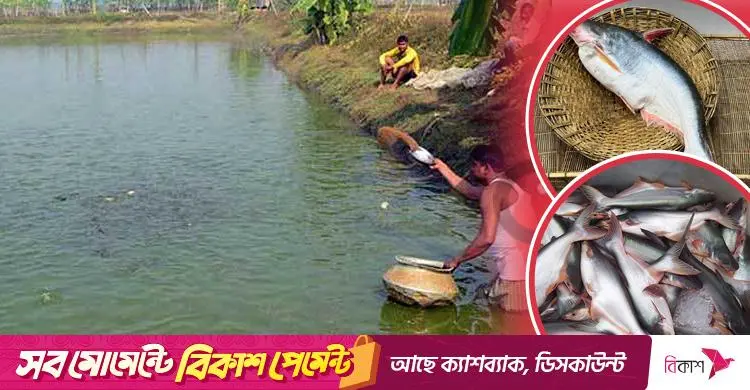
Pangas has long been part of the Bangladeshi diet. The fish was once found naturally in rivers and coastal areas, and the rivers of the south were its natural breeding grounds. Pangas was once a symbol of prestige. But with rivers losing navigability and natural breeding grounds destroyed, its availability is falling. The good news is that there is still huge scope for farming pangas in ponds, and initiatives in this sector have been running since the 1980s.
Two main types of pangas are found in Bangladesh: native pangas and Thai pangas. Native pangas is silvery, dark on the back and light grey above the lateral line. This scaleless fish is found mostly in the Padma, Meghna, Jamuna and Brahmaputra rivers, and is still tasty and expensive. Thai pangas originates in Thailand, Vietnam and other Southeast Asian countries. It was first bred successfully in Bangladesh in 1993. It grows faster than the native species and has become widely popular in commercial farming.
Choosing the method and the pond
The type of pangas farming depends on the farming environment, the pond's features, water quality, capital, market management and the availability of quality fingerlings. Monoculture or intensive farming can produce more in a relatively short time. It allows stocking of 20,000 to 25,000 fingerlings per hectare, and with protein-rich artificial feed, 15 to 20 tonnes of fish can be produced per hectare.
Rectangular ponds are best for farming. The pond bottom should be levelled and the water kept 1.5 to 2 metres deep. Ponds with loam soil are most suitable. A deep or shallow tubewell is essential to ensure water supply. Repairs should be finished in advance so the pond does not break in heavy rain. The pond should also be in a place with good communications and security.
Preparing the pond
The first step in pond preparation is to remove all weeds and predatory or unwanted fish, dragging a fine-mesh net several times to take them out. Cleaning the water and tilling the pond bottom then helps. If needed, medicine can be used on the advice of the local fisheries officer. Liming is very important: 250-300 kg of lime is needed per hectare, and grinding it fine increases its effect.
Fertiliser should be applied four to five days after liming. New or sandy ponds need more organic fertiliser, and old or muddy ponds more chemical fertiliser. Per decimal, 8-10 kg of cow dung or 4-5 kg of poultry droppings is used, mixed with 100 grams of TSP and soaked for 8-10 hours. Then 100 grams of urea is added and the mixture is spread across the pond. When the water turns green or brown four to five days after fertilising, it is the right time to stock fingerlings.
Fingerlings should be sourced from a trusted hatchery. Before transport they should be kept without food in a tank for four to five hours to make them hardy, and care should be taken that they do not become overexcited in transit.
Feeding and harvest
To increase pangas production, quality, balanced feed must be ensured; natural food alone is not enough. The amount of feed should be set according to the age and weight of the fish. A few fish should be weighed every 15 days to check they are growing properly. Feed should be scattered at a fixed time each day at six to eight set spots in the pond. Nutrition is ensured by scattering granular feed and giving ball-shaped supplementary feed. Dividing the feed into two or three portions rather than giving it all at once helps. Liming and fertilising should also continue.
Pangas usually reach an average of 500-600 grams after five to six months. Selling about 50 per cent of the fish then, according to market demand, lets the remaining fish grow faster.
Fish farming plays an important role in ensuring food security and nutrition in Bangladesh. If pangas were farmed in a planned way in the country's roughly two and a half lakh hectares of ponds and 6-7 lakh hectares of water bodies, overall fish production would leap. This would create jobs for unemployed young people and women, and pangas farming could be an important tool in reviving the almost lost tradition of Bengalis as people of "fish and rice".
Source: Jagonews24. First published in Bengali on The Agro News.

Comments
(0)