
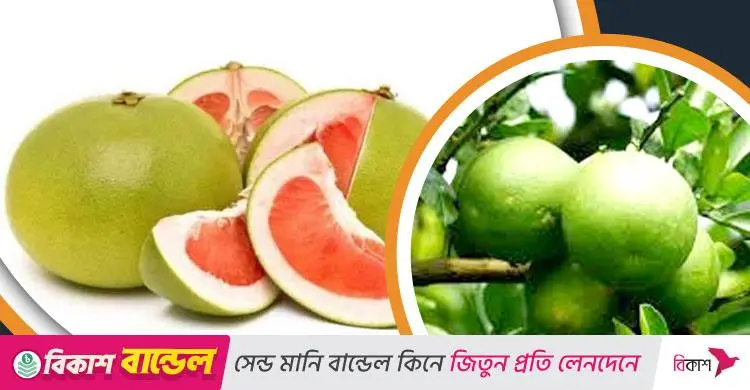
Many call it batabi lebu; some call it jambura. It is also known as tarunja. It is a tasty, nutritious fruit shaped rather like a large lemon. The unripe fruit is green outside and turns light green or yellow when ripe. The segments inside are white or pink and taste sweet and sour, though some varieties can be bitter.
It belongs to the citrus family. Its English name is pomelo and its scientific name Citrus maxima or Citrus grandis. It is a good source of vitamin C, folic acid and potassium.
In various languages it is also called jabong, shaddock and so on. In some parts of Bangladesh it is called cholom, and people of Sagarnal in Juri upazila, Moulvibazar, call it "matul jamir".
The biggest citrus
Its rind is quite thick and soft and foam-like on the inside. It is the largest of the citrus fruits, 15-25 centimetres in diameter and weighing 1-2 kg. It is native to South and Southeast Asia.
In Bangladesh it is most available in the markets in autumn and late autumn (sharat and hemanta). It is grown most in the Chattogram, Rangamati, Sylhet, Rajshahi and Madhupur areas.
The pomelo is a very familiar seasonal fruit, cheap and highly nutritious. It helps prevent disease and helps with weight loss. Being high in fibre, it aids digestion. It keeps nerve function normal, helps keep skin healthy, is good for pregnant women, helps relieve gastric problems and boosts metabolism.
Its vitamins help reduce excess fat. It is also effective against colds and fever, and helps control blood pressure. It can be eaten raw, made into juice or used in salads.
This useful fruit can be planted around the home or in the yard. On a larger scale it can be grown commercially in orchards, and there is fairly good demand for it in the market.
The writer, Suraiya Yasmin Sumi, is a third-year honours student of geography and environmental science at Government BL College, Khulna.
Source: Jagonews24. First published in Bengali on The Agro News.

Comments
(0)