
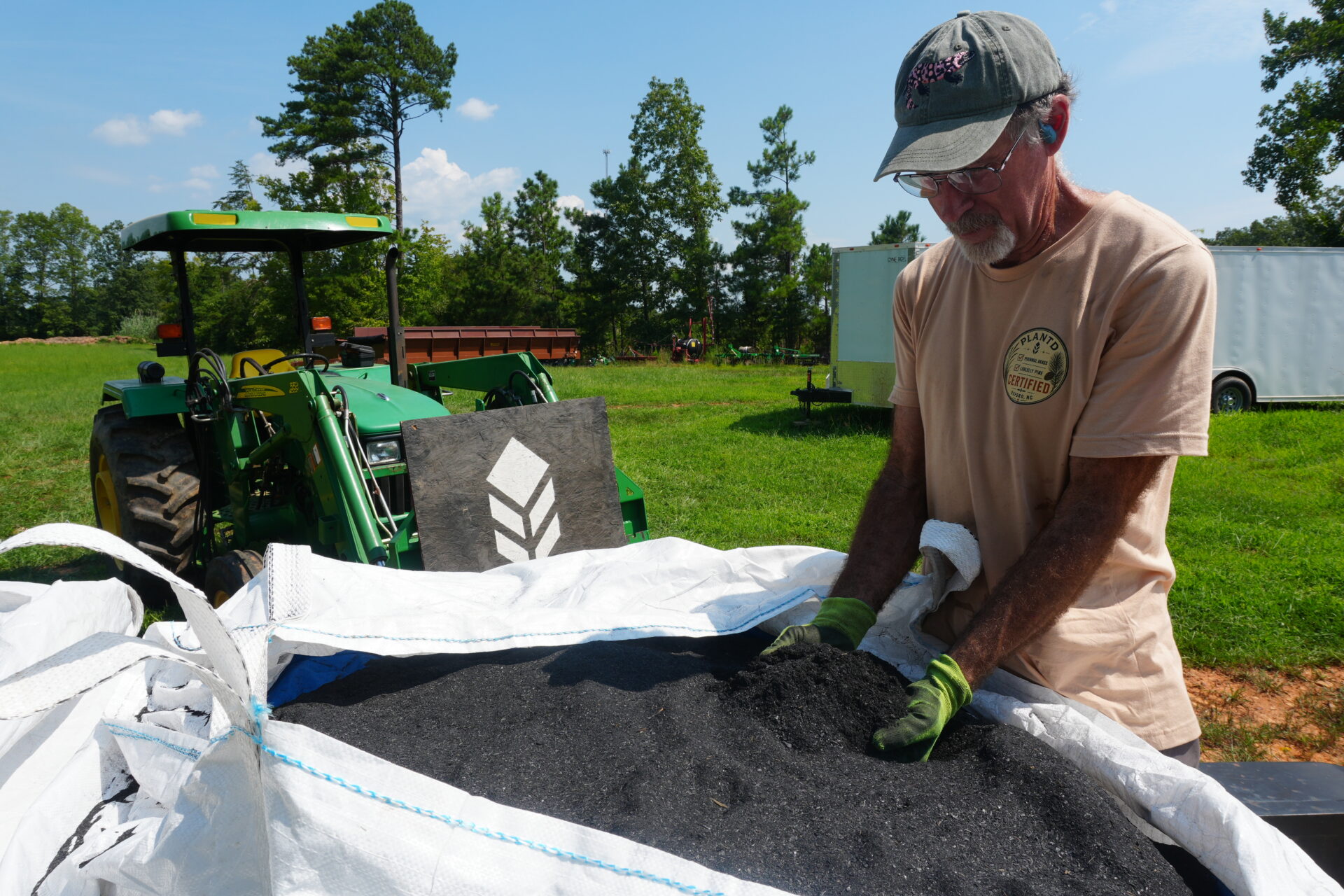
Plantd, a North Carolina company best known for construction panels made from grass, has launched a biochar product line that it sells to farmers as a soil amendment. The line grew out of a waste problem: leftover biomass from panel manufacturing was costing the company $13,000 a month to remove. Cofounder and CEO Nathan Silvernail says the new product turns that bill into a substantial second revenue stream and brings the company closer to a closed-loop factory.
Plantd’s main business is a drop-in replacement for OSB board. It grows a fast-growing perennial grass on its own plantations, harvests it nine months after planting and compresses the extracted fibres into structural panels, with the factory sited on the plantation to cut haulage. Silvernail, who spent several years as an engineer at SpaceX, claims a 15-fold land advantage over timber, which is harvested every 15 years or so. “If you solve for sustainability and efficiency from the get-go, all of the cost efficiencies come with it,” he said.
To deal with the waste, Silvernail ran leftover biomass through a benchtop bioreactor and sent the biochar out for testing. “We realized from the test results that it was basically premium,” he said. “This was pretty much top-of-the-line fertilizer.”
Biochar is a carbon-rich solid made by heating biomass at high temperature with little or no oxygen, which locks part of the plant’s carbon into a durable form. Farmers have used it for at least 2,000 years; today it is valued for cutting fertiliser use and adding carbon to the soil. Plantd markets its product for rejuvenating damaged soils and says it may eventually sequester enough carbon to support a carbon-credit strategy.
The company says its grass-derived biochar is more consistent than many products on the market. “Not all biochar performs the same in the field,” said Dr Janel Ohletz, Plantd’s director of agriculture. “Our high silica content biochar has been shown to improve crop disease resistance and shows promise for delivering stronger agricultural performance than wood-based biochar.” She added that it improves water retention and soil structure, raises soil pH naturally and stores carbon long term.
Plantd is working with agricultural solutions provider Qualterra on biomass processing, and the relationship has given it an initial customer base for the soil amendment.
Not all of the biochar will go to fields. Plantd’s all-electric panel machine currently runs on grid power, and while solar and wind are planned, Silvernail says the gasification step that makes biochar could also supply heat and electricity to the plant, so that every part of the process becomes a product. For farmers, the result is a new domestic source of a high-silica soil amendment from a company outside the usual input supply chain.
Source: AgFunderNews

Comments
(0)