
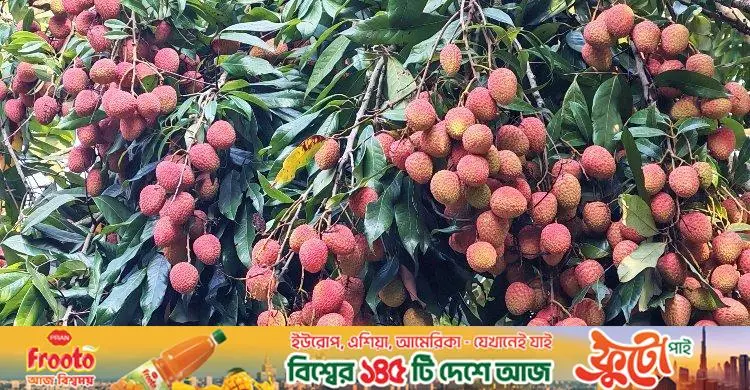
In Pirojpur, known for rice and fish, commercial litchi farming is on the rise. Small and large litchi orchards have sprung up across the district, and many farmers are turning to the crop because it brings good profit at low cost. Those involved say many more farmers would take up litchi farming if they could get loans on easy terms. Litchi production is benefiting farmers and expanding the district's economy, and seeing successful growers in their villages, local people are becoming more interested in growing litchi and other fruit.
Bright red litchis hang in clusters among green leaves, a sight that draws crowds of local people and can now be seen in several upazilas of Pirojpur. Where people once planted a litchi tree in the yard as a hobby, it has now become a commercial crop. Tarabunia village in Nazirpur upazila is now known as the "litchi village". From the entrance to the village, trees laden with plump red litchis catch the eye. Men and women are busy across the orchards, picking in one place and sorting in another, and the whole area has the air of a seasonal festival.
A village of litchi growers
Litchi has been grown in the village for about two decades, and more than a hundred families are now involved. Favourable weather this season has brought the expected yield. Because the fruit is grown without chemicals, by organic methods, demand for Tarabunia's litchis has spread beyond the local market to other districts. The litchis here are formalin-free, large and tasty, and are in high demand among local people. Three varieties are grown most in the district: Bedana, China-3 and Bombai. Besides meeting local demand, wholesalers take the fruit to sell in nearby places, and there is demand for it in Nazirpur, Pirojpur, Sriramkathi, Tungipara, Bagerhat and elsewhere.
Litchi growers say demand is very high and wholesalers from nearby markets come to collect the fruit. Litchis sell wholesale at Tk 350 to 380 a hundred. They say production could rise further with loans on easy terms. Besides litchi, mango, jujube, dragon fruit and several other fruits are grown here, and many are being inspired by successful growers.
Himangshu Mistry, a litchi grower in Tarabunia, said: "Our litchi orchard is on 5 bighas of land. The yield is good this year. I am selling at Tk 3,500 per thousand litchis. The litchis from here go to Bagerhat, Pirojpur, Gopalganj, Kawkhali, Nesarabad and other places. The fruit is good this year, so the price is a little lower."
Grower Hangshapati Mistry said: "The yield is better this year than last year. Last year I could not sell any litchis. I hope to make a good profit this year. Many fruits including litchi, mango and jujube are grown in the area, and people come from far away to see the litchi orchards."
Recovering from last year's losses
Local grower Shibu Chakraborty said: "Last year our yield was very low. From such a big orchard I could not sell even Tk 10,000 worth. It cost about Tk 10 lakh, and the whole Tk 10 lakh was a loss. The yield is better this year than last, so I should be able to recover much of last year's loss. We need more help from the agriculture office to raise yields."
Orchard worker Gita Rani said: "I come to the orchard to pick litchis, bundle them and sort them. When traders come to buy, I help them. Ten to 12 of us work in this orchard. We pick litchis from morning to afternoon, wholesalers keep coming all the time, and we load the litchis for them."
Md Khalid Hossain Sajal, chairman of Shankharikathi union parishad, said: "The litchis of this area are much better than those of Rajshahi and the north, and they are formalin-free. They are in greater demand in the market than other litchis. Growers don't have to take their litchis anywhere; wholesalers come and collect them. The taste is different and is no less than that of litchis from Rajshahi and other regions. The village is called Tarabunia, but because of its many fruits it is becoming known as the fruit village."
Soumitra Sarkar, deputy director of the Department of Agricultural Extension (DAE) in Pirojpur, said: "Litchi has been cultivated on about 67,000 hectares in Pirojpur district this year. Production is 401 tonnes, with a market value of about Tk 5 crore. Most cultivation is in Nazirpur and Nesarabad upazilas. China Three, Bombai, Mozaffarpuri and local varieties are grown here. We are giving farmers various technical advice and advice on tree care."
Source: Jagonews24. First published in Bengali on The Agro News.
Comments
(0)