
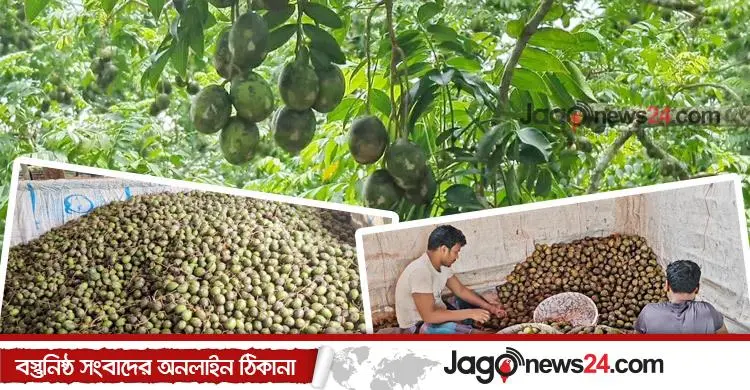
The southern district of Pirojpur is famous for its guava, and visitors come from across the country during the guava season. But as soon as the guava season ends, farmers, traders and wholesalers get busy with amra, because Pirojpur is also a leading producer of this fruit.
Amra production has grown in Bhandaria, Kawkhali, Mathbaria and Nesarabad, with Nesarabad upazila producing the most in the district. Because it is large and sweet, Pirojpur's amra is in demand across the country.
Boats full of fruit
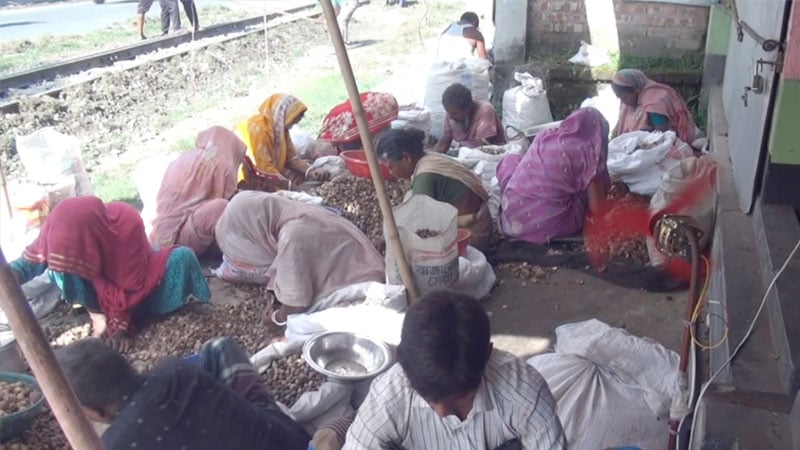
In late autumn, when the ripe amra turn from green to a coppery colour, the canals come alive with workers picking, sorting and loading the fruit and carrying it to wholesale markets. From dawn until midday, boats laden with amra crowd the wholesale markets. The bargaining, transport and trading have turned the wholesale markets at Atghar Kuriana in Nesarabad upazila into something like a festival.
The fruit is brought by boat early in the morning from Bharatkathi, Atghar, Kuriana, Guarekha, Jalabari, Daihari, Baldia, Samudaykathi, Sarengkathi, Sohagdal and other parts of the upazila, and traders also bring amra here from other upazilas of the district. Amra is currently selling at Tk 2,000-3,000 a maund. Wholesalers buy from growers and small sellers and send the fruit by road to Chattogram, Feni, Noakhali, Cumilla, Mymensingh and other parts of the country.
Farmers say guava no longer brings the profit it once did, which is why over the past decade they have turned to amra on a large scale. Many who lost money on guava have been able to make up for it by selling amra this season, and the fruit has become a new source of hope. Since Barishal's amra received GI recognition, demand for it has grown further in different parts of the country, and the amra of Barishal division has built its own reputation for taste, aroma and quality.
Although yields were somewhat lower this season because flowers dropped, farmers are satisfied as prices have been good. Last year, depending on quality, a maund of amra sold for Tk 1,000-1,600, but towards the end of the season the price rose to Tk 2,000-3,000.
Trade worth crores
Wholesalers say amra worth Tk 200-250 crore is bought and sold in a season. Because it is now a GI product, farmers are more interested in growing it, and production in the district is expected to increase further.
According to the district Department of Agricultural Extension (DAE), Pirojpur produced 10,124 tonnes of amra on 577 hectares, the highest in Barishal division.
Litu Bepari, an amra commission agent at Bhimruli market, told Jagonews: "Pirojpur's amra has a reputation across the country. It is large, tasty and formalin-free, so it is at the top of people's list. We are constantly finding new markets. Demand is rising." He said 20 labourers work under him in the season; with the season nearly over there are fewer workers now, but he still supplies 400-500 sacks of amra himself every day.
Jasim Howlader, an amra commission agent at Atghar market, said: "This season amra worth Tk 200-250 crore has been traded. If the yield is good in future, the figure will exceed Tk 300-400 crore."
Grower Mithun Mondal told Jagonews that the GI recognition for Barishal's amra would boost their sales further, which made them very happy. "The yield was proportionately lower this year because of rain, floods and other problems," he said. "But we hope the yield will be higher next year, and then we will be able to recover our losses."
Jasim Bepari, who came from Kuakata to buy amra, told Jagonews: "The quality of the amra here is very good. It is large and sweet. Every year I buy amra worth Tk 10-15 lakh and sell it retail."
Sumon Mondal, a worker at an amra wholesale shop, told Jagonews that the GI status opened up the possibility of sending amra abroad. "Amra production in the area is increasing day by day. This year amra worth close to a crore taka has been sent to different parts of the country," he said.
Soumitra Sarkar, deputy director of the DAE in Pirojpur, said amra is grown on 577 hectares in different upazilas of Pirojpur, producing 10,124 tonnes with a market value of nearly Tk 100 crore. "The reputation of the amra here is growing since it received GI recognition, and production has also increased. The agriculture department is giving constant advice and support to those newly interested in growing this crop," he said.
Source: Jagonews24. First published in Bengali on The Agro News.
Comments
(0)