
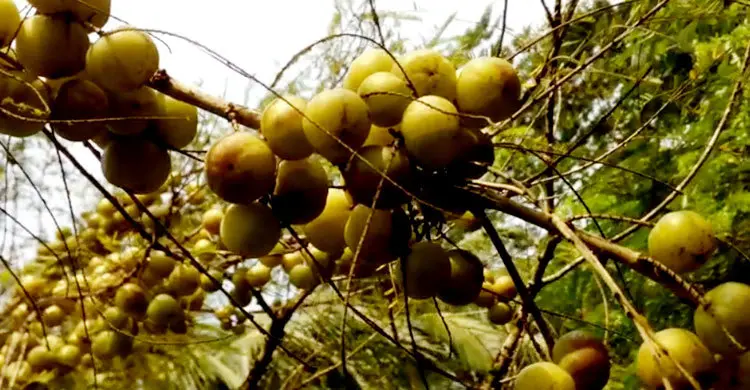
Amla can be grown successfully on fallow land, and Abdul Hai Sheikh of Mulgram in Tona union of Pirojpur Sadar upazila has proved it. Amla can be grown successfully in a homestead yard or on fallow land, he says, and given the chance it could become a commercial crop in the area.
Growing amla on the flat land of south Bengal is surprising, and this juicy fruit used to be rare for people in the region. Abdul Hai has made the impossible possible and is one of the farmers who have succeeded with amla.
Abdul Hai said amla trees in the district grow 8-18 metres tall, as they do in almost every part of Bangladesh. An amla tree bears fruit in about four years, and the fruit is available from August to November. An orchard can be raised from seed, and the monsoon is the right time to plant saplings.
Growing interest
He said farmers are now growing far more of the fruit than before, and amla trading in the district is brisk at this time every year. Traders from Dhaka buy the district's amla and sell it in various markets. The bumper harvests have made everyone interested, and people from the district agriculture department to farmers and tree lovers have been impressed by his orchard.
Abdul Hai Sheikh said he first planted 100 saplings. Four and a half years later his orchard produced 25 maunds of amla, with a market value of Tk 26,000. He hopes to sell much more this year.
Local farmers said the government should take steps to export the fruit to other countries, which could be good news for the people of the region. The district office of the Department of Agricultural Extension (DAE) has promised to help if people take up fruit growing.
"At least two or three amla trees can be seen at every house in the district," said DAE deputy director Abu Hena Mohammad Jafar. "Now many families are growing amla commercially, so this year it has been grown on 44 hectares and production is 373 tonnes, up 30 per cent from last year. That is an average yield of 8.47 tonnes a hectare."
Source: Jagonews24. First published in Bengali on The Agro News.
Comments
(0)