
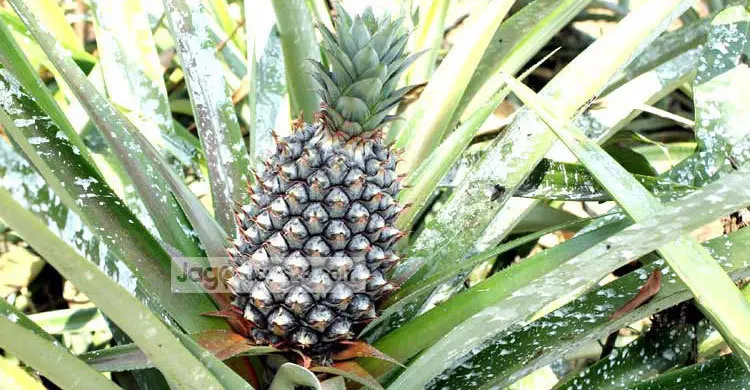
Pineapple is a tasty and nutritious fruit. Growing it commercially can meet a family's nutritional needs, and the surplus can be sold for extra income. In Bangladesh pineapple is grown on a large scale mainly in Sylhet, Moulvibazar, Chattogram, the Chittagong Hill Tracts and Tangail.
Pineapple is also an important cash crop and is highly valuable for its nutrition. Here is how to earn extra income by growing it.
Capital and training
About Tk 20,000 is needed to grow pineapple on one bigha. If you need a loan, you can turn to close relatives, government and private banks, or non-governmental organisations (NGOs), which lend on conditions.
Before starting, learn the details from someone experienced. For any information on cultivation, contact the union-level agriculture officer of the Department of Agricultural Extension (DAE) or the upazila agriculture office. Every district and upazila also has a training centre of the Department of Youth Development.
Season and soil
Mid-Ashwin to mid-Agrahayan is the right time to plant pineapple suckers. With irrigation, they can also be planted from mid-Magh to mid-Falgun. Loam and sandy loam soils are best suited to pineapple.
Varieties
- Honey Queen: the flesh of the ripe fruit is yellow, the eyes pointed and raised, and the average weight about 1 kg. The leaves are thorny and pinkish-brown. Honey Queen is very sweet.
- Giant Kew: the ripe fruit is greenish with light yellow flesh, and the eyes broad and flat. The average weight is about 2 kg. The leaves are green and almost thornless.
- Ghorashal: the ripe fruit is reddish with creamy white colouring, and the eyes are broad. The average weight is about 1.25 kg. The leaves are thorny, wide and wavy.
Propagation
Pineapple does not normally produce seed, so it is propagated with different kinds of suckers: side suckers, slips from the stalk, crowns and ground suckers. Of these, side suckers are best for commercial cultivation.
Preparing the land and planting
- Plough the soil until it is loose and level it with a ladder so that rainwater does not collect anywhere.
- Make beds 15 cm high and 1 metre wide.
- Keep 50 to 100 cm between beds.
- Plant two rows on each one-metre bed.
- Keep 50 cm between rows and 30 to 40 cm between plants.
Fertiliser, irrigation and drainage
For a good yield, use as much organic fertiliser as possible. Apply fertiliser according to the soil type after a soil test. Compost made from rotted waste can also be used.
- Irrigating pineapple fields in the dry season is essential.
- In the rainy season, dig drains so that water does not collect at the base of the plants.
Pests and care
If pests attack, locally made organic pesticides can be used. If that does not control them, contact the local DAE office for advice.
- If the plants are too tall, trim the leaf tips evenly, leaving about 30 cm.
- Keep the field free of weeds at all times.
Harvest and market prospects
Pineapple plants usually flower 15 to 16 months after planting, between mid-Magh and mid-Chaitra. The fruit ripens from mid-Jyoishtho to mid-Bhadra, and ripe fruit should be picked then.
Pineapple can be preserved as canned food, and besides being eaten fresh it can be made into jam, jelly and juice. After meeting domestic demand, the surplus can be exported, and various export companies offer help with this.
Source: Jagonews24. First published in Bengali on The Agro News.

Comments
(0)