
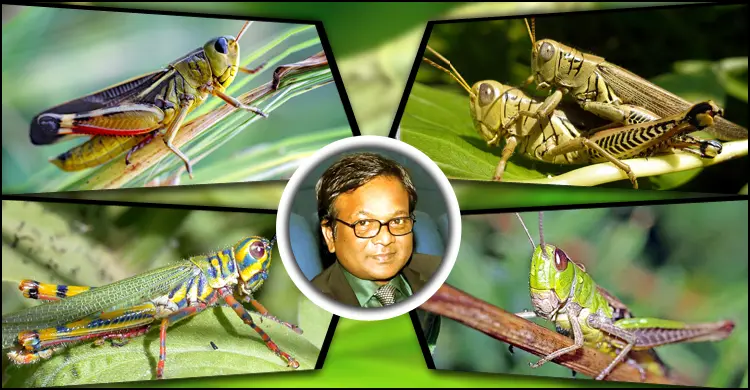
The phoring (the Bengali name used for both grasshoppers and dragonflies) is one of the most familiar insects. It hops about, and people of all ages feel the urge to chase and catch it. The bright red, yellow or grey ones are especially loved. The raj phoring, or king phoring, holds a special attraction: it is a little bigger than the others and lands suddenly in the yard or the jungle. The red phoring, meanwhile, is thought of as the queen.
Hard to catch
The phoring is a very cunning and clever creature and very hard to catch. There are many ways of catching it at home and abroad. Village children in Bangladesh smear glue on the end of a jute stick to catch phorings from a distance. Species can be told apart by the bright colours of their bodies. The phoring has two pairs of strong, transparent wings and a long body. When it settles, its wings are held horizontally, at right angles to the body. Although it has six legs like other insects, it cannot walk; its legs are spiny and suited to perching on twigs. There are two black spots at either end of the upper surface of the wings that look like a pair of eyes. With wings spread, it clings strangely to a leaf and, despite its distinct shape, is hard to notice without close attention, looking like a lime mark on the leaf. According to scientists, "this strange form and nature of the phoring may have come about through evolution."
Food and habitat
The phoring is a plant-eater. Soon after hatching, as a nymph it begins eating any small, easily digested plants, grass or tender new shoots around it. After moulting once or twice and growing a little, it eats tougher plant food, and young phorings eat the same plants as adults. Since it feeds on grass, leaves and young crop leaves, it prefers such low-lying habitats, though different phorings are found in almost all habitats. Fewer live in freshwater and mangrove wetlands, where water levels rise and fall a great deal and egg-laying sites are flooded. In bad weather phorings migrate in large numbers and can travel up to about 15 kilometres a day. About twenty thousand species have been identified worldwide so far, and twenty in Bangladesh. Although birds are usually the main enemy of insects, birds generally do not attack the phoring, so it flies fearlessly around them. Phorings are, however, quite hostile to one another: given the chance, the strong attack the weak and eat them.
Remarkable eyes
The phoring's head is large and can be turned at will. Two hemispheres cover almost the whole of either side of the head, and at the top the two eyes merge together. According to biologists, "these astonishing eyes are really large compound eyes, somewhat oval and looking like peas." In scientists' words, "the phoring does not really have two eyes but several thousand, because a large phoring's eyes hold about twenty-eight thousand small simple eyes, each separate." According to biologists at Boston University, "the phoring can see things clearly 120 feet away. Remarkably, ultraviolet rays are invisible to us, but the phoring's eyes can detect them. With this power it finds food even among clean, shiny leaves. Many leaves, flowers and fruits carry markings that cannot be seen without ultraviolet light. The phoring cannot see four colours as we do, but it sees many things our eyes cannot."
Researchers have asked whether our world must then appear as a different world to the phoring. Scientists say clearly that "to the phoring the world is only ash-coloured, darker in some places and lighter in others." This is because seeing colour requires pigment particles in the retina, which the phoring lacks. Yet in many ways it surpasses humans. Without turning its head, it can see its surroundings in front, on both sides and even behind, as humans cannot. Unlike humans, however, it cannot look at two completely different things at once with its eyes. Biologists have found that "the phoring sees clearly only things up to twenty times its own body length away." It can also correctly recognise a picture of a phoring shown on a television screen, rather than a live one; this is known because it shows a kind of excited behaviour as when it sees something alive.
However skinny and weak it may look, the phoring has great power of self-defence and attack. For these varied qualities, traits and liveliness, people fondly call it the "prince insect".
Source: Jagonews24. First published in Bengali on The Agro News.

Comments
(0)