
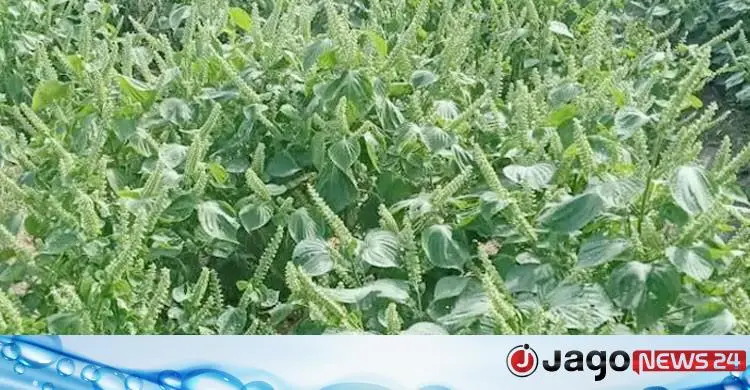
Perilla is a new edible oil crop adapted to Bangladesh. On 12 January 2020 the National Seed Board, under the Ministry of Agriculture, registered the country's first perilla variety, SAU Perilla-1 (Golden Perilla BD), in the name of Sher-e-Bangla Agricultural University.
Perilla is originally a South Korean variety known as Korean perilla. Its oil is used in South Korea, China, Japan, Thailand, India and many countries of South-East Asia. Its main feature is a high omega-3 fatty acid (linolenic acid) content of 50–60 per cent, along with 22–23 per cent omega-6 fatty acid (linoleic acid), and it is free of harmful erucic acid. Some 92 per cent of the oil is unsaturated fatty acids. Being rich in omega-3, perilla oil is very beneficial for the human body and has a notable role in controlling and reducing the risk of heart disease and high blood pressure.
Why perilla matters for Bangladesh
Bangladesh's average annual demand for edible oil is about 2.2 million tonnes. According to the Ministry of Commerce, about 2.0–2.6 million tonnes of crude soybean oil and palm oil are imported each year. The country's traditional oil crops—mustard, sesame, linseed, groundnut and others—meet only 10 per cent of its own needs. Except for sesame, these oil crops are grown in the Rabi (winter) season, and competition with other Rabi crops makes it impossible to expand oil crop acreage even when desired.
Perilla's life cycle is 100–105 days (25–30 days in the seedbed and 70–75 days in the main field). Its seed contains about 40 per cent oil. Aus rice is grown on about 15 lakh hectares in Bangladesh, and after the Aus harvest most of that land lies fallow for about two and a half months before mustard sowing begins in the first week of November. Because perilla spends only 70–75 days in the main field, it can easily be planted and harvested on most of that land before mustard. Being salt tolerant, flood-free fallow land in coastal areas can also be brought under perilla. Growing perilla on higher Aman land that needs supplementary irrigation at relatively high cost could reduce farmers' production costs, and using seedbeds left fallow after Aman transplanting for perilla could partly fill the country's oil crop deficit.
Bangladesh has a large, well-off consumer class that eats imported olive, canola and sunflower oils, which are expensive. If perilla cultivation expands, interest in this omega-3-rich oil could be created among these consumers, saving the country money while letting farmers sell their crop at a better profit. Educated unemployed young people could become self-reliant by growing perilla and trading its oil. Because perilla fetches a high price, edible oil traders could also make good profits in domestic and international markets. Perilla oil can be eaten without refining, so farmers and villagers can extract oil from the seed with machines already common in the country. If the Ministry of Agriculture expands perilla cultivation among farmers, high-quality perilla oil could reach all classes of people, meeting nutritional needs and saving a great deal of money.
Soil and sowing
Almost any soil where water does not stand is suitable, though sandy loam or loam is best.
The crop is grown in the Kharif-2 season, and the right sowing time is 10–25 July. Perilla is highly photosensitive: it usually starts flowering from the last week of September to the first week of October. So seed must be sown within the set period for adequate vegetative growth and the desired yield. About 1–1.5 kg of seed is needed per hectare. A seedbed should be 1–1.5 metres wide and as long as the land allows. Organic manure in the seedbed produces healthy seedlings. Keep a channel between two beds so that excess water does not stand in the seedbed after rain.
Because the seed is small, the soil should be made as fine and crumbly as possible. Guard against ant attacks. Since rain is likely in the Kharif-2 season, polythene can be raised on stakes around the seedbed for the first 15 days after sowing. Sowing seed in lines a quarter of an inch deep improves germination; alternatively, broadcast the seed and cover it with fine soil. Water the seedbed lightly after sowing and make sure it never dries out completely.
Transplanting and harvest
Prepare the land with 4–5 cross ploughings and laddering to make the soil fine. A drain around the field helps drainage. Transplant seedlings with 30–40 cm between plants and 30–40 cm between rows.
The crop can be harvested within 70–75 days of transplanting. Leaves usually fall as the seed matures. When at least 80 per cent of the leaves have turned yellow, the seed turns grey and is ready to collect. Because the seed is visible from outside, maturity is easy to judge.
Source: Jagonews24. First published in Bengali on The Agro News.

Comments
(0)