
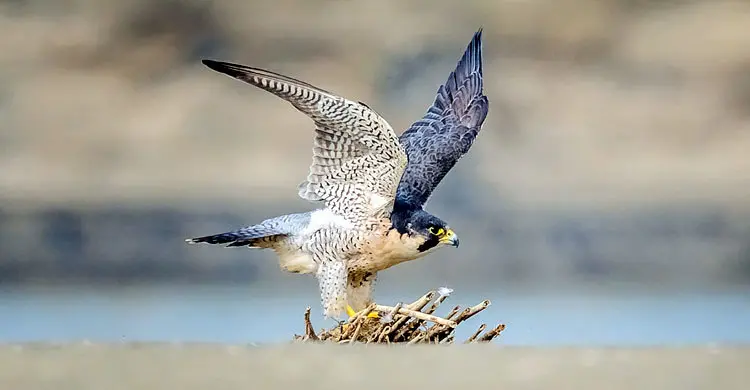
The animal that can move three times faster than a cheetah is the peregrine falcon, the fastest animal in the world. When it hunts, the peregrine uses gravity: folding its wings tight against its body, it swoops at 300km an hour or more to catch its prey. For speed it beats even the cheetah. While a cheetah reaches 112-120km an hour when chasing prey, the peregrine falcon reaches 300-350km an hour.
The peregrine carries its prey to a chosen spot, where it first plucks the feathers and then tears off the flesh to eat. It hunts pigeons, waterbirds, herons and ducks. When it needs food it can also hunt mammals such as bats, rabbits and rats, as well as reptiles, insects and even fish. It is expert at striking down bats and other birds in flight.
Where it lives
This migratory bird is seen in winter. It ranges over rivers, lakes, steep hills, wetlands, mangroves, semi-deserts and rocky plains, and is found in North and South America, Australia, the Indian subcontinent, China and Indonesia.
Ornithologist Dr Inam Al Haque, founding president of the Bangladesh Bird Club, says peregrines usually hunt alone and stay alone even on migration; they are very rarely seen in pairs. They strike their prey in mid-air, diving straight down at nearly 300km an hour with wings pressed to their sides and seizing it in an instant.
Size and breeding
The peregrine falcon is usually 42 centimetres long, with a wing of 28 centimetres, a bill of 2.6 centimetres, a leg of 4.9 centimetres and a tail of 14.5 centimetres. Males and females look alike, though the female is comparatively larger. The head is black, with a moustache-like mark on the cheek and a black patch on white below the eye. The upperparts are grey with black streaks. It has broad shoulders, and its wings taper from broad to narrow.
It has very sharp eyesight, and its eyes are dark brown. Very fine dark streaks run from below the breast to the belly, and the underwings are full of black streaks. The tail is short and not fanned. It is most active at dawn and dusk. It breeds from March to May and lays three to four eggs. The female alone incubates them, and the chicks hatch after 25-27 days.
Source: Jagonews24. First published in Bengali on The Agro News.


Comments
(0)