
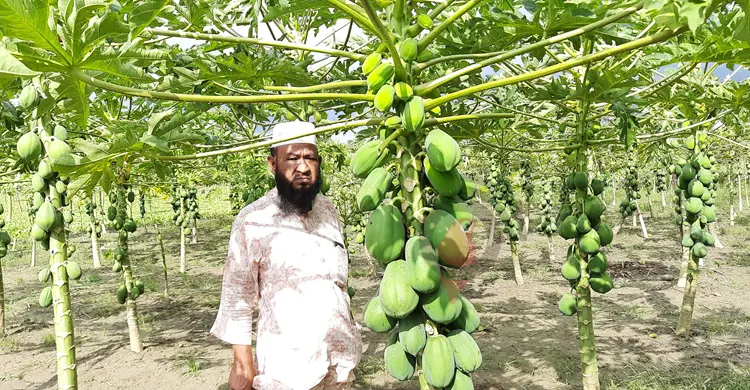
Pabna's fields seem fruitful in every season. Cropland is full of vegetables, and village after village has orchards of all kinds. Most of these vegetable plots and orchards were set up by educated young people who, rather than chasing jobs, became self-reliant by growing vegetables and fruit. Many young men followed one man down this path, bringing a quiet vegetable revolution to Pabna.
The hero of this revolution is Shahjahan Ali Badsha, a farmer from Chhalimpur village in Ishwardi. He began growing vegetables on just two bighas, and his farm now covers about 200 bighas. He has received the Bangabandhu Gold Medal and the President's Award for agriculture, and this year he was recognised as an AIP (Agriculturally Important Person). More than a hundred young men in the district have become self-reliant by following his lead.
In Sahapur, Jagannathpur, Chhalimpur, Baktarpur, Charkalampur, Charkurulia, Digrirchar, Chargargari, Charkatra Bharaimari, Pakuria, Kanthalbaria, Dashuria and Purardair in Ishwardi upazila, field after field is laid out with vegetables. Papaya orchards stand out most, with small and medium trees laden with fruit.
From two bighas to 200
According to the agriculture department, papaya is grown on about 3,000 bighas a year in Ishwardi alone. Papaya cultivation began to grow in this traditional upazila after the 1980s, and in the 1990s parts of Ishwardi became papaya villages. Today's AIP Shahjahan Ali Badsha brought a revolution to papaya farming, and became so well known for it in the district that everyone knows him as "Pepe Badsha" (papaya king).
Badsha told Jagonews that he completed his master's in 1977 and then began growing potatoes, tomatoes, carrots, aubergine and other vegetables on his father's 4-5 bighas in Chhalimpur. He first succeeded with aubergine, making a profit of Tk 33,000 at the time from two bighas. That is when he decided for good to make vegetable farming his profession.
In 1988-89 he leased land and grew vegetables on 80 bighas. In recognition of this success he received the President's Award in 1991, and in 1997 the Bangabandhu Krishi Gold Medal. He has now built the "Ma-Moni Krishi Khamar" on about 200 bighas, growing about 35 kinds of vegetables and 10-15 varieties of fruit. He has also set up a dairy farm.
Badsha is the first in the country to grow custard apple (sharifa) orchards commercially. His farm employs 50-60 people every day, and many more families benefit indirectly. He says he reached his current position with support from the Department of Agricultural Extension (DAE), BARI, BINA, BADC and Rajshahi Krishi Unnayan Bank.
"My interest has always been in growing new fruits and vegetables. I haven't only profited from this work; I've tried to inspire many farmers. Countless educated young people have turned their fortunes around by growing vegetables or fruit instead of chasing jobs," he said.
Farmers' financial security is essential
Badsha is now president of the central committee of the Bangladesh Farmers' Association (BFA), the country's largest farmers' organisation. He has not stayed busy only with his own farm; he thinks about the problems of farmers across the country, and set up the association for that purpose.
The BFA began a decade ago with the pledge "We will provide safe food". One of its main aims is to deliver toxin-free food alongside food security. But Badsha says farmers also need financial security if the country is to have food security and safe food.
He said that, for the welfare of farmers and consumers, the BFA has taken the initiative through its branches across the country to train and motivate farmers to produce chemical- and toxin-free vegetables and fruit and supply them to Dhaka. It plans to market them through its own wholesale outlet in Dhaka, so farmers get good prices and consumers get safe food.
Meanwhile, farmers are losing out for lack of strong market management and government support, with marginal farmers worst off, and traders buy produce through syndicates. Farmers have no choice but to become aware of their rights to survive. To save farmers, subsidies to genuine farmers must be increased, and farmers' views must be given priority in drawing up the budget.
Badsha said farmers are in a bad way because they do not get fair prices for their crops. The huge gap between retail and wholesale prices hurts farmers, and climate change has also meant losses year after year. The crisis in agriculture has become a crisis in farmers' lives, and many marginal farmers have been left destitute and forced to change profession.
Door open to young people
Failing to find a job is no reason for despair, he says; one can improve one's lot by focusing on vegetables or papaya. Badsha is always keen to share his experience with aspiring vegetable growers. "My door is open to everyone who is interested," he said.
On receiving AIP status, Badsha said he had long demanded dignity for farmers, both personally and through the organisation, and in response to their long-standing demand the government has taken a fine initiative. Farmers now get recognition for their labour, and like CIPs, AIPs will now enjoy various benefits. He is pleased, as are farmers in his area and across the country, because some farmers will now receive AIP status every year.
Asked about this, Dr Saiful Islam, deputy director of the DAE in Pabna, said: "Pabna is an advanced district in agriculture. It has great agricultural diversity and many renowned farmers, many of them national award winners. Since last year the government has started giving AIP status to farmers who have made special contributions to agriculture, and two farmers from Pabna are among them. I hope Pabna's farmers will receive AIP status in future too."
Source: Jagonews24. First published in Bengali on The Agro News.
Comments
(0)