
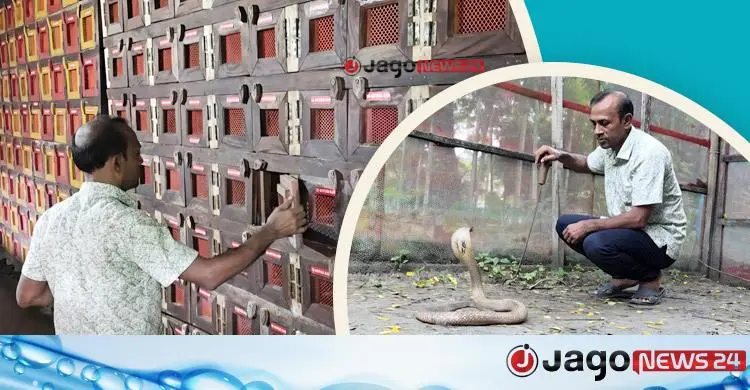
Many people in Bangladesh die of venomous snakebites every year simply because they do not get treatment in time, above all because hospitals lack enough antivenom. The country still depends on imports for antivenom. The only commercial snake venom farm in the country, set up in Patuakhali, has raised hopes of reducing that dependence. But although it won government registration after a 26-year wait, no pharmaceutical company has come forward to process its venom, and the venture has yet to reach its potential.
The farm could produce snake venom worth Tk 8 crore a month; its owner is struggling because drug companies are not interested; and the farm could cut the country's reliance on foreign antivenom.
A farm of 250 snakes
Expatriate entrepreneur Abdur Razzak Biswas set up the snake venom farm in 2000 in Nandipara village of Madarbunia union in Patuakhali Sadar upazila. After many obstacles, it recently received registration from the Department of Livestock Services, which allows it to collect venom from venomous snakes legally. The farm now keeps about 250 snakes of various species, including king cobra, black cobra, pankhiraj, kalkeute, padma goma, white goma, bishjhuri, python and darash.
The farm has five employees, but Abdur Razzak cannot pay their wages. Running costs come to Tk 3,000 a day, or nearly Tk 1 lakh a month, which he manages with great difficulty.
Abdur Razzak Biswas said the farm could collect about one pound of snake venom a month, worth about Tk 8 crore on the international market. Raw venom cannot be sold directly, however; it has to be processed through set procedures before it can be used to make antivenom and other medicines. Three months after registration, no drug company has shown any interest.
He said he had spent a great deal of money running the farm over a long period, and financial trouble made it hard even to pay staff regularly. With government and private support, he said, the venture could grow into a major industry for the country.
Workers and neighbours ask for support
Local resident Sobhan Mia said Razzak Biswas had built such a large farm on his own initiative, and could go much further if the government and the institutions concerned helped him.
Farm worker Hridoy said the owner could not pay wages regularly because of his financial crisis. With the necessary support, the farm would survive and the workers could earn a normal living.
What officials and industry say
Patuakhali district livestock officer Dr Md Habibur Rahman said the farm had been registered to collect venom, but the venom it collects cannot be marketed directly. It can be used by the pharmaceutical industry only after processing to set standards and through approved management.
On the lack of interest, Md Al-Amin Howlader, owner of Patuakhali Biogene Pharmaceutical, said the medicines his company makes do not need antivenom. But the country imports crores of taka worth of antivenom every year, and other drug companies should come forward, he said, so that the money stays in the country and entrepreneurs are created.
Patuakhali civil surgeon Dr Khaledur Rahman Mia said antivenom was vital for treating snakebite patients in coastal areas and currently has to be imported. Large pharmaceutical manufacturers need to come forward to produce antivenom from venom collected in the country. If the farm applies, he said, he will try to take the necessary steps after discussing the matter with higher authorities.
Dr S M Hemayet Jahan, vice-chancellor of Patuakhali Science and Technology University and professor of entomology, said collecting snake venom scientifically and under control was very important. If antivenom could be made from local venom, dependence on other countries would fall, foreign currency would be saved and snakebite patients could be treated faster. He stressed coordinated action by the government and drug manufacturers, along with strict biosafety and government oversight.
Source: Jagonews24. First published in Bengali on The Agro News.
Comments
(0)