
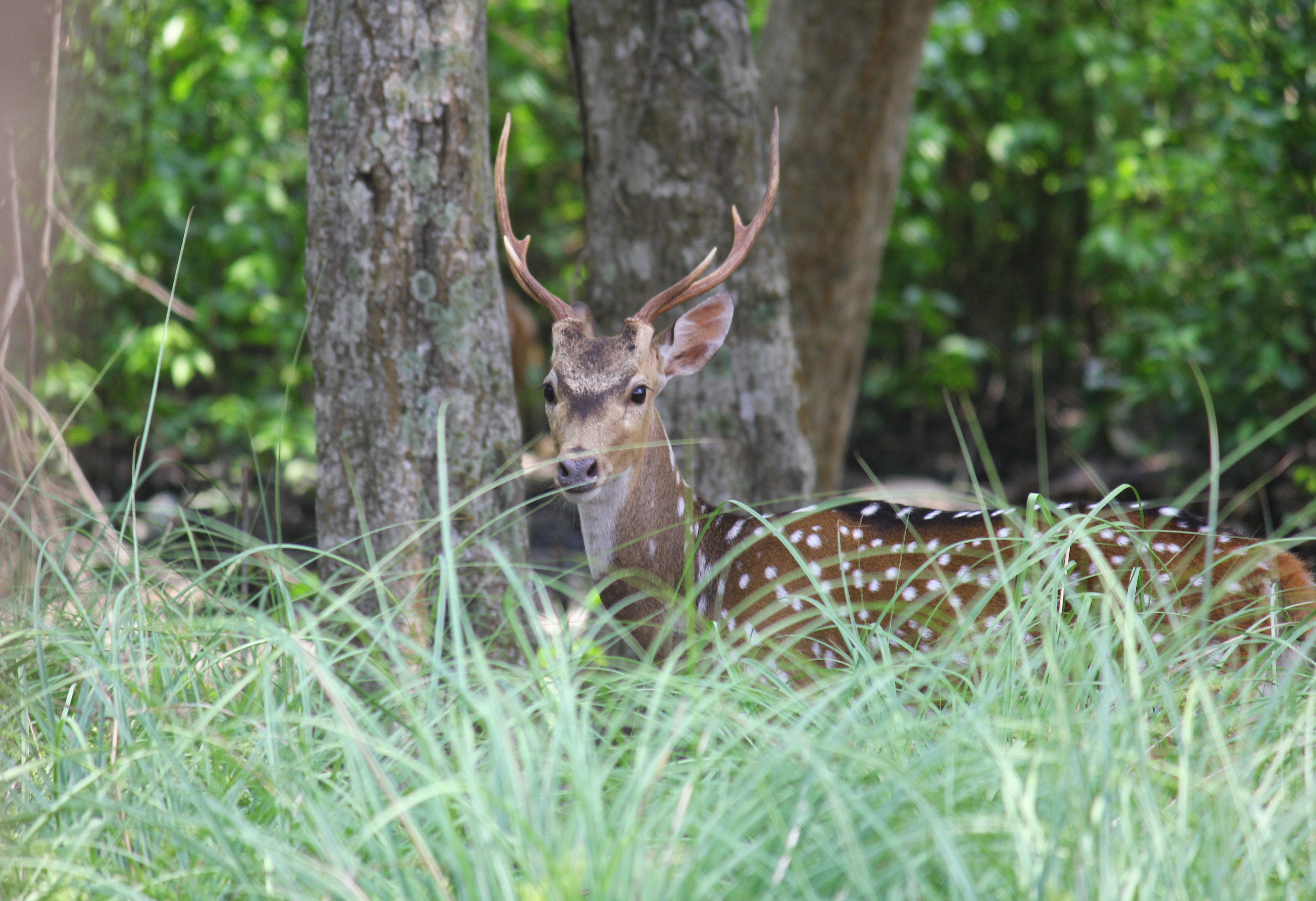
On Monday, 11 May 2026, the Forest Department rescued two injured deer that had strayed out of the Sundarbans into villages of Charduani union in Patharghata upazila, Barguna district. After first aid and care, both animals were released back into the forest, Jagonews24 reported that evening.
The first deer was rescued in the morning in the Gabbaria area of Charduani union. The second was found around midday in the Kaliarkhal area of the same union. The report did not say which species the two deer were, how old they were or whether they were male or female, and the forest department said it was still investigating why they had left the forest and how they had been wounded.
How the two rescues unfolded
According to the forest department and local sources quoted by Jagonews24, forest staff went to Gabbaria after hearing that a deer had come out of the Sundarbans into the village. With the help of local residents, they rescued the animal alive from the edge of a pond in the area. Wounds were visible on several parts of its body. Forest staff then gave it first aid and food.
Around midday, residents of Kaliarkhal saw another deer in their area. On receiving the news, forest staff went to the spot and rescued the second deer as well. After treatment, both deer were released into the forest.
Surajit Chowdhury, the acting officer in charge of the Gyanpara special patrol post of the Sundarbans East Forest Division, told Jagonews24: "Two deer that came from the Sundarbans into the villages have been rescued. After first aid, they were released into the Sundarbans forest on the instructions of the divisional forest officer. However, our investigation into why the deer came into the villages and how they were wounded is continuing."
The report did not give a cause for the wounds, and on the day it was published the forest department had reached no conclusion. In earlier cases along the edge of the forest, described further below, forest officials had likewise asked whether a deer found in a village had crossed a river by itself or had been brought out by people.
Patharghata, Charduani and the edge of the forest
Patharghata is a coastal upazila at the southern end of Barguna district in Barishal division. It covers 387.36 square kilometres. Bamna upazila and Mathbaria upazila of Pirojpur district lie to its north and the Bay of Bengal to its south. To the east are Barguna Sadar upazila and the Bishkhali River, and to the west are Sharankhola upazila of Bagerhat district and the Haringhata River. Besides Patharghata municipality, the upazila has seven unions: Charduani, Kakchira, Kalmegha, Kanthaltali, Nachnapara, Patharghata and Raihanpur.
The land itself was won from the Sundarbans. In the early twentieth century, people from Mathbaria, Bamna and Betagi came to the area, cleared stands of sundari trees and settled there. Patharghata became an upazila on 24 March 1983. Farming is the main occupation, but the local economy also leans heavily on marine fishing, and the upazila has fish landing and wholesale fish trading facilities. The 2022 census counted 177,893 people in 47,166 households in Patharghata, against 163,927 people in the 2011 census.
Barguna district as a whole covers 1,939.39 square kilometres and had 1,010,531 people at the 2022 census. Its main rivers include the Payra, the Bishkhali, the Baleshwar and the Haringhata, and river water makes up about 22 percent of the district's area. The district has 30,533.90 acres of reserved forest.
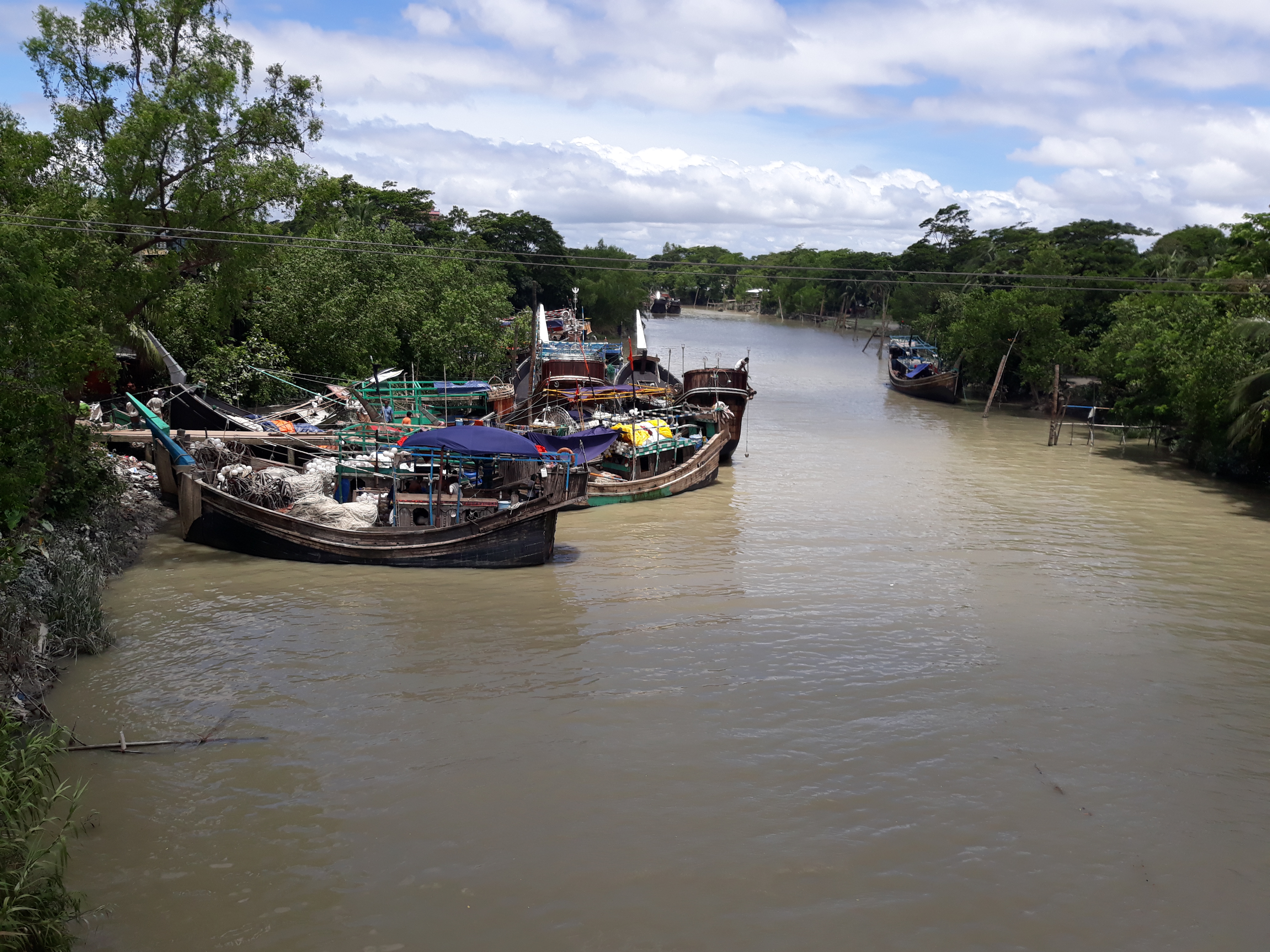
The Baleshwar, also called the Baleshwari, is about 146 kilometres long. It forms the eastern border of Bagerhat district and the western border of Barguna district, and the Sundarbans Reserve Forest lies along its far bank. The river flows south into the Haringhata, which empties into the Bay of Bengal. UNESCO describes the Bangladesh Sundarbans as lying between the Baleswar in the east and the Harinbhanga in the west, so for Patharghata the forest begins just across the water.
The forest division that handled the rescue
The two deer were handled by staff of the Sundarbans East Forest Division, which comes under the Forest Department's Khulna circle and manages the Sharankhola and Chandpai ranges of the forest.
Organised forest management in the Sundarbans goes back to the nineteenth century. The first forest management division with jurisdiction over the Sundarbans was set up in 1869, and a forest division with its headquarters in today's Khulna was created in 1879. Three wildlife sanctuaries in the south of the Bangladesh part of the forest were established in 1977, according to UNESCO.
In January 2026, the divisional forest officer of the Sundarbans East Forest Division, Md. Rezaul Karim Chowdhury, told Prothom Alo that patrols had been increased and that more traps were being recovered than before as a result. He said deer caught in traps were often rescued and released. His division had two SMART patrol teams that went out on two patrols a month, and each patrol lasted two weeks at a stretch. The Sundarbans West Forest Division also had two SMART patrol teams, its divisional forest officer, A Z Hasinur Rahman, told the newspaper.
Both divisional forest officers called for enough staff, more boats, more patrols and greater local awareness to reduce the dangers facing the forest's tigers, Prothom Alo reported.
The world's largest mangrove forest
The Sundarbans is the largest contiguous mangrove forest in the world. UNESCO gives its total area as about 10,000 square kilometres, 60 percent of it in Bangladesh and the rest in India. In the Bangladesh part, land including exposed sandbars covers 414,259 hectares, about 70 percent, while rivers, creeks and canals cover 187,413 hectares, about 30 percent. The forest was inscribed on the World Heritage List in 1997, and the inscribed property in Bangladesh covers 139,500 hectares.
The name is usually traced to the sundari tree (Heritiera fomes), the mangrove that is abundant in the forest. UNESCO records 334 plant species in 245 genera and 75 families, and 693 species of wildlife, including 49 mammals, 59 reptiles, 8 amphibians, 210 white fishes, 24 shrimps, 14 crabs and 43 molluscs, along with 315 species of birds. It calls the Sundarbans the only mangrove habitat in the world for the Bengal tiger.
UNESCO also lists the pressures on the forest: over-exploitation of timber and wildlife, illegal hunting and trapping, and agricultural encroachment. The mangroves act as a natural barrier against cyclone surges for people living around Khulna and the port of Mongla. In 2007, the landfall of Cyclone Sidr damaged about 40 percent of the Sundarbans.

Spotted deer and barking deer
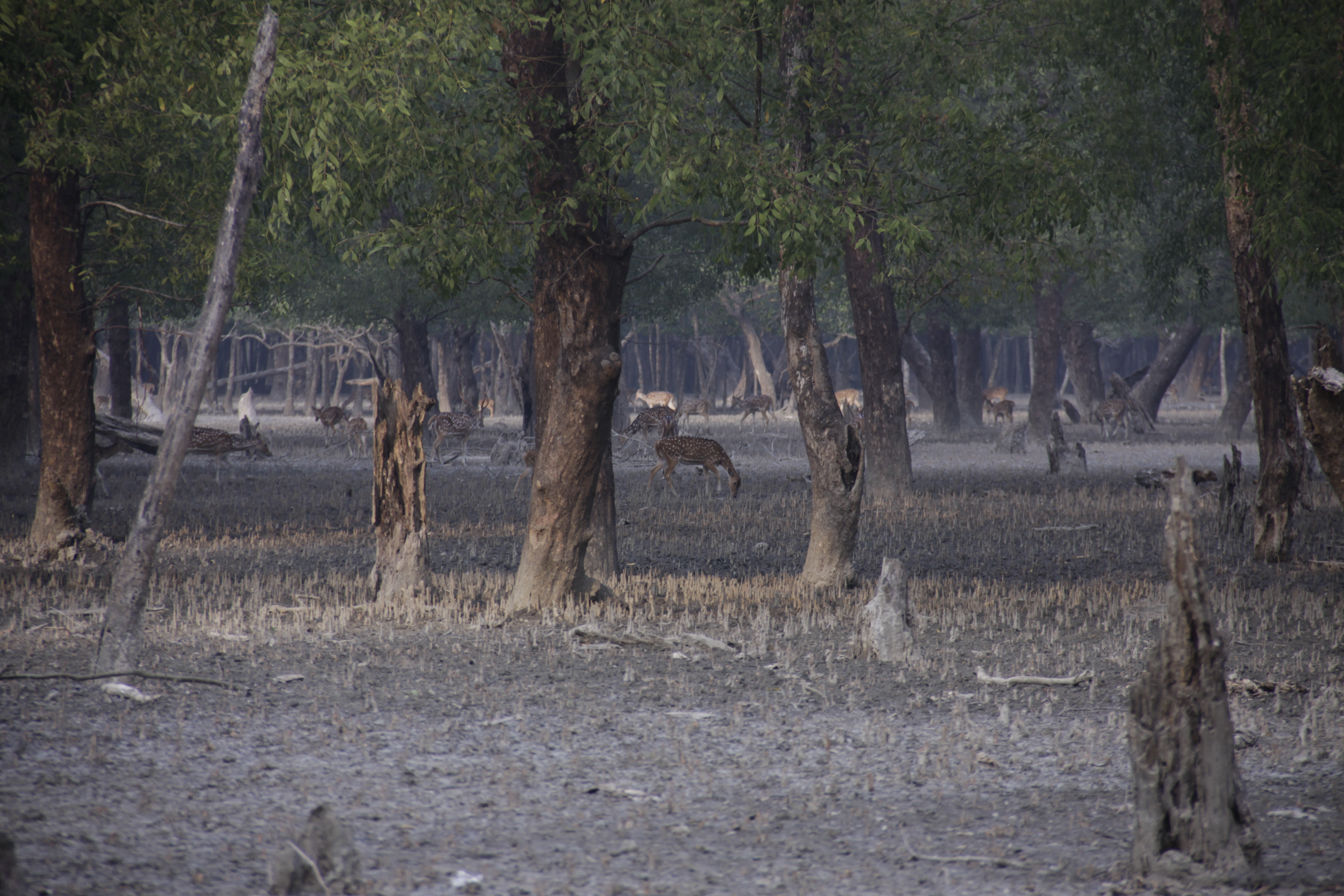
Two species of deer are mainly found in the Sundarbans: the spotted deer, known in Bengali as chitra horin, and the barking deer, known as maya horin. Of the two, the spotted deer is far more numerous, bdnews24.com reported in February 2025. Deer are shy animals, and on hearing people from a distance they try to hide in the dense forest.
The spotted deer, or chital (Axis axis), is native to the Indian subcontinent. It is a medium-sized deer: males stand 90 to 100 centimetres at the shoulder and females 65 to 75 centimetres. Females weigh about 25 to 45 kilograms, and mature stags can reach 98 to 110 kilograms. The upper body is golden to reddish brown and covered in white spots, while the belly, throat, inner legs, ears and tail are white. Only males carry antlers. These have three points, can be nearly a metre long, and are shed every year.
Chital live in loose herds built around adult females and their young. When alarmed they flee together and then hide in dense undergrowth, and they usually stay within about 300 metres of cover. They mainly graze on grasses and eat more leaves, shrubs and fruit in winter, when the grasses are no longer palatable. Their predators include tigers, leopards, pythons and dholes. In the wild they usually live five to ten years.
The IUCN Red List lists the chital as least concern because it occurs over a very wide range with many large populations, but hunting for meat has caused heavy declines and local extinctions. In Bangladesh the species survives in the Sundarbans and some eco-parks around the Bay of Bengal and has disappeared from the central and north-eastern parts of the country.
Deer numbers and the tiger
According to a survey by the International Union for Conservation of Nature (IUCN) in December 2023, there were 136,604 deer in the Sundarbans, bdnews24.com reported. In 2004 the figure had been 83,000, which meant the number had risen by 53,604 in 19 years. Visitors had been seeing herds of deer regularly along the creeks and rivers and near forest offices.
Mihir Kumar Doe, chief conservator of forests for the Khulna region, told bdnews24.com that pirates used to roam the forest all year and that more than 50,000 people from across the country used to attend the Rash Mela at Dublar Char near the end of each year, when large numbers of deer were hunted. Regular patrols by law enforcement agencies and the forest department, fewer pirates and the end of the Rash Mela had reduced hunting considerably, he said. He added that in the dry season, when water in the creeks dries up, deer move about more and poachers become more active.
Deer are the base of the tiger's food chain. The forest department's survey published in October 2024 counted 125 tigers in the Bangladesh Sundarbans, up from 114 in 2018 and 106 in 2015. The survey was carried out in January, April and November 2023 and March 2024 across 2,240 square kilometres of the forest, using 657 camera traps and footprint counts along 1,306 kilometres of creek banks. It found 2.62 tigers per 100 square kilometres and recorded 21 cubs or young tigers, against five in the two previous surveys of 2015 and 2018, Prothom Alo reported.
The government's Tiger Action Plan (2018-2027) says the number of tigers an area can hold depends on the number of deer available there, and that there must be at least 500 deer for every tiger. Spotted deer are the tiger's main prey in the Sundarbans, followed by wild boar and barking deer. M A Aziz, a professor of zoology at Jahangirnagar University and a tiger specialist, told Prothom Alo in January 2026 that a tiger needs one deer weighing 50 or 60 kilograms every week. His team's 2023 study had found an adequate number of deer, he said, but the rate at which deer traps were being set was a cause for concern.
Snares and poaching along the forest edge
Poachers use four kinds of snare to catch deer in the Sundarbans, the forest department told Prothom Alo in January 2026. All are made of nylon rope:
- Mala traps: a rope is stretched from one tree to another, and many nooses are hung from it side by side like a garland. These were the most common.
- Chitka traps: single traps set one at a time in a circle.
- Gola (neck) traps: nooses set a little above the ground that catch a deer by the neck.
- Hata (walking) traps: nooses set near the ground that catch a deer by the leg.
In the eight months from May to December 2025, the Sharankhola and Chandpai ranges of the East division recovered 61,010 feet of mala traps, 380 chitka traps, 2,000 hata traps and 20 feet of gola traps. The West division said that over two years it had recovered 1,200 feet of mala traps, 1,200 feet of gola traps and 748 hata traps. In the same two years the two divisions seized 1,148 kilograms of deer meat from poachers. The East division filed 22 cases against 69 people, of whom 62 were arrested; the West division filed 50 cases against 130 people, of whom 19 were arrested.
According to the forest department, people from Patharghata cross the Baleshwar to enter the forest at Kochikhali and Kokilmoni and set traps there. The East division's divisional forest officer told Prothom Alo that selling deer meat was the occupation of many people around the forest, and he named several areas of Patharghata upazila and Sharankhola among the places where, he said, deer had been hunted for generations.
The snares also endanger tigers. On 4 January 2026, an injured tiger caught in a chitka trap set for deer was rescued near Sharkir Khal in the Mongla part of the East division. In 2012 a tiger lost a leg in such a trap, and in 2014 another tiger that broke free from one later died, Prothom Alo reported. The Tiger Action Plan names deer snares as one of the threats to tigers and notes that many forest users set them as a second source of income, because there is demand for deer meat in local markets.
Residents near the forest told bdnews24.com in February 2025 that deer meat sold for 500 to 600 taka a kilogram in villages next to the Sundarbans and for 1,000 to 2,000 taka in district towns, and that 15,000 to 20,000 taka was asked for a live deer. Professor Anwarul Quadir, executive director of the Sundarbans Academy in Khulna, told the news site that several times more deer were hunted than the meat and skins seized by law enforcers suggested. The government offered a reward of 20,000 taka for information exposing a deer-related crime inside the forest and 10,000 taka for one outside it.
Earlier deer found in villages near the forest
Deer turning up in villages next to the Sundarbans were not new on the date. On 1 February 2026, forest staff rescued a barking deer, with the help of villagers, from the Telikhali area of Chila union in Mongla and returned it to the forest, The Business Standard reported. Dipan Chandra Das, assistant conservator of forests of the Chandpai range, said locals had informed the department after seeing the deer running about. The animal was completely healthy, so it was released back into the Sundarbans.
Local people said the deer had crossed the Pashur river into the village. Das disputed this, saying it was not possible for a deer to swim across the wide Pashur. The initial assumption, he said, was that poachers had caught the animal and then let it go for fear of being caught in public, and an investigation had begun. The report added that several deer had been rescued from villages in Mongla on earlier occasions.
In the Patharghata case of 11 May, the forest department likewise said its investigation into how the two deer reached the villages and how they were wounded was continuing.
What the wildlife law said
On the date of the rescue, wild animals in Bangladesh were protected by the Wildlife (Conservation and Security) Act, 2026 (Act No. 86 of 2026), dated 10 April 2026. It replaced the Wildlife (Conservation and Security) Ordinance, 2026 (Ordinance No. 9 of 2026), issued on 7 January 2026, and is deemed to have taken effect on that date. Section 54 of the Act repealed the Wildlife (Conservation and Security) Act, 2012, although cases filed under the old law continue to be settled as if it had not been repealed. Like its predecessor, the new Act cites Article 18A of the Constitution, which makes the conservation of biodiversity, forests and wildlife a duty of the state.
Schedule 1(kha) of the Act, headed "Protected animals", lists both deer found in the Sundarbans, the spotted deer (Axis axis) and the barking deer (Muntiacus muntjak), along with the hog deer and the sambar. The schedule says the animals on it may not be hunted, harassed, transported, bought, sold, imported or exported in any circumstances without a licence or possession certificate, except where research or scientific needs require it. The Act defines hunting broadly: killing, catching or poisoning a wild animal, chasing it for any of those purposes, or injuring or harming it. The provisions most relevant to deer, as published on the government's Laws of Bangladesh website, are these:
- Section 41(3) and Section 44: hunting an animal listed in Schedule 1(kha) is punishable by up to three years in prison, a fine of up to 300,000 taka, or both; a repeat offence by up to five years, a fine of up to 500,000 taka, or both.
- Section 41(5) and Section 44: collecting, possessing, buying or selling the meat, body parts or trophies of such an animal without a permit is punishable by up to one year in prison, a fine of up to 100,000 taka, or both; a repeat offence by up to two years, a fine of up to 200,000 taka, or both.
- Section 10: no one may keep, rear or hold a wild animal in captivity, or possess, buy, sell or transport one, without a licence, possession certificate or permit; wild animals may not be traded through social media advertisements or markets; all wild animals, their body parts and meat are treated as government property; and cruelty to a wild animal is an offence.
- Section 14: a rescued, seized or captured wild animal must be released into a suitable natural environment, though it may be kept in confinement if it risks spreading disease or needs care.
- Section 12: a wildlife warden, with the approval of the chief wildlife warden or an empowered officer, may remove, cull or rehabilitate a wild animal that threatens human life or is physically disabled or has a contagious or incurable disease, and must report the matter to the advisory board and scientific committee within fifteen days.
- Section 34: the Forest Department may set up rescue centres to give wild animals treatment, food, shelter and security, and may issue guidelines for releasing them into nature.
Section 35 of the Act allows the government to form a Wildlife Crime Control Unit under the Forest Department, made up of officers named in the Act, customs officers and members of law enforcement agencies, to work anywhere in the country, including at airports, land ports and seaports.
Photo: Ashis Kumar Datta / Wikimedia Commons (CC BY-SA 4.0)
Sources: Jagonews24, Prothom Alo, bdnews24.com, The Business Standard, Laws of Bangladesh (Legislative and Parliamentary Affairs Division), UNESCO World Heritage Centre, Wikipedia



Comments
(0)