
By Jahidul Islam Mehedi
Plastic and polythene pollution has become a terrible crisis. These materials do not break down in the soil even in hundreds of years and harm the environment. The effects are clearly visible in Patharghata in the coastal district of Barguna. But it is here that Shafikul Islam Khokon has taken an unusual awareness initiative, working tirelessly to promote giving up plastic and polythene locally.
When pieces of plastic fall into rivers, fish eat them. When people eat those fish, the plastic enters their bodies and creates serious health risks. Research has found that tiny plastic particles (microplastics) are entering human blood and may cause cancer and other diseases. The world's air, water and soil are badly polluted today, and industrialisation, urbanisation and human carelessness are speeding up that pollution.
Fishermen and farmers feel the damage
Abdur Rahim, 50, a fisherman in Patharghata, Barguna, said: "There used to be no great shortage of fish in the river. Now the river is full of plastic and polythene. Whenever we cast a net, this waste comes up instead of fish. Because of it fish are dying, and we are suffering too."
Local farmer Amir Hossain, 45, said: "Our land does not yield crops as before. Polythene from the market mixes into the soil and reduces fertility. Water gets trapped in the soil and roots cannot grow properly."
Patharghata is an important fishing area on Bangladesh's coast. Its river- and sea-based economy rests mainly on fishing and farming, but plastic and polythene pollution is threatening the local ecosystem.
Environmental activist Arifur Rahman said: "Every day we see how polythene falling into the river endangers fish. Plastic breaks down into small pieces that fish eat. If this pollution is not stopped, the coastal economy will be destroyed in future."
One man's campaign
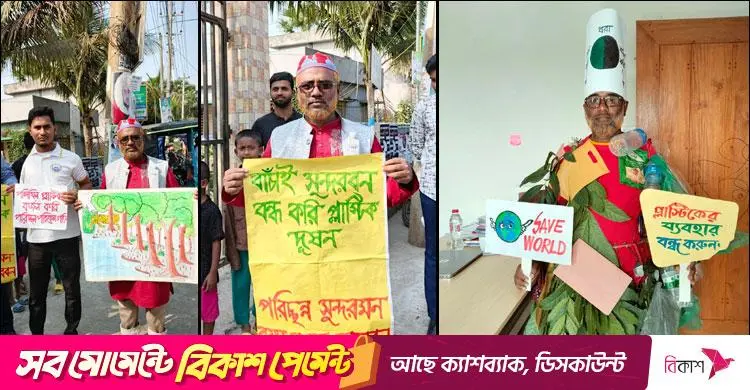
Shafikul Islam Khokon is a nature lover who is building local awareness against plastic and polythene pollution. On his own initiative he visits markets, schools and colleges in Patharghata and fishermen on the riverbanks to explain why plastic must be given up. He also tries to raise awareness through his clothing, and encourages the use of cloth and jute bags.
"Plastic pollution can be reduced only if people become aware. We are campaigning so that people understand what harm plastic is doing to us. If everyone becomes aware, a polythene-free environment is possible. I am regularly running eco-friendly campaigns with school and college students and promoting a plastic-free Patharghata," Shafikul Islam Khokon said.
What needs to be done
Polythene and single-use plastic must be banned, and the use of jute, cloth and reusable bags ensured. The local administration must take effective steps to improve waste management. Environmental education must be spread and plastic kept out of educational institutions. Campaigns in the media and on social media are needed to make ordinary people aware, and eco-friendly policies must be adopted for coastal areas, especially for fishing communities.
Plastic pollution is not the problem of any one area but a global crisis, and its effects are being seen most in places such as Patharghata in Barguna, where it could become even more frightening in future. But this disaster can be prevented through the combined efforts of the government, local administration and ordinary people, alongside individual initiatives. If we stand beside aware people like Shafikul Islam Khokon and all build the habit of living without plastic, we may be able to leave a liveable world for the next generation.
Source: Jagonews24. First published in Bengali on The Agro News.

Comments
(0)