
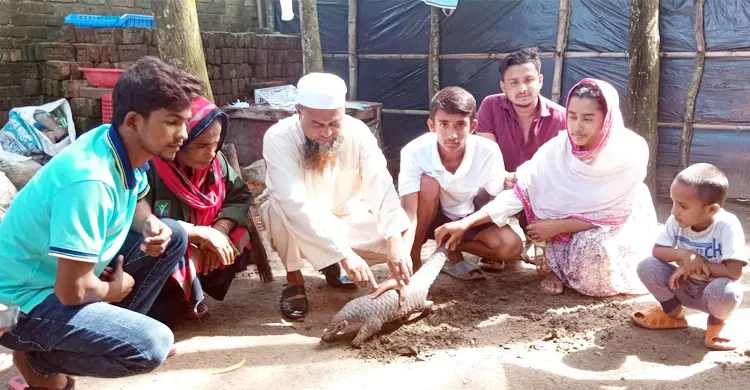
Several species of pangolin, known locally as khuduk, were once seen in the grasslands next to the hills of Cox's Bazar. But their organs, skin and scales are highly valued as raw material for various medicines, making the animal a target for traffickers. It is now close to vanishing from nature.
Though rarely seen, pangolins are occasionally rescued from traffickers. People involved say a single pangolin fetches about Tk 2 lakh on the black market.
A string of rescues
On Friday (15 September) an Indian pangolin (desi banrui) was rescued from Samitipara, a seaside village in Cox's Bazar town. It was identified as the Indian pangolin, known locally as khuduk. About four months earlier the forest department had rescued a pangolin from the same area; it was caught by forest staff as a disabled person was being used to take it to market for sale. In July a pangolin was rescued in Tahirpur, Sunamganj. On 23 June last year police arrested four members of a trafficking ring with two pangolins at Hamid Mia's house near the Shah Amanat bridge in Chattogram. Posing as buyers, forest staff rescued two more: one from Phulbari in Kamalganj upazila of Moulvibazar in February of the same year, and one from Rangichhari tea estate in Kulaura upazila in May of the year before. Two pangolins were rescued from traffickers in Chunarughat, Habiganj, in March 2020 and in Nageshwari upazila of Kurigram in October 2019.
Sources say a ring collects animals from different parts of the country and sells them.
Pangolins are found in Asia and in various African countries. There are 8 species in the world, 4 of them in Asia, and three of the Asian species are found in Bangladesh.
In 2014 the International Union for Conservation of Nature (IUCN) listed the four Asian species as threatened. Of these, the Indian pangolin (Manis crassicaudata) and the Philippine pangolin (Manis culionensis) were listed as endangered, and the Sunda pangolin (Manis javanica) and a Chinese species as critically endangered.
Wildlife conservation officer Asim Mallick said pangolins from Bangladesh are smuggled to China, Japan, Singapore and Malaysia. They are mainly eaten as meat in China and Japan. The scales of the shell are used as buttons on expensive branded clothing and sometimes as jewellery, which is why pangolins sell for high prices.
About the animal
According to zoologists, the pangolin is a scaly, ant-eating animal, one of the eight species of armoured, toothless mammals in the order Pholidota. The English word pangolin comes from Malay and means something that rolls, referring to its habit of curling into a ball to defend itself. An adult pangolin is usually 30 to 90 cm (1-3 feet) long, with a tail of about 26 to 70 cm (about 10-28 inches). Except for its face and underside, its whole body is covered in brown scales made of a kind of cemented hair. Its nose is narrow and pointed, and its long, sticky tongue can extend up to 25 cm (10 inches). Its eyes and ears are also small. Remarkably, its front claws are twice as long as its hind claws. It weighs 5 to 27 kg (10-60 pounds).
Some pangolins, such as the African black-bellied Manis longicaudata and the Chinese M. pentadactyla, live in trees. Africa's large M. gigantea is a ground-dwelling pangolin. All the others are nocturnal, living in burrows by day. They can also swim. Termites are their favourite food, but they also eat ants and other insects, finding prey by smell. In danger, they release a foul-smelling liquid from anal glands and curl into a ball and roll away.
Pangolins are very timid animals and live alone or in pairs. Most species give birth to only one young at a time, though in some Asian species two or three male young may be born. At birth a young pangolin's covering is very soft, and for a time it rides on its mother's back. Scientists are unclear about its average lifespan, but zoologists say pangolins have been observed living up to 20 years in captivity.
Source: Jagonews24. First published in Bengali on The Agro News.

Comments
(0)