
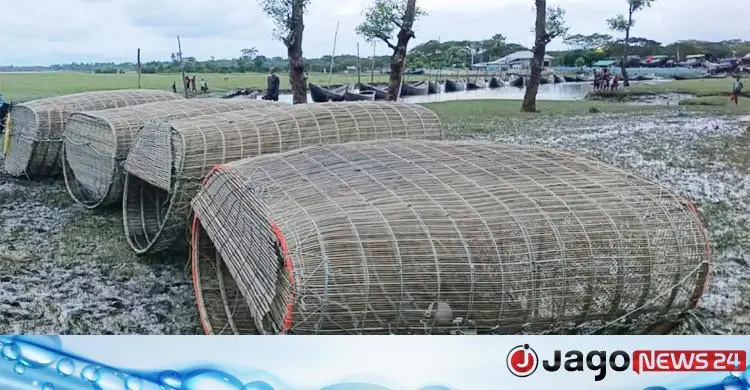
It is late afternoon at the Padma sluice area of Patharghata in Barguna, on the edge of the Bay of Bengal. From a distance a huge object woven of bamboo and net can be seen burning. Up close, it turns out to be a "chai", as it is called locally. Several chai seized by local environmental activists and the administration are being destroyed by fire, because though they look harmless, they are a deadly trap laid across the breeding path of pangas in the rivers and sea.
The team that burned the traps on 21 July was led by environmental activist Arifur Rahman. Drawing on several years of fieldwork, he said: "These chai are pushing the natural breeding cycle of the southern rivers and sea towards destruction. Each chai costs Tk 45,000 to Tk 50,000 to make. They are so big that two or three people can easily get inside."
He said an organised ring in Bauphal upazila of Patuakhali makes and supplies the banned traps and the special bait used in them. The bait, a mixture of dried fish, oil cake, rice bran, sugar, flattened rice and fish oil, is used to lure fish, and the traps are set 40 to 50 feet deep in the rivers.
Two crore fry at risk
Analysing research and field data, Professor Dr Rajib Sarkar of the Department of Biology and Genetics in the Faculty of Fisheries at Patuakhali Science and Technology University said each chai catches an average of about 120 kg of pangas fry a day. The fry are so small that a single kilogram holds about 40 of them. If this continues, at least two crore fry could be destroyed in just six months, which would drive the country's pangas production to rock bottom.
According to marine life expert Dr Md Kamrul Islam, "If just 20 fishermen catch several maunds of fry a day, the natural breeding cycle suffers irreparable damage."
SM Zakir Hossain, general secretary of the Bangladesh Fish Workers' Federation, said: "The chai trap pangas fry only 3 to 7 inches long. They are cleverly sold in the market as 'river tengra' or 'pangas-tengra'. Ordinary buyers, and even many small traders, are not aware of the difference."
Zahir Sikder, a fish wholesaler (aratdar) on Barishal's Port Road, said: "These banned fry are now selling for Tk 500 to Tk 700 a kg in the market. Yet under government rules, catching pangas shorter than 30 cm is completely banned from 1 November to 30 July every year."
Breeding grounds under threat
According to the Barishal divisional fisheries office, several important points in the south are now in the grip of this ring. At least 12 important breeding areas in Patuakhali and Bhola, including Hadir Char, Charguni, Majher Char, Patar Char, Char Borhan, Char Kalmi and Char Montaz, are under threat. The same activity is going on in the Meghna near Nalbunia in Barishal's Mehendiganj, and in the Sugandha, Arial Khan, Kalabadar and Tentulia rivers. The estuaries of the Payra, Bishkhali and Baleshwar in Barguna are no exception.
People involved say that if this deadly method can be stopped, pangas stocks in the rivers could increase many times over. To protect this resource, drives on the rivers alone are not enough; strict surveillance is also needed in the areas where chai are made. If the destruction of pangas by chai cannot be stopped, the country's food security and aquatic biodiversity will face an irreparable crisis.
Hasibul Haque, senior fisheries officer of Patharghata upazila, said: "To avoid fisheries department drives, dishonest fishermen now use WhatsApp live location to tell each other where the chai are, which has made our operations harder. When aware local people find such chai, they seize them and inform fisheries officials. These banned chai have already been burned in several drives."
Source: Jagonews24. First published in Bengali on The Agro News.
Comments
(0)