
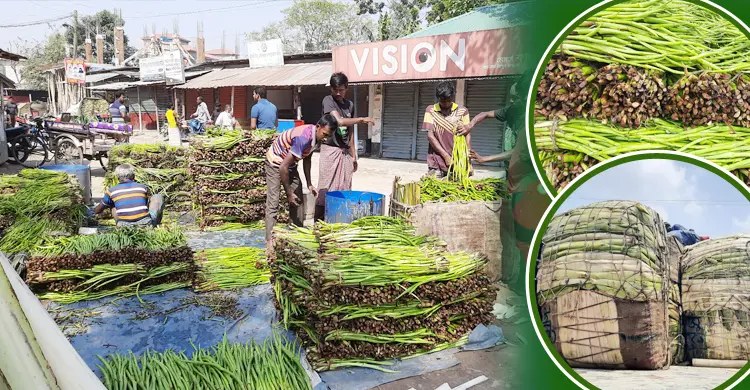
Latiraj kochu (taro) has changed the fortunes of farmers in Panchbibi upazila of Joypurhat. Prized for its taste, nutrition and yield, it quickly became popular and now features in the district's branding. Because it brings more profit for less labour and cost than other crops, farmers are increasingly keen on growing kochu lati (taro stolons). After meeting local demand, it has been exported for the past few years to about 20 countries, including the United States, the United Kingdom and Australia.
How it is grown
According to the Joypurhat district office of the Department of Agricultural Extension (DAE), Latiraj taro is grown in two seasons, from December to January and from April to May. It can be grown from seedlings or from stems. Production starts a month after planting stems and two and a half to three months after planting seedlings. From one or two months after planting, the lati are sold for about seven or eight months. Stems are produced along with the lati.
Farmers spend Tk 20,000 to Tk 25,000 a bigha on ploughing, labour, irrigation, cow dung, DAP, potash, gypsum and urea, and sell lati worth Tk 80,000 to Tk 90,000. They get 3,000 to 4,000 kg of lati from each bigha.
A visit found Latiraj taro growing in ditches and low-lying land across the upazila, including Shimultoli, Dorgapara, Aymarasulpur, Balighata, Koria, Belpukur, Bagjana, Dhoronji and Sluice Gate. Farmers were busy weeding and applying fertiliser.
Farmers said Latiraj taro was first grown on a trial basis in the upazila about 25 years ago. Because it produced a crop and a profit in a short time, it spread quickly among farmers. They are angry, however, that no permanent site has yet been arranged for the lati market.
Farmers and traders
Farmer Lutfar Rahman told Jago News in his field: "From this market in the upazila, kochu lati is exported to the Middle East, Kuwait, Saudi Arabia and various countries in Europe. More than 300 workers are employed in processing, which has created jobs for many unemployed people in the area."
Farmer Dolon Kumar told Jago News: "Last year I grew lati on 3 bighas. This year I have grown it on 4 bighas. Demand for kochu lati is so high that it sells as soon as it is taken from the field to the local markets. It costs Tk 20,000 to Tk 25,000 to grow a bigha of taro. Selling the lati and the taro brings a profit of at least Tk 70,000 to Tk 80,000 a bigha."
Nurul Amin, a lati grower from Dorgapara village, said: "Many people in our area have become self-reliant by growing lati. Although the full season is six months, it yields all year round. Last year I grew it on 1 bigha. This year I have planted 3 bighas, and I have been getting good yields since last month."
Abu Zafar from Dhaka and Siraj from Chattogram told Jago News: "In the season, 60 to 80 tonnes of lati are sent every day from this lati market at Botoli to various districts. We are buying lati from farmers at Tk 50 to Tk 60 a kg, depending on the type, and sending it to different districts."
DAE deputy director Agriculturist Mst Rahela Parvin told Jago News: "This season kochu lati has been grown on about 1,800 hectares in the district, which could produce 80,000 tonnes of lati. Farmers are being given the advice they need to raise lati production."
Source: Jagonews24. First published in Bengali on The Agro News.


Comments
(0)