
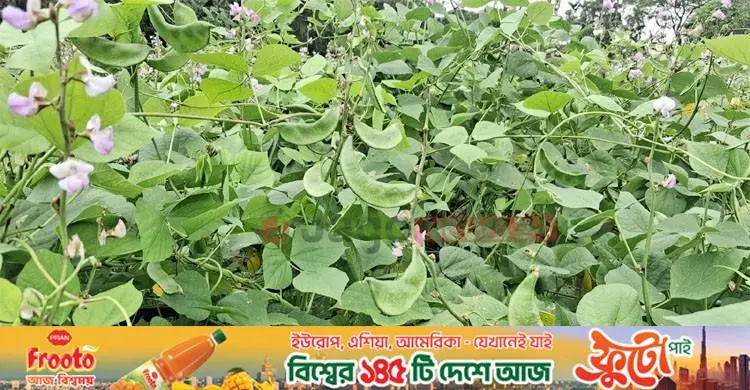
Before daylight has fully spread, farmers are already arriving one by one in the fields of Chandipasha Charpara. Some carry bamboo baskets, others bags for picking beans. Young beans hang among the green leaves on the trellises, and the farmers pick them busily before sorting, weighing and preparing them for market.
Behind the bustle is a simple sum: little land, relatively low cost and good prices from getting beans to market before the season. For farmers in Chandipasha Charpara village of Chandipasha union in Pakundia upazila, Kishoreganj, early beans are no longer an experiment but one of their main sources of extra income.
The numbers from two farms
Farmer Gias Uddin's accounts are the best example. Growing early beans on 20 decimals of land cost him about Tk 6,000. He has already sold about Tk 30,000 worth, and expects to sell about Tk 1.4 lakh more from the beans still in the field. If all goes as expected, his total sales from the 20 decimals could reach about Tk 1.7 lakh, a possible net profit of about Tk 1.64 lakh after costs.
Gias Uddin said he has been growing early bean varieties for about seven years. With good yields and prices every year, it is now a regular crop for him. Early beans bear fruit faster than many other crops, and selling when market supply is relatively low brings a good price. That is why he plans his bean land afresh every year. Many other farmers in the village have also turned to early beans.
On the plot next to Gias Uddin's, farmer Faruk Mia has built bean trellises on 35 decimals of land this year at a cost of about Tk 15,000 to 16,000. He has already sold about Tk 30,000 worth and hopes to sell about Tk 2 lakh more from the beans in the field, taking total sales to about Tk 2.3 lakh and a possible net profit of about Tk 2.14 to 2.15 lakh.
Faruk Mia said: "I have been growing early beans for about 10 years. If you catch the early market you get a good price. So although there is risk in growing beans alongside other crops, the chance of profit is also higher."
Seeds from Pabna, then their own
Local farmers say early bean varieties were first grown in Chandipasha Charpara about eight to 10 years ago, when a few farmers brought seed from Pabna and tried them out. Good yields and profits from those first crops drew in others; one farmer would see another's trellis and start growing beans too. Gradually the area under early beans grew, and many farmers in the village now grow them. Some no longer buy seed from the market each year but save seed from the best beans in their own fields for the next season.
Seed saving is another success. Although they first brought seed from outside, as they gained experience the farmers began collecting seed from their own high-yielding plants. They say this has cut seed costs, and seed adapted to local soil and weather gives better yields. Alongside their own efforts, advice from the agriculture department on controlling diseases and pests is also becoming important.
Sub-Assistant Agriculture Officer Mohammad Jahangir Alam said: "The soil of the Chandipasha area is very suitable for early summer beans. With demand in the market, farmers are getting good prices. The upazila agriculture department is providing vegetable incentives, advice on protecting crops from diseases and pests, and technical support on various aspects of cultivation."
Pakundia also has a record of incentives to encourage vegetable growing: in the 2025-26 fiscal year the upazila agriculture department distributed seeds of various vegetables and fertiliser to farmers.
Small plots, big returns
Look across the fields of Chandipasha Charpara now and you see trellis after trellis, with farmers picking beans in one place, sorting in another and preparing loads for market in a third. A crop started a few years ago by a handful of farmers has spread to others, one person's success encouraging the next. Gias Uddin's 20 decimals and Faruk Mia's 35 are not just two families' accounts; they show that by matching the right crop to the right time and market demand, even small plots can bring farmers a large income.
So the farmers of Chandipasha Charpara now do new sums with every bean hanging from the trellis: how much was spent, how much sold, how much more will sell. Low-cost cultivation, an early market and the hope of good prices have together made beans more than a vegetable here; they have become a crop of new income opportunities.
Source: Jagonews24. First published in Bengali on The Agro News.

Comments
(0)