
By Kamrul Hasan Hridoy
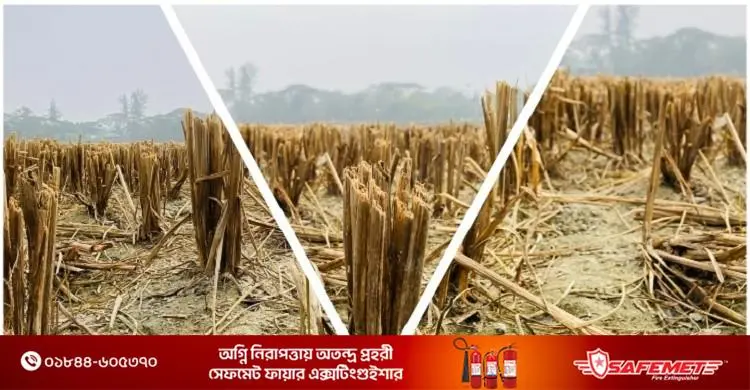
As the cold mornings of Poush arrive, a familiar sight appears in the countryside. As far as the eye can see, the remains or stumps of paddy plants stand in the wide crop fields, known locally as nara. After the paddy is cut in Poush, this stubble quietly announces that another chapter of the farming year has ended.
Nara was once at the centre of rural life. Houses were built with paddy straw, and people lived in them through the monsoon, summer and winter. With changing times, straw houses are almost extinct and brick-and-cement buildings have gone up even in the villages. Still, nara survives as an essential part of the rural economy and farm life.
Still part of the farm economy
According to the agriculture department, paddy is still the main crop on most farmland. After this season's harvest, farmers leave the stubble in the fields for a while, then plough the land to prepare it for the next crop. Other crops are grown on this land through January and February, and this continuous cultivation keeps the rural economy going.
Nara is not just what is left after harvesting. In this livestock-dependent area, straw from the stubble is the main feed for cattle and goats. Many farmers collect it and build straw stacks to store for the whole year, and when straw prices rise, it also serves as a source of extra income for farmers.
Fires, stories and memories
Many memories of rural life are tied to nara and the Poush cold. Cutting and piling up stubble to warm oneself by a fire on winter mornings and evenings was once a familiar scene in rural Bengal. Storytelling sessions gathered around those fires, with talk of market news, crop accounts and the joys and sorrows of the village.
Md Rakib Mia, who has returned from working abroad, said that as a child, cutting nara to warm themselves by a fire morning and evening was a normal part of life. That warmth cannot be found in the mechanical life of the city, he said, and whenever he stands in a field and sees the stubble, his childhood days come back to him.
Saiful Islam said: "Even about five years ago, after the harvest, village children would gather the paddy left in rat holes and sell it. Traders went from house to house giving jilapi by the weight of the paddy, along with rosh-poa and gulgula. These small joys were the great rewards of a rural childhood."
Farmer Babul Mia said: "The paddy yield is good this season, but with production costs up, we are not as well off as before. Once the granaries were full; we could sell paddy even after feeding ourselves. Now it is often a struggle just to make sure the family has enough to eat."
According to people involved in agriculture, straw houses have disappeared with the modernisation of farming, but nara remains deeply tied to rural life. It is part of the farmer's production on one hand and a support for livestock on the other, and it also carries rural memory and history.
At the end of Poush the land will be ploughed again, the stubble will mix into the soil and new crops will rise. Yet the nara lying in the fields will be a reminder of how farming and memory live side by side, something that changes with time but never disappears entirely.
The writer is a fiction writer and journalist.
Source: Jagonews24. First published in Bengali on The Agro News.


Comments
(0)