
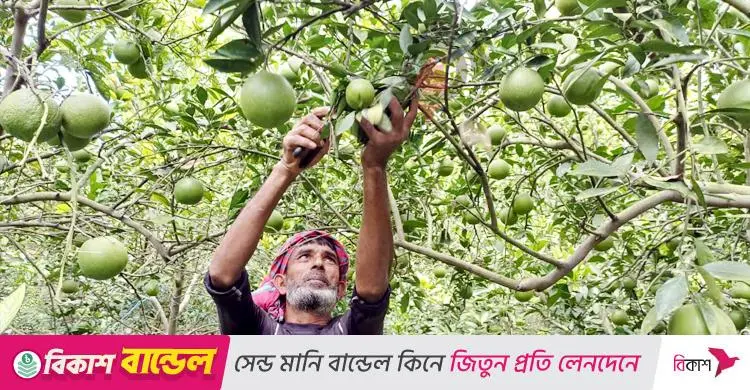
Shamim Akter Tuhin once grew guava and banana orchards, but repeated losses left him at a loss what to do. He had given up a job and other business, dreaming of success in farming, and that dream was clouded by despair. Now a success story has grown around him on a char of the Padma.
Tuhin, son of Abdul Jalil Biswas of Kolchori village in Char Tarapur union of Pabna Sadar upazila, is changing his fortunes with the local variety BARI Malta-1. With good yields and prices on char land suited to malta, his 18-bigha orchard now earns him at least Tk 15 lakh a year. It has also created jobs. Because the malta sells for twice the cost of growing it, the profit is large. Following his lead, farmers who have lost money on murikata onions year after year are showing interest in the variety.
Losses before the turnaround
"In 2009 I started with a jujube (boroi) orchard as a hobby," Tuhin said. "Later I earned a little from guava on 55 bighas. Then I planted guava and banana on 18 bighas, so in all the orchards covered about 70 bighas. But Cyclone Amphan and coronavirus finished everything. I lost roughly Tk 50 lakh. Finally the malta orchard gave me hope again. The char soil of the Padma is sandy loam or silt, so yields are good. Prices and yields were low at first, but this year, with a comparatively good market and yield, I am in profit. After costs I will earn about Tk 15 lakh a year."
He said that, hoping to recover, he leased 18 bighas of char land that had risen in the Padma in 2022 and started growing malta. He planted 1,700 BARI Malta-1 seedlings from a nursery in Chuadanga. The first harvest was 500 maunds, but he was not discouraged. In the following years the yield was 700 and then 900 maunds. With favourable weather, at least 1,200 maunds can be marketed this year. At the current Tk 2,500 a maund, that would be worth about Tk 30 lakh.
"Malta is picked from the orchard once a year at this time," Tuhin said. "Fertiliser twice a year costs Tk 1 lakh, pesticide Tk 2 lakh, organic fertiliser Tk 40,000 and labour Tk 5 lakh. On top of that, land at Tk 20,000 a bigha comes to Tk 3 lakh 60 thousand, and with marketing the total cost is Tk 12-15 lakh. The malta is sold to wholesale depots and shopkeepers in Pabna town, Kashinathpur and Sujanagar."
"People in this country show an extra liking for anything with a foreign name, and fruit is no exception," he said. "If people bought more local fruit instead of leaning towards foreign fruit, the market would be good and our interest in growing it would increase. The market price now is Tk 2,400-2,600 a maund. It will rise later, possibly to Tk 3,000 to 4,000."
Workers and neighbours
Farm worker Sanowar started on a wage of Tk 7,000; with rising profits and market prices he now earns Tk 18,000. He said there is no especially hard labour in the orchard: "Malta orchards do not take as much work as other orchards or fields. The work is easy. There was little fruit on the trees at first, but this year a lot has come, and it tastes good. If the price is good, the owner will make a good profit this time."
Another worker, Sarowar, said: "I have been with the owner from the beginning. Because the soil and weather are good, there has been hardly any disease in the orchard so far. Sometimes the leaves curl because of mites or fungus. Then I show the owner and apply pesticide as he advises, but that is very rare. Otherwise no extra fertiliser or pesticide is used. There is a lot of fruit this time, hanging in clusters on every branch. There will be a big profit this year."
Local farmer Abdur Rahim, who came to see Tuhin's orchard, said: "I grow onions on this same char every year. I kept seeing from a distance and hearing that good malta had grown in this char soil, so I thought I would come and see. The trees are bearing well. At Tk 2,500-2,600 a maund there should be a good profit. I am wondering whether we could take up this crop."
Farmers Hanif, Sabuj and Rashid said: "Growing murikata onions has left us completely crushed by debt. Apart from the odd year it happens almost every year. Last year many people lost Tk 60,000 to Tk 1 lakh per bigha. Still, when the season comes we plant again; what else would we do but farm? But Tuhin bhai is making a good profit from malta. A profit of about Tk 10 lakh a year would be a lot for us. If it pays, we will plant orchards like this too."
DAE support
Md Jahangir Alam Pramanik, deputy director of the Department of Agricultural Extension (DAE) in Pabna, said: "Malta used to depend mostly on imports. Now its cultivation is becoming more popular in the char areas. The fruit is quite sweet, so there is demand in the market. It has been grown on 19 hectares in Pabna. The agriculture department has been supporting growers to expand cultivation and improve yields."
"At first they did not get good prices because they did not know the right time to harvest," he said. "Picking early meant lower weight and taste, and so lower demand. That problem is gone now. We are giving the necessary advice and support and will help anyone who is interested. I hope malta cultivation will grow further."
Source: Jagonews24. First published in Bengali on The Agro News.
Comments
(0)