
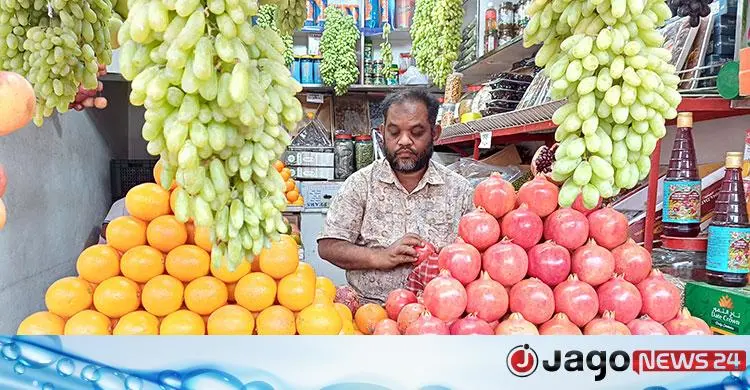
The fruit market in Pabna has become volatile around Ramadan. Prices have risen by Tk 30 to 70 a kg, with apples and malta rising the most. For low-income people, breaking the fast with a slice of apple or malta has become almost impossible.
Although Pabna is known as an agricultural district, no fruit other than jujube (boroi) and guava is grown there, so demand is met with fruit brought in from Dhaka, Sirajganj and Natore. Prices were somewhat lower about two weeks before Ramadan, but began to heat up from the week before it started.
The heat rose further from two days before Ramadan to the second day of the month, when prices went up by Tk 50 to 100 a kg. Prices have eased a little since, but buyers are still paying Tk 30 to 70 more than before Ramadan.
What fruit costs now
Red apples now sell at Tk 380 a kg. From before Ramadan to the start of the second day of Ramadan the price rose to Tk 400; before Ramadan it was Tk 340-350. Fuji apples now cost Tk 340, up from Tk 300 before Ramadan. Gala apples have similarly risen to Tk 420 and green apples to Tk 400. Kinnow oranges that were Tk 220 now sell at Tk 260, mandarin oranges at Tk 350 from Tk 320, pears at Tk 440 from Tk 350, and malta at Tk 340 from Tk 300. Pomegranates that were Tk 500-580 depending on size now sell at Tk 520-610, though before that their price was Tk 350-400.
Among cheaper fruits, pineapple sells at Tk 70 a kg and this season's watermelon at Tk 80; Jannat watermelon sold at Tk 100 at the start of Ramadan. Jujube, which sold at Tk 150 up to the second day of Ramadan, now sells at Tk 100, and bananas at Tk 30-40 for four. Dates sell at Tk 280 to 1,700 a kg depending on quality; from a week before Ramadan to its first day they sold at Tk 100 to 200 more. Grapes, however, have become cheaper: ordinary or green grapes now cost Tk 400-420 a kg, down from Tk 450. Red grapes have fallen from Tk 600 to Tk 550 and black grapes from Tk 600 to Tk 560.
Buyers turn to local fruit
Buyers say that with fruit beyond the reach of ordinary people, the low and middle classes are turning to local fruit, but there is no relief there either, as all fruit, local or imported, is expensive. They want market monitoring stepped up to curb sellers raising prices opportunistically.
Hafiza Hasan, shopping at fruit shops in Pabna town, said the body needs vitamins and other nutrients after fasting all day, so some fruit should be kept at iftar. She was going from shop to shop, but at these prices she could not afford any. Jujube and guava were within reach for now, though they too were comparatively overpriced. Since she had to buy, she would reluctantly take a few apples and malta at the higher price.
Another buyer, Raisul, said fruit prices began to rise from the week before Ramadan and rose sharply over the two days before and on the first day of fasting, by as much as Tk 100 for some fruits. Sellers manipulate prices on the pretext of short supply, he said, and many shopkeepers charge more than the price lists they hang up to show the administration. This is how the market has moved beyond ordinary buyers, especially low-income people.
Rickshaw puller Matin and Azmat Sheikh, who works in a labour post at a local private company in Pabna, said it is a struggle just to buy vegetables and daily essentials; buying one thing means going without another. Fruit is a great luxury for them. One apple costs Tk 50-60. A rickshaw puller now earns at most Tk 400 a day after paying rent and charging, and the job pays Tk 500. With that, there is no chance of breaking the fast with fruit even if they want to.
Sellers point to supply
Fazlu of Bismillah Phal Bhandar said prices were a little higher from a few days before Ramadan to its start and have fallen somewhat since. They sell with a price list displayed and do not overcharge, he said.
Rafid Islam of New Pabna Phal Bhandar said high prices hurt sellers as well as buyers, because sales fall. They too want prices to stay bearable so everyone can come and buy fruit, but these things are not in their hands, he said.
A fruit seller who did not want to be named said Pabna's fruit market depends on fruit traders in Dhaka, Sirajganj and Natore. Local importers bring fruit from them and it then spreads to the shops, with most coming from Dhaka, so the market goes the way they control it. There are also some problems with local importers, he said, because prices outside town, in Kashinathpur in Bera or other upazilas, are somewhat lower.
Manju of Mayer Doa Phal Bhandar said sales are lower than in other Ramadans. Demand rises in Ramadan while supply falls, so prices go up a little, and there is nothing sellers can do. A profit of Tk 30-50 a kg depending on the fruit is the most they want, he said, because fruit is perishable and 2-3 kg per carton is spoiled in transit.
Mahmud Hasan Roni, assistant director of the Directorate of National Consumer Rights Protection in Pabna, said many fruit traders use the extra Ramadan demand to destabilise the market, causing hardship for buyers. To ease this, markets have been monitored regularly since the start of Ramadan, with fines and other action whenever overcharging or irregularities are found. On Wednesday, drives were carried out at fruit shops in Hajirhat and other places, he said, adding that they are doing their utmost to protect consumers' right to buy at fair prices.
Source: Jagonews24. First published in Bengali on The Agro News.


Comments
(0)