
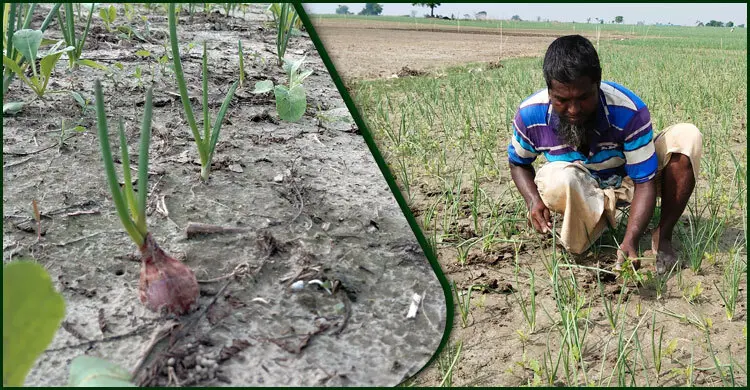
Pabna farmers usually plant the early murikata onion in the first week of October. Because this onion reaches the market before the main seasonal crop, it keeps supply normal and brings the market under control.
This year, however, repeated spells of excessive rain left water standing in onion fields, and planting had to be delayed by two to three weeks. With more rain in the meantime, seed in low-lying land is rotting before it can germinate. Farmers fear production will be somewhat lower this year. At the same time, costs have risen because seed, fertiliser and pesticide were bought at high prices, leaving them worried about profits.
The agriculture department, however, says that although costs have risen, the late planting and limited rotting will not have much effect on yield, and farmers will profit from good prices.
Rising costs
Farmers say the price of murikata onion seed has gone up. Seed that cost Tk 5,000-6,000 a maund had to be bought this year for Tk 8,000-9,000. A bag of BADC DAP fertiliser that cost Tk 1,000 is now Tk 1,200-1,250, and Bangla DAP has risen from Tk 1,500 to Tk 1,700-1,800. Labour and other costs have also risen across the board.
Meanwhile, waterlogging from repeated heavy rain has also put them behind with planting. With further rain, seed in low land is rotting underground, and in places even seedlings that have germinated are rotting. Replanting in these places will add to costs, delay the crop's arrival in the market and reduce the yield.
Arif, an onion farmer at Mujahidpur in Sujanagar, said: "Because the rainwater was slow to drain from the land, we fell behind with planting this year. Some land is still not fit and has not been planted. We will have to plant seed there in three or four days. Because of this delay we will take a hit on yield. When sown late, the plants flower more and the yield is lower. Where we normally get 60 maunds a bigha, this year it will be 5-10 maunds less. It will also reach the market late." He said he was worried about getting a good price.
Makbul Mia, a farmer in the same area, has planted onions on three bighas. Saying costs had risen sharply, he said: "This year it cost about Tk 1 lakh to Tk 1.15 lakh a bigha to plant onions. Fertiliser, pesticide and seed prices are far too high. It will cost nearly Tk 2,500 to bring one maund of onion home. We are farming on loans, which carry interest. Unless we can sell at Tk 4,000-5,000 a maund, it won't pay."
A Majid, a farmer in Gopalpur village, said: "I have grown murikata onion on 10 bighas this year. Of that, the onion on five bighas has been ruined by the rain. Costs were already up because I bought seed at a high price, and replanting the ruined onion doubles the cost. It's hard to say what fate holds this time."
'We grow it, traders profit'
Several farmers, including Rafiq, Ifnus Mridha and Zahirul Islam, were tending newly germinated onions in the field. They said yield would be lower this year because of late planting. "If we get a good price, farmers might survive. But that doesn't happen. When we go to buy in the market it's Tk 150-200 a kg, but when we go to sell there is no price. This is how we are cheated. We grow it, but the traders reap the benefit. Costs are high this year and almost all of us have farmed on loans. To save farmers, our appeal to the new government is to set a fair price," they said.
The agriculture department says Pabna, a northern district, produces one third of the country's onions. They are grown in several upazilas including Sujanagar, Santhia and Bera. This year the onion cultivation target in Pabna has been set at 52,801 hectares, of which murikata accounts for 8,580 hectares. Against that, 2,123 hectares have been planted. The production target has been set at 1,22,596 tonnes. This onion takes at most 80 days to reach the market, though this year it will take less because the soil is richer after the rain. Overall, the agriculture department expects it to reach the market towards the end of December.
Roknuzzaman, additional deputy director (crops) of the DAE in Pabna, said: "Because of the rain, onions in Pabna were planted in the second week of October this year. Even so, farmers are not behind, because the season for murikata onion runs until November. Also, only a very small amount of onion in low land may rot because of the rain. That will not have much effect on yield. If the weather stays good, farmers will get a good yield, and with good prices they will profit."
Source: Jagonews24. First published in Bengali on The Agro News.

Comments
(0)