
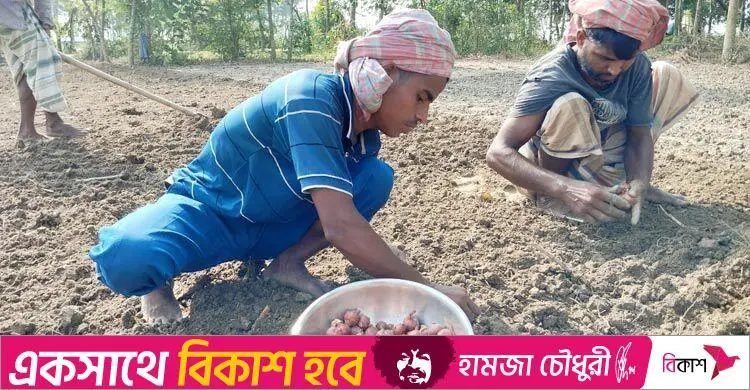
Rice is the most widely grown crop in Pabna, followed broadly by onions and various vegetables. For seed, however, farmers depend almost entirely on government and private organisations. Apart from rice, Pabna farmers do not save seed of these crops, so they buy seed every season. This raises costs, and adulterated seed cheats farmers and hurts output.
Across Pabna's nine upazilas, the green shoots of murikata onions are now swaying in the fields, and these onions will start reaching the market within one to one and a half months. Preparations have also begun for planting seedling (hali) onions, especially in Santhia, Bera and Sujanagar upazilas. Many have already sown onion seed in beds, and some who have raised seedlings are preparing land and transplanting. While some farmers save murikata seed, farmers in this region do not keep seedling onion seed at home, so they buy it from nearby shops or dealers at planting time. Some source it from Kushtia and other districts.
Weak seed this year
Swapan, a farmer from Mathurapur in Sujanagar upazila, farms with his father and elder brother. This season they are preparing to grow seedling onions on 30 bighas, for which they sowed 26 kg of onion seed sourced from Kushtia. The seedlings are nearly ready to transplant, but fewer came up than in other years, which worries the family.
"We keep rice seed at home," Swapan said. "Some farmers keep murikata seed, but almost no farmer in our area saves seedling onion seed. Government seed is not easy to get at planting time, so people take seed from various companies. We usually don't take company seed; for several years we've bought from a farmer in Kushtia. But this time the seed has partly failed."
He said seedlings are usually reckoned at one kg of seed per bigha, but when the seed germinates properly one kg can plant more than a bigha, nearly one and a half. "That won't happen for us this time. One kg's seedlings will cover at most one bigha."
Most Pabna farmers do not save vegetable seed either. What one or two produce does not meet even minimal demand, and government seed is hard to come by. So vegetable growers rely on seed from private companies or organisations. Seed from one or two companies does well, but farmers are often harmed by adulterated seed.
Farmers have no control over seed. To meet demand and chase higher yields, the cultivation of local varieties of all crops has fallen sharply and hybrids have taken over. Farmers play no part in developing these varieties or storing their seed, so they have none at home. Even where seed of some crops could be saved, they do not keep it, for various reasons.
Why farmers do not save seed
Nasir, a farmer from Shukchar in Sadar upazila, said: "We mainly grow onions. Murikata seed has to be kept from seedling onions. We could keep it if we wanted, but we don't. Most of us have no good way to store it, so a lot of onions rot, dry out or spoil in other ways. So we don't keep it."
Rakib, a farmer in the Gajnar Beel area, said: "At the start of the season we farm on loans and borrowed money. When the onions come in, the loans press on us, so we have to sell everything. Sometimes we can keep a little. So we sell cheap at harvest and have to buy at extra cost at planting time."
Shahin Alam, a national award-winning farmer from Ishwardi, explained the main obstacle. The population is rising fast, he said, and so is demand for food and farm produce, but the land stays the same. So the same land is now farmed with modern methods, and to raise output farmers must grow high-yielding hybrid varieties, most of which depend on technology. Seed storage depends entirely on modern technology that farmers do not have, so they are forced to rely on government and private organisations for seed.
He said that given the multiple uses of land and the need for high yields, there is little room to do otherwise, so farmers generally do not save seed. But he does not see this as a big problem; the availability of fertiliser, pesticide and other inputs is farmers' main concern, he said.
BADC supply against demand
Agriculture department data show that in FY2024-25 the district needed 1,929 tonnes of boro rice seed, 1,920 tonnes of aman, 18,018 tonnes of murikata onion, 332 tonnes of seedling onion, 3,575 tonnes of wheat, 342 tonnes of mustard and 328 tonnes of jute seed. Against this, BADC supplied 2,251.9 tonnes of boro seed, 1,010.4 of aman, 58.69 of murikata onion, 1.5 of seedling onion, 1,883 of wheat, 221.2 of mustard and 46.53 tonnes of jute seed. In all, demand for these crops was 26,444 tonnes, and BADC distributed 5,473.22 tonnes, meaning farmers could get only 20.70 per cent of their seed from BADC. The remaining roughly 80 per cent had to come from private organisations and other sources.
The agriculture department has not been able to estimate vegetable seed demand in Pabna, but the scale of vegetable farming across the district shows it is substantial. New varieties are constantly being developed, and farmers lack the technical capacity to store their seed, so they cannot save seed of hybrid crops. Little such seed is available from the relevant government departments either, so every season they worry about seed, and shortages of fertiliser and pesticide add insult to injury.
Md Jahangir Alam Pramanik, deputy director of the Department of Agricultural Extension (DAE) in Pabna, said it is not possible to give government seed to every farmer. "By our reckoning, 70 per cent of seed is supplied by private organisations or entrepreneurs. We work to ensure the quality of their seed so that farmers get good seed and are not cheated," he said.
He said smallholders mainly farm to meet their own needs and do not want to keep seed. "For those who do want to store seed, we provide all kinds of support, including technical help. For example, high-flow machines are being installed for onion storage. Although Pabna farmers do not keep much seed at home, there is no seed shortage."
Source: Jagonews24. First published in Bengali on The Agro News.
Comments
(0)