
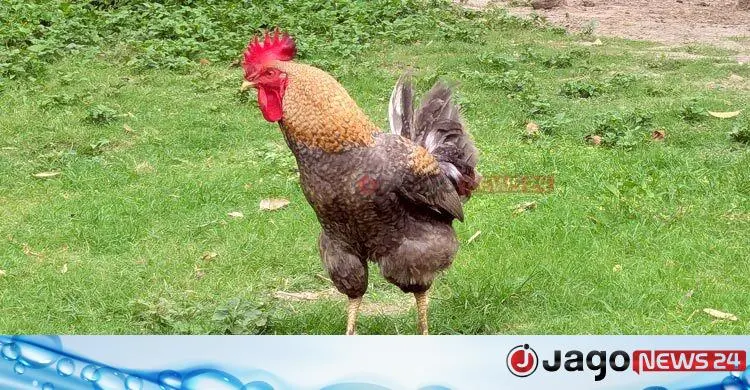
"There is a saying: the in-laws' house is a pot of honey. It is very true. In our time, going to the in-laws' meant all kinds of pitha and other food. As soon as you entered the in-laws' house you would hear a great commotion of 'catch it, catch it!' That was the sound of them catching a crested, full-voiced rooster. A home-reared deshi rooster was caught for the son-in-law. Even if there was fish or other food at lunch, the son-in-law was treated to that rooster at night."
This is how Abdur Rahman, 60, of Sadirajpur in Dogachhi union of Pabna Sadar upazila, recalled visits to his in-laws.
Abdur Rahman says he last went on a naior (a visit to the in-laws) about 15 years ago. On that last visit he did not get a rooster; he was served a deshi hen raised in the open at home.
From rooster to beef
Perhaps it was from around then that the days of honouring a son-in-law with a big-crested deshi rooster began to fade. Roosters are no longer caught when a son-in-law or relatives visit. Beef has taken their place, along with some buffalo or goat meat. The reason is that deshi roosters and hens are no longer reared in the open in villages as they once were.
Abdur Rahman said: "After harvesting the chaitali crops we would have some free time. The in-laws knew this was when the son-in-law would come with their daughter. We also went around various festivals. The big rooster was kept waiting for the day we would visit. They would never slaughter and eat it themselves. Instead they would send word in various ways that the big rooster had been kept and we should come quickly, since you never know when a fox or mongoose might take it or it might fall ill. Then when we went, everyone in the house would run around to catch the rooster. If there were no boys at home, neighbours' boys were called to catch it. That doesn't happen now."
He said: "It wasn't only for sons-in-law; a big rooster was killed for any relative who came. How well a guest had been treated was judged by whether a rooster had been killed for them, and if so, how big it was. These festive customs are completely gone now. So are the roosters and hens."
The old man added: "Chickens aren't reared at home the way they used to be. Our houses used to keep chickens in two or three coops. Every morning the coop doors were opened and the birds were fed in the yard, which would fill up with them. The children loved watching. Now this is just a story. Nobody rears chickens like that. Women today see it as a hassle, and a large number of them think it is dirty work. So deshi hens and roosters are hard to find now."
Scarce and expensive
Enquiries prompted by Abdur Rahman's claim found that chicken rearing in the open has indeed declined in the countryside. Most of Pabna's villages are villages in name only; their atmosphere is largely urban, and life follows urban thinking and ways. As a result, most villages no longer keep these domestic birds as before. In the most remote villages of Chatmohar, Santhia, Bera, Sujanagar, Bhangura, Faridpur, Ishwardi, Atgharia and Sadar upazilas, comparatively more deshi chickens are still reared, but numbers have fallen by almost half compared with 10-15 years ago. Their prices have risen abnormally, and finding the prized big-crested red rooster has become next to impossible.
Md Shafiqul, a chicken seller in the chicken lane of Pabna town, told Jagonews24 that although there is demand, deshi chickens have become hard to get and are very expensive. They are currently selling at Tk 740-750 a kg.
Saying he had had no deshi chickens for two days, the seller added: "We usually buy from middlemen, but they are getting fewer chickens too. They go from village to village and still can't find them. Before, you would often see householders sitting with their chickens at markets and street corners."
Shahidul Alam bought a chicken at the Boi Library crossing in Pabna town. "Someone was sitting at the crossing with three chickens, which he said were reared at his home," he said. "I had been looking for deshi chicken for several days but couldn't find any. Who knows whether what the shops sell is really deshi? So I try to buy from householders, but they are not available as they used to be."
Why the change
Ruhul Amin, associate professor and head of the Bengali department at Government Edward College, said: "As children we saw our mothers, after prayers at dawn, feeding a flock of chickens in the yard. Such scenes have come into literature through description and in other ways. But you don't see that now."
Explaining the reasons, the literature teacher said: "People used to be self-reliant, because things were not so readily available then. Now they are; everything is within reach. So we have moved away from self-reliance and producing for ourselves, to a policy of getting things as easily as possible without labour. Besides, various hybrid chickens have come in, and they grow fast. Houses also used to have open yards, which made rearing easy; now there is not enough of that either. For these reasons you don't see chickens reared at home as before, and hospitality has changed too. But it is not dying out. Some people are rearing deshi chickens commercially, and it still goes on to some extent in villages."
Pabna district livestock officer Dr Md Zahurul Islam said everyone now approaches everything commercially, and deshi chickens offer little profit, while broilers, Sonali and other hybrid chickens offer more. So people are turning mostly to hybrids.
He added that demand for chicken meat and eggs was growing over time and could not be met with deshi chickens. A deshi hen lays at most 30-36 eggs a year in several clutches, compared with about 320 for the hybrid breeds, which also grow much faster. That is why farmers have little incentive to rear deshi chickens. But it is not that they are not reared at all, he said; because there is demand, some production still goes on.
Source: Jagonews24. First published in Bengali on The Agro News.
Comments
(0)