
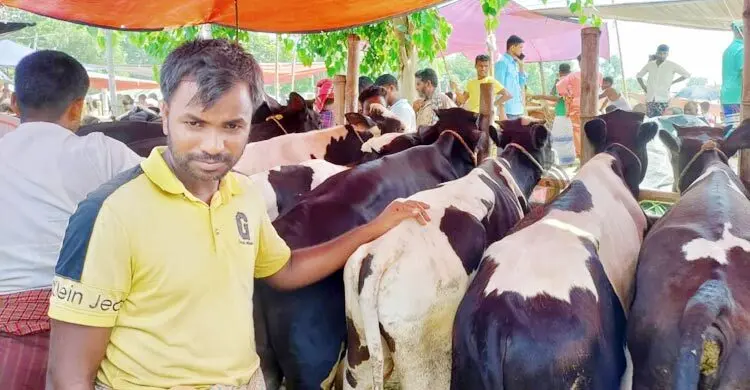
Since Eid-ul-Azha, the cattle markets of Pabna have been busy with a festival of calf buying and selling. Farmers and smallholders are buying calves in the hope that in a year they will become assets worth a lakh taka. Buyers say high feed prices make a profit unlikely, yet calf buying has not slowed. Smallholders explain that the feed money goes out day by day, while at the end of the year the whole sum comes into their hands at once, and to them that is the gain.
The livestock department says at least half a lakh calves will change hands across the district in this post-Eid season. In its view, feeding green grass and molasses will cut production costs, and if farmers raise calves as it advises, everyone will see a profit.
Why calves flood the markets after Eid
Farmers and smallholders usually sell the bulls they have raised before Eid-ul-Azha. With the growth of "meat associations" in the country (groups that pool money to buy cattle), many bulls are also sold at the end of Ramadan. These farmers then restock by buying calves, usually at the markets held after Eid-ul-Azha.
Because this has become a custom, far more calves are brought to the cattle markets at this time. Farmers who buy calves after Eid raise them through the year. Some also buy at the end of winter, because, they say, calves grow less in the cold; so many buy calves after winter and fatten them.
A check at the Aranakola, Kashinathpur, Karamja Chaturhat, Arifpur Hajirhat, Pushpapara and Bongram cattle markets in Pabna found brisk calf trading, as in every year. Depending on size and breed, calves are selling for Tk 50,000 to Tk 1 lakh. Some calves look like full-grown cattle because they are of improved breeds; large Sahiwal calves, for example, are changing hands for a lakh taka.
Traders at the markets said demand is high for crossbred and local calves, but no calf can be had for under Tk 50,000. Farmers said small calves are relatively expensive: for another Tk 30,000 on top of a Tk 50,000 calf, one could buy and raise an animal of twice the weight. With little capital, smallholders pay more at the start by buying calves, while large farmers, having more capital, buy bigger cattle, so their production cost is somewhat lower from the outset.
Profits squeezed by feed and medicine prices
Farmers and smallholders said buying and fattening calves used to be very profitable, but with the steep rise in the price of feed and medicine there is no longer any profit in it. A decade ago, they said, a calf could be bought for Tk 20,000 and sold at the end of the year for Tk 80,000, or in some cases a lakh, giving small, medium and large farmers alike a chance to profit. The picture has changed: a bull or heifer calf now costs Tk 50,000 to Tk 70,000, and an improved breed can cost a lakh. After what is spent on such a calf, the price it fetches at the end of the year leaves no profit.
Selim Uddin of Bharara village in Pabna Sadar upazila recalled that in 2012 he bought a calf for Tk 20,000, fattened it and sold it to a trader at Arifpur Hajirhat for Tk 66,000, making a net profit of Tk 30,000. Rahima Khatun, Kariman Nesa and Sufia Begum of Char Gargari village in Ishwardi upazila said that in 2013 they each took a Tk 20,000 loan from an NGO to buy a calf, and sold it at market for Tk 40,000 only six months later.
Laboni Akter Lovely of the Sakregari area in Salimpur union, Ishwardi, said that in 2013 her husband Anowarul Islam bought two bull calves from Aranakola in Ishwardi for only Tk 12,000. They raised them for two years and sold them for Tk 5 lakh.
Afsar Ali, a school teacher from Bahalbaria village in Santhia, and Jalal Uddin of Bishnupur village said: "The salary the government gives us is not enough to run the household, so every year we raise a bull calf. At Eid-ul-Azha it can be sold for nearly a lakh taka."
But Jalal Uddin said raising calves is no longer profitable. Even if the animal sells for a lakh, nothing is left once costs are deducted. He blamed the rise in feed and medicine prices.
Babu Ali, a van driver from Bamandanga village in Santhia upazila, said he bought a calf for Tk 50,000 and raised it. The animal is now worth a lakh, but after the price of the calf and the feed bill there is no profit, and he has not even counted his own labour. Asked why they raise calves at all, he said the feed costs are spent day by day, but when the animal is sold the money comes all at once, and that is the gain.
The district livestock department says there are about 10,000 commercial farmers in the district who raise cows and bulls. In addition, about half a lakh middle-class and lower-middle-class people raise one or two bull calves, some as a hobby, some to escape unemployment and some to bring comfort to their households. This year 634,414 animals were prepared in the district for Eid-ul-Azha, of which 193,100 were cattle. Once so many cattle are sold, farms start again with calves. Farmers buy calves more or less all year round, but the most calves are bought and sold after Eid-ul-Azha.
Calf sellers, meanwhile, said that rising feed prices are making dairy cows unprofitable and many have shut their farms. Keeping a cow, they said, pays through the calf it produces. Calves sell most after Eid-ul-Azha or at the end of winter.
At Karamja Chaturhat, the biggest calf market, a young man named Sagar Hossain from Bamandanga village of Ataikula police station said his family raises one calf every year. This year he paid Tk 55,000. Small calves are comparatively expensive, he said; it would have been better to buy one for Tk 75,000 to Tk 80,000, but he could not for lack of capital.
Calf trader Babul Mia said he bought a number of calves about a month ago and has now brought them to market. Because so much was spent on feeding them, his profit is small.
Advice from the livestock office
District livestock officer Dr Gouranga Kumar Talukder said they advise farmers and smallholders to keep a newly bought calf apart from the other cattle at home for at least a week, and then to give the calf four vaccines at intervals of 15 to 20 days. If the calf is fed molasses along with ordinary grass, it grows into a healthy bull or cow at little cost.
Avoiding expensive feed in favour of green grass cuts costs, he said, and green grass is plentiful across the district, so the prospects of profiting from raising calves are bright.
Source: Jagonews24. First published in Bengali on The Agro News.
Comments
(0)